
Chef Juliette
John Dory (St. Pierre)
John Dory has the delicacy of sole and the firmness of turbot. A light flouring, a quick butter sauté, and nut-brown beurre noisette show exactly why looks never mattered.
A cooking platform built around craft, culture, and the stories behind what we eat.
Created by Chef Juliette
Based on No. 1499, Poularde aux Œufs d’Or, from Le Guide Culinaire (1907) by Auguste Escoffier
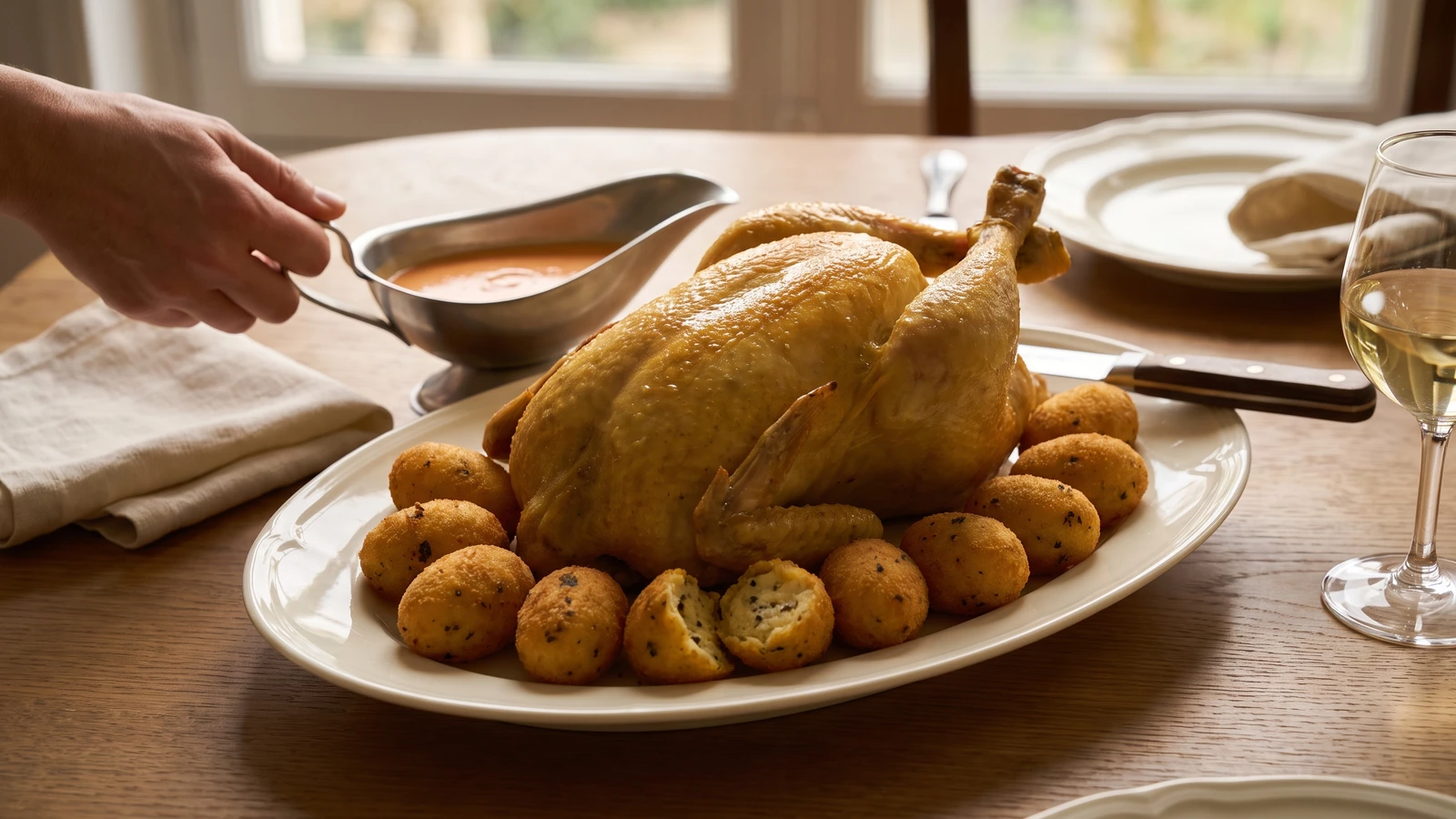
Poularde kept pale beneath butter, its aromatic liquor sharpened with lemon and ringed by crisp truffled egg croquettes. The lesson is restraint: protect the bird’s tenderness, then let the sauce gleam.
Poularde aux Œufs d’Or (a butter-roasted young hen with truffled golden egg croquettes) teaches restraint. Poêlé is a protected butter roast, not a braise, and the one true thing to know before touching the pan is that no liquid meets the bird while it cooks. Moisture would soften its flavor and change the technique. The poularde should arrive pale and succulent, with only the faintest butter-gold color.
The brigade formula assumed a saucier to clarify and mount the liquor, brown veal stock never off the fire, a standing fryer, and a salamander waiting nearby. The salamander has no work here because deep color is precisely what we don't want. For four, one poularde prepared by Poëlings (No. 250), a fine sieve instead of a cloth strainer, a small saucepan, and a three-quart pot of oil give us the same intent. Cloth straining and separate hot holding are brigade scaffolding. The dry poëling, the arrowroot liaison, the full three ounces of butter, the half lemon, and the truffled croquette border are the dish, so they stay.
The croquettes can be shaped and chilled while the bird cooks, then fried during its rest. One cook, one stove, one evening. Guard the poëling above everything else: no added liquid and no hard browning. That restraint decides the dish.
Poularde aux Œufs d’Or belongs to the grand Parisian dining-room repertoire and the national classical table rather than to one regional larder. It joins two signs of formal service, a plump young hen cooked poêlé and a symmetrical border of savory croquettes, while the simplified covered butter roast allowed the dish to travel readily to the bourgeois home table. The golden eggs are the fried egg-and-truffle croquettes, not gilding or a yolk-thickened sauce, and the lightly tomato-tinted sauce is properly passed separately.
Quantity
1 poularde, 4 to 4½ lb (1.8 to 2 kg), Poëlings (No. 250)
Quantity
1½ cups (360 ml / 360 g), from Poëlings (No. 250)
reserved
Quantity
4
Quantity
2 tablespoons (30 ml / 20 g)
drained if preserved and finely chopped
Quantity
2 tablespoons (30 ml / 28 g)
Quantity
¼ cup (60 ml / 30 g)
Quantity
¾ cup (180 ml / 185 g)
Quantity
1¼ teaspoons (6 ml / 7 g)
divided
Quantity
¼ teaspoon (1.25 ml / 0.5 g)
Quantity
½ cup (120 ml / 60 g)
Quantity
2
Quantity
1 tablespoon (15 ml / 15 g)
Quantity
1½ cups (360 ml / 120 g)
Quantity
6 cups (1.4 L / about 1.3 kg)
Quantity
1 tablespoon (15 ml / 16 g)
Quantity
2 teaspoons (10 ml / 6 g)
Quantity
1 tablespoon (15 ml / 15 g)
Quantity
6 tablespoons (90 ml / 85 g)
cut into small cubes
Quantity
½, yielding about 1½ tablespoons (22 ml / 22 g) juice
juiced
Quantity
1/16 teaspoon (0.3 ml / 0.1 g)
| Ingredient | Quantity |
|---|---|
| poularde or plump young hen prepared by Poëlings | 1 poularde, 4 to 4½ lb (1.8 to 2 kg), Poëlings (No. 250) |
| strained and degreased poëling liquorreserved | 1½ cups (360 ml / 360 g), from Poëlings (No. 250) |
| large eggs | 4 |
| black truffle, fresh or preserved in its own juicedrained if preserved and finely chopped | 2 tablespoons (30 ml / 20 g) |
| unsalted butter for the croquette base | 2 tablespoons (30 ml / 28 g) |
| all-purpose flour for the croquette base | ¼ cup (60 ml / 30 g) |
| whole milk | ¾ cup (180 ml / 185 g) |
| fine sea saltdivided | 1¼ teaspoons (6 ml / 7 g) |
| finely ground white pepper | ¼ teaspoon (1.25 ml / 0.5 g) |
| all-purpose flour for breading | ½ cup (120 ml / 60 g) |
| large eggs for breading | 2 |
| cold water for the egg wash | 1 tablespoon (15 ml / 15 g) |
| fine dry breadcrumbs | 1½ cups (360 ml / 120 g) |
| neutral frying oil | 6 cups (1.4 L / about 1.3 kg) |
| smooth canned tomato purée | 1 tablespoon (15 ml / 16 g) |
| arrowroot | 2 teaspoons (10 ml / 6 g) |
| cold water for the arrowroot slurry | 1 tablespoon (15 ml / 15 g) |
| cold unsalted butter for the saucecut into small cubes | 6 tablespoons (90 ml / 85 g) |
| medium lemonjuiced | ½, yielding about 1½ tablespoons (22 ml / 22 g) juice |
| cayenne pepper | 1/16 teaspoon (0.3 ml / 0.1 g) |
Heat the oven to 325°F (165°C). Prepare the poularde through the covered-oven stage of Poëlings (No. 250), scaled for this bird. Do not add liquid during the cooking, and keep the vessel covered except when the referenced method requires attention. This is the principle inside the procedure: poêlé concentrates poultry and aromatic vegetables through butter, while added stock would turn the bird into a braise.
While the poularde cooks, lower the four eggs into gently boiling water and cook for 10 minutes. Cool them promptly in cold water, peel, and dry them well. Chop the whites and yolks together into pieces about ¼ inch (6 mm) across. Keep the texture visible; a paste would make the croquettes heavy.
Melt the 2 tablespoons butter over medium-low heat without coloring it. Stir in the ¼ cup flour and cook for 90 seconds, then whisk in the milk by degrees. Cook, stirring firmly, until the mixture becomes a very thick béchamel that pulls from the pan and leaves a clean trail behind the spoon, about 4 minutes. Remove it from the heat and fold in the chopped eggs, truffle, ½ teaspoon of the salt, and the white pepper. Spread the mixture ¾ inch (2 cm) deep on a small tray, press parchment against its surface, and chill until firm, about 35 minutes.
Divide the cold mixture into 12 equal portions and shape each between lightly floured palms into a small egg about 2 inches (5 cm) long. If the mixture slumps instead of holding, stop and chill it for another 20 minutes. If it remains loose, return it to gentle heat and stir until the spoon once again leaves a clean trail, then rechill it. Ça se rattrape. Whisk the two raw eggs with the tablespoon of water. Roll each croquette first in flour, then egg wash, then fine breadcrumbs, keeping the outline smooth. Chill the breaded croquettes for at least 20 minutes.
Begin checking the poularde after about 55 minutes. As the breast approaches 160°F (71°C), uncover it only briefly to finish, following Poëlings (No. 250) but refusing any color beyond pale butter-gold. If the breast is already the right color, cover it with buttered parchment rather than chasing a darker roast. Remove the bird when the breast registers 160 to 162°F (71 to 72°C) and the thigh about 170°F (77°C); rest it loosely covered for 20 minutes, during which the breast should reach 165°F (74°C). Complete the referenced poëling liquor as directed, then reserve 1½ cups strained and thoroughly degreased.
Pour the reserved poëling liquor from Poëlings (No. 250) into a small saucepan and whisk in the tomato purée. Bring it just to a simmer. Mix the arrowroot with its tablespoon of cold water until perfectly smooth, then whisk in three-quarters of the slurry. Let the sauce reach one lazy bubble and assess it before adding more. It should be nappant, lightly coating the back of a spoon while remaining pourable. Arrowroot turns ropy when overused and loses strength under a hard boil. If the sauce becomes gummy, loosen it gradually with hot water; if it remains thin, bring it once more to the first bubble before adding the remaining slurry.
Take the saucepan off the heat. Make the monté au beurre, the cold-butter finish, by whisking in the 6 tablespoons of butter a few cubes at a time, adding each portion only after the last has disappeared. Whisk in the lemon juice, cayenne, and enough of the remaining salt to sharpen the sauce without making it salty. It should be glossy, faintly coral, and taste of poultry first, butter second, with lemon arriving at the end. If butter gathers in an oily ring, the pan became too hot; whisk in a teaspoon of cold water away from the heat until the sauce comes together. Keep it warm, never boiling, and transfer it to a heated sauceboat.
Heat the oil in a deep three-quart saucepan to 350°F (175°C). Fry one test croquette until evenly golden, about 2½ minutes, then check that its shell remains intact. Fry the rest in batches of three or four, allowing the oil to return to temperature between batches. If one splits, remove it at once, patch any visible cracks in the remaining croquettes with egg wash and breadcrumbs, chill them for 15 minutes, and restore the oil to 350°F (175°C) before continuing. Drain the croquettes on a rack rather than paper so their undersides stay crisp.
Set the whole rested poularde on a warmed oval platter. Arrange the 12 croquettes closely around it as a border of small golden eggs, with their pointed ends alternating for a generous, orderly ring. Send the sauce separately, as the dish requires, so the croquettes remain crisp and each guest can spoon the glossy liquor over the carved poultry. Carve at the table and serve three croquettes to each person. À table!
1 serving (about 520g)
Culinary guides, cultural storytelling, and the editorial depth that makes cooking meaningful.
Discover Culinary ExplorerChef Juliette
John Dory has the delicacy of sole and the firmness of turbot. A light flouring, a quick butter sauté, and nut-brown beurre noisette show exactly why looks never mattered.

Chef Juliette
Fresh haddock proves its delicacy in the meunière pan: a fine flour crust, moist pearly flakes, and beurre noisette sharpened with lemon and parsley, ready from one skillet in half an hour.

Chef Juliette
Éperlans à l’Anglaise turns small fish into a lesson in disciplined coating: boned smelts under a close, crisp crumb, pan-fried in clarified butter and finished with bright, half-melted maître d’hôtel butter.

Chef Juliette
Tiny smelts, shallot, mushrooms, white wine, gratin sauce, and fine bread raspings meet a fierce oven, where the fish must turn tender in the same breath the buttered crust bronzes.