
Chef Juliette
John Dory (St. Pierre)
John Dory has the delicacy of sole and the firmness of turbot. A light flouring, a quick butter sauté, and nut-brown beurre noisette show exactly why looks never mattered.
A cooking platform built around craft, culture, and the stories behind what we eat.
Created by Chef Juliette
Based on No. 1496, Poularde à la Montmorency, from Le Guide Culinaire (1907) by Auguste Escoffier
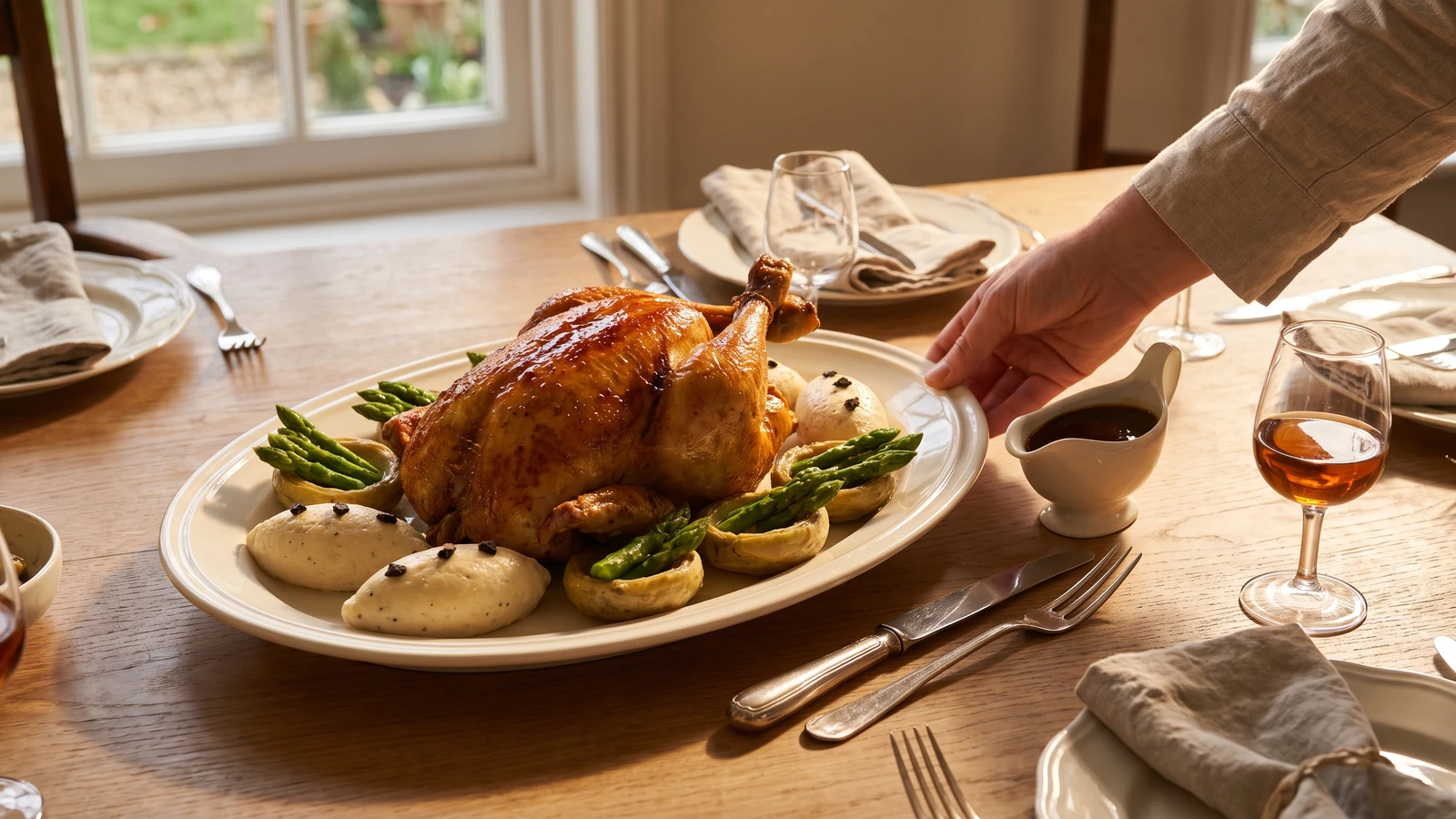
Poularde à la Montmorency brings the grand garnish home: truffle beneath burnished skin, Madeira in the braise, fine poultry quenelles, and butter-bound asparagus tucked into artichoke bottoms.
Poularde à la Montmorency (truffle-larded hen braised in Madeira) teaches one law of the grand braises: the cooking liquor is not aftermath. It is the sauce waiting to be finished. The truffle perfumes the flesh from within, Madeira gathers the browned fond, and prepared demi-glace (the reduced brown-sauce foundation) gives that liquor the body to coat rather than flood the plate.
The original assumes a saucier with demi-glace ready, stock never off the fire, a larding needle, and another pair of hands shaping decorated quenelles (fine poultry dumplings). At home, a narrow paring knife threads in the truffle, a food processor makes two fine quenelles, and good unsalted demi-glace replaces the brigade stockpot. No salamander enters the source, so the covered oven and stovetop are enough. The platter is scaled to one bird, two quenelles, and four filled artichoke bottoms: one cook, one stove, one evening.
The larding needle and spare hands were scaffolding. The truffle larding, Madeira braise, quenelles, butter-bound asparagus in artichoke bottoms, and separate sauce must stay, because together they are the dish. The decisive step comes when the bird leaves the casserole: strain the braising liquor, reduce it into the demi-glace, and never pour it away.
Poularde à la Montmorency belongs to the Parisian grand-kitchen repertoire, its title borrowing Montmorency in Île-de-France rather than recording a farmhouse specialty of that town. Montmorency is celebrated for sour cherries, but this formula contains none; its precise identity is the formal garnish of truffle-larded poularde, Madeira, quenelles, and asparagus-filled artichoke bottoms, carried from the service platter to the home table.
Quantity
1, about 4½ lb (2 kg)
giblets removed and skin patted dry
Quantity
1 small, about 1 oz (30 g)
scrubbed if fresh and dried
Quantity
2 teaspoons (10 ml / 12 g)
divided
Quantity
¾ teaspoon (3.75 ml / 1.5 g)
divided
Quantity
7 tablespoons (105 ml / 100 g)
divided
Quantity
1½ cups (360 ml / 360 g)
divided
Quantity
2 cups (475 ml / 475 g)
Quantity
¾ cup (180 ml / 180 g)
Quantity
1 small, about 7 oz (200 g)
diced and thoroughly chilled
Quantity
1
Quantity
⅓ cup (80 ml / 80 g)
thoroughly chilled
Quantity
4 large, about 12 oz (340 g) drained
thawed if frozen
Quantity
24, about 6 oz (170 g)
cut to 2 inches (5 cm)
| Ingredient | Quantity |
|---|---|
| poularde or plump roasting chickengiblets removed and skin patted dry | 1, about 4½ lb (2 kg) |
| whole black truffle, fresh or preservedscrubbed if fresh and dried | 1 small, about 1 oz (30 g) |
| fine sea saltdivided | 2 teaspoons (10 ml / 12 g) |
| ground white pepperdivided | ¾ teaspoon (3.75 ml / 1.5 g) |
| unsalted butterdivided | 7 tablespoons (105 ml / 100 g) |
| dry Madeiradivided | 1½ cups (360 ml / 360 g) |
| unsalted chicken stock | 2 cups (475 ml / 475 g) |
| prepared unsalted demi-glace | ¾ cup (180 ml / 180 g) |
| skinless, boneless chicken breastdiced and thoroughly chilled | 1 small, about 7 oz (200 g) |
| large egg white | 1 |
| heavy creamthoroughly chilled | ⅓ cup (80 ml / 80 g) |
| cooked artichoke bottomsthawed if frozen | 4 large, about 12 oz (340 g) drained |
| asparagus tipscut to 2 inches (5 cm) | 24, about 6 oz (170 g) |
Cut six paper-thin slices from the truffle and reserve them for decorating the quenelles. Cut the remainder into about sixteen slender batons. Piquer aux truffes means larding the flesh with truffle: loosen the skin carefully over the breasts and upper thighs, then use a narrow paring knife to make short tunnels parallel to the surface of the meat. Push in the truffle batons without piercing the outer skin, smooth the skin back into place, and season the bird with 1½ teaspoons of the salt and ½ teaspoon of the white pepper. Keep it chilled while you make the quenelles.
Chill the food processor bowl and blade if the kitchen is warm. Process the diced chicken breast with the remaining ½ teaspoon salt and ¼ teaspoon white pepper until smooth and sticky. Add the egg white and process again, then pour in the cold cream in a thin stream with the motor running. Stop as soon as the mixture is smooth and glossy, and press it through a fine-mesh sieve. If it turns loose or greasy, it has become too warm. Stop, chill it for 15 minutes, then pulse briefly until it gathers again. Ça se rattrape.
Bring a wide pan of lightly salted water to 175 to 180°F (80 to 82°C), a quiet tremble with no rolling bubbles. Butter two large tablespoons, divide the forcemeat between them, and shape two generous smooth ovals about 5 inches (13 cm) long. Lower them into the water and poach for 12 to 15 minutes, turning once, until firm and 165°F (74°C) at the center. Boiling makes quenelles coarse; if the first begins to feather at the edges, lower the heat and chill the remaining mixture for 10 minutes before shaping. Drain well, press three reserved truffle slices onto each warm quenelle, brush lightly with butter, and refrigerate if they will wait longer than 30 minutes. Wash the processor, blade, board, and utensils thoroughly before preparing the vegetables.
Heat the oven to 325°F (165°C). Melt 2 tablespoons of the butter in a heavy lidded casserole over medium heat. When the foam subsides, brown the poularde carefully on the breast, back, and both sides, about 10 to 12 minutes in all. Move it only when the skin releases cleanly and has reached a deep butter-gold. If the butter blackens, lift out the bird, pour away only the burnt fat without disturbing the brown fond, and begin again with fresh butter from the measured amount. Burnt butter cannot become a good sauce.
Set the poularde breast-side up and take the casserole off the heat. Pour 1¼ cups (300 ml / 300 g) of the Madeira around the bird, keeping it off the browned skin, then scrape every bit of fond from the bottom. Return the casserole to medium heat for 2 minutes, add the chicken stock, and cover tightly. Braise in the oven for 70 to 85 minutes, basting twice, until the thickest part of the breast reaches 165°F (74°C) and the thigh reaches at least 170°F (77°C). The liquid should barely tremble. If it boils hard, lower the oven to 300°F (150°C); fierce heat toughens the breast and clouds the liquor.
While the poularde braises, blanch the asparagus tips in lightly salted water for 2 to 3 minutes, just until tender and vividly green, then cool them promptly in cold water and drain well. Warm the artichoke bottoms in a shallow pan with 1 tablespoon of the butter and 2 tablespoons (30 ml / 30 g) water. Toss the asparagus with another tablespoon of butter until each tip gleams, then arrange six tips snugly in every artichoke bottom. This is the source's instruction to cohere them with butter: the tips remain distinct, but the butter gathers them into one garnish. Cover and hold them gently warm.
Lift the cooked poularde onto a warm plate, tent it loosely, and rest it for 15 minutes. Pour every drop of braising liquor into a wide saucepan through a fine-mesh strainer, scraping the casserole so the dissolved fond comes with it. Let the liquid settle briefly and skim away excess surface fat. The braising liquor is not waste or an incidental by-product. It is the foundation of the finished sauce.
Boil the strained braising liquor until reduced to about 1 cup (240 ml / 240 g). Add the prepared demi-glace and the remaining ¼ cup (60 ml / 60 g) Madeira, then simmer until the sauce is glossy and naps the back of a spoon, about 8 to 12 minutes. If it tightens too far, loosen it with a spoonful of unsalted stock or water; if it remains thin, give it another minute of reduction. Remove it from the heat and monter au beurre, whisking in 2 tablespoons of cold butter a little at a time to enrich and emulsify the sauce. If the butter beads apart, whisk in 1 teaspoon (5 ml / 5 g) cold water off the heat. Ça se rattrape. Taste before adding any salt.
Rewarm the quenelles for 5 minutes in barely trembling water if they were chilled, then drain them carefully. Set the poularde in the center of a warmed oval platter and brush its skin with a spoonful of the finished sauce. Place one decorated quenelle at either end. Arrange two asparagus-filled artichoke bottoms along each side of the bird, spooning any remaining melted butter over them. Pour the rest of the Madeira demi-glace into a warmed sauceboat and serve it separately, exactly as the dish requires. À table!
1 serving (about 570g)
Culinary guides, cultural storytelling, and the editorial depth that makes cooking meaningful.
Discover Culinary ExplorerChef Juliette
John Dory has the delicacy of sole and the firmness of turbot. A light flouring, a quick butter sauté, and nut-brown beurre noisette show exactly why looks never mattered.

Chef Juliette
Fresh haddock proves its delicacy in the meunière pan: a fine flour crust, moist pearly flakes, and beurre noisette sharpened with lemon and parsley, ready from one skillet in half an hour.

Chef Juliette
Éperlans à l’Anglaise turns small fish into a lesson in disciplined coating: boned smelts under a close, crisp crumb, pan-fried in clarified butter and finished with bright, half-melted maître d’hôtel butter.

Chef Juliette
Tiny smelts, shallot, mushrooms, white wine, gratin sauce, and fine bread raspings meet a fierce oven, where the fish must turn tender in the same breath the buttered crust bronzes.