
Chef Juliette
John Dory (St. Pierre)
John Dory has the delicacy of sole and the firmness of turbot. A light flouring, a quick butter sauté, and nut-brown beurre noisette show exactly why looks never mattered.
A cooking platform built around craft, culture, and the stories behind what we eat.
Created by Chef Juliette
Based on No. 1459, Poularde Chimay, from Le Guide Culinaire (1907) by Auguste Escoffier
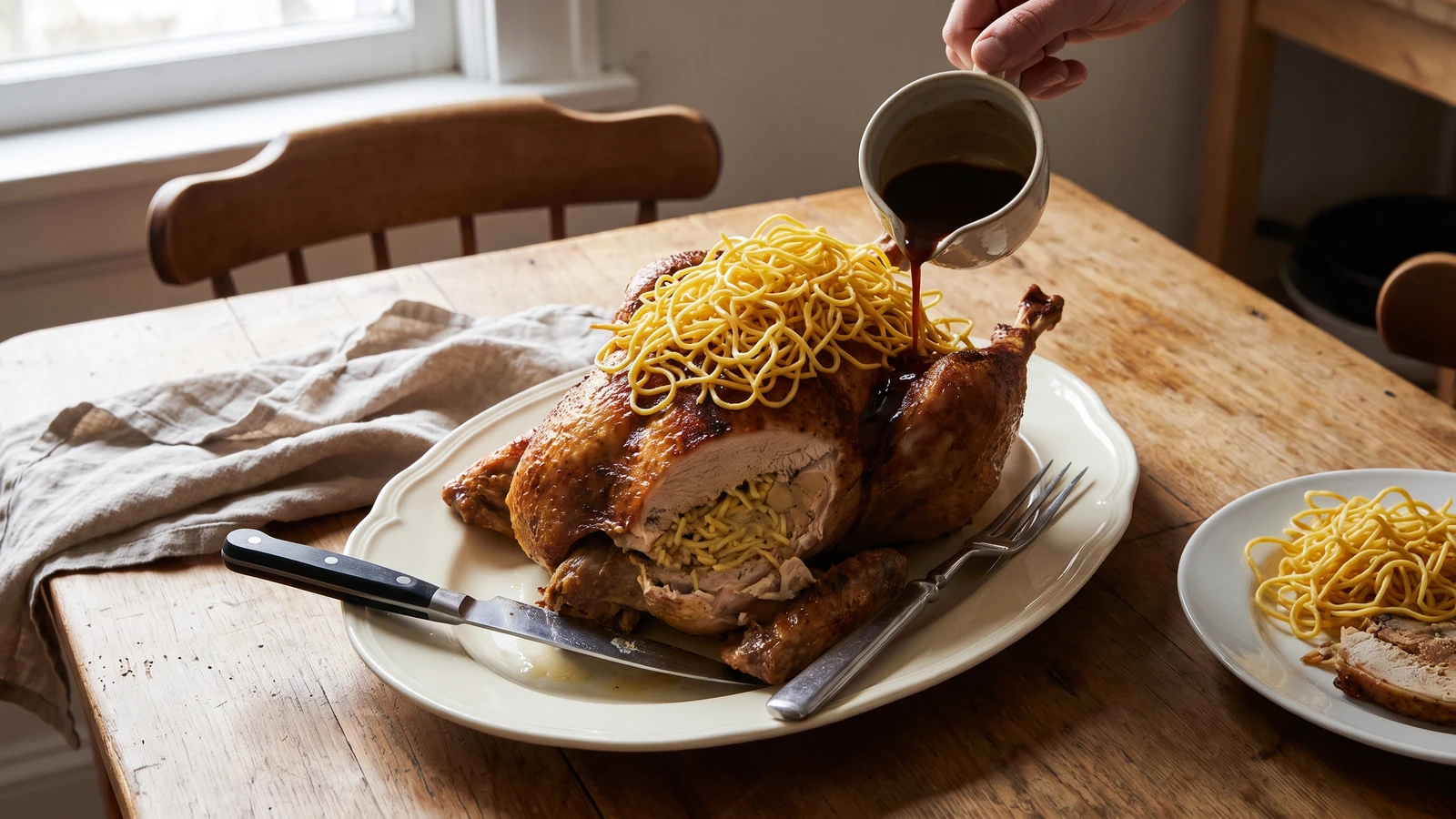
Poularde Chimay teaches the discipline of half-cooking: tender butter-poêlé poultry, foie gras and cream-bound noodles within, crisp clarified-butter noodles above, and a glossy poëling sauce served generously.
Poularde Chimay (gently butter-roasted pullet stuffed with noodles and foie gras) teaches restraint inside richness. The one true thing to know before touching a pan is this: the filling noodles must be only half-poached. They finish cooking inside the bird; boil them tender first and they collapse into paste.
The classical entry assumed Poëlings (No. 250) already understood, a stock never off the fire, and a saucier free to turn the cooking liquor into sauce. At home, a tight-lidded casserole handles the butter cooking, a thermometer replaces brigade instinct, and a small beurre manié thickens the strained liquor while the bird rests. The separate hands were scaffolding and can go. The half-poached filling, the unmoistened poêling, and the final crown of raw noodles sautéed in clarified butter are the dish, so they stay. One cook, one stove, one evening.
The finished poularde is burnished and glossy, its cavity generous with creamy noodles and warm cubes of foie gras, its sauce deep with the bird's own juices. Over everything goes a crisp tangle of butter-gold noodles. Before you meet the pan, remember the filling noodles: supple outside, firm at the heart.
Chimay is a town and princely title in Hainaut, in French-speaking Belgium, while Poularde Chimay belongs to the naming language of the French classical kitchen rather than to a provincial French farmhouse repertory. The name traveled through grand dining rooms as a fixed composition: butter-poêlé poultry, a noodle and foie gras stuffing, thickened poëling liquor, and a crown of sautéed raw noodles. Despite the name, neither Chimay beer nor Chimay cheese belongs in this formula; its identity lies in the method and garnish.
Quantity
1, 4 to 4½ lb (1.8 to 2 kg)
giblets removed and skin dried
Quantity
1 tablespoon plus 1 teaspoon (20 ml / 24 g)
divided
Quantity
1 teaspoon (5 ml / 2 g)
Quantity
1 home-scale quantity Poëlings (No. 250), prepared for one 4 to 4½ lb (1.8 to 2 kg) poularde
Quantity
About 3½ loosely packed cups (830 ml / 225 g)
for the filling
Quantity
2 tablespoons (30 ml / 28 g)
melted
Quantity
3 tablespoons (45 ml / 45 g)
Quantity
About ½ cup (120 ml / 85 g)
well chilled and cut into large dice
Quantity
About 2⅔ loosely packed cups (630 ml / 170 g)
left uncooked for the crown
Quantity
⅓ cup (80 ml / 75 g)
Quantity
2 teaspoons (10 ml / 9 g)
softened for the beurre manié
Quantity
1 tablespoon (15 ml / 8 g)
for the beurre manié
| Ingredient | Quantity |
|---|---|
| poularde or plump young chickengiblets removed and skin dried | 1, 4 to 4½ lb (1.8 to 2 kg) |
| fine sea saltdivided | 1 tablespoon plus 1 teaspoon (20 ml / 24 g) |
| freshly ground white or black pepper | 1 teaspoon (5 ml / 2 g) |
| Poëlings | 1 home-scale quantity Poëlings (No. 250), prepared for one 4 to 4½ lb (1.8 to 2 kg) poularde |
| thin fresh egg noodlesfor the filling | About 3½ loosely packed cups (830 ml / 225 g) |
| unsalted buttermelted | 2 tablespoons (30 ml / 28 g) |
| heavy cream | 3 tablespoons (45 ml / 45 g) |
| firm foie graswell chilled and cut into large dice | About ½ cup (120 ml / 85 g) |
| thin fresh egg noodlesleft uncooked for the crown | About 2⅔ loosely packed cups (630 ml / 170 g) |
| clarified butter | ⅓ cup (80 ml / 75 g) |
| unsalted buttersoftened for the beurre manié | 2 teaspoons (10 ml / 9 g) |
| all-purpose flourfor the beurre manié | 1 tablespoon (15 ml / 8 g) |
Heat the oven to 325°F (165°C). Have the home-scale Poëlings (No. 250) ready in a heavy covered casserole that holds the bird closely. Pat the poularde dry inside and out, then season the cavity and skin with 2 teaspoons of the salt and all the pepper. A dry skin takes colour; a wet one merely grows damp beneath the lid.
Bring a large pot of water to a boil and season it with the remaining salt. Add the filling noodles and cook them for half their usual time, generally 45 to 60 seconds for thin fresh noodles. They should bend without breaking but retain a firm, pale core. Drain immediately and shake them thoroughly dry, then toss them with the melted butter and cream. If liquid collects beneath them, drain it away; a wet filling turns the cavity into a braise.
Let the dressed noodles cool until just warm, then fold in the cold foie gras dice with two or three gentle turns. Spoon the mixture loosely into the cavity without compressing it; the noodles need room to finish cooking. Truss the legs and tuck the wing tips beneath the bird. Cook it at once. Stuffed poultry should never wait about while the oven warms.
Set the stuffed bird into the prepared casserole and follow Poëlings (No. 250) through its covered butter-cooking stage. Roast gently for 50 to 60 minutes, basting twice with the fragrant butter in the casserole. Add no water, wine, or stock during this stage. Moistening it now would make a braise, while poêling concentrates the flavour of the bird in butter.
Uncover the casserole, raise the oven to 375°F (190°C), and baste once more. Roast for another 20 to 30 minutes, until the skin is richly burnished and a thermometer reaches 165°F (74°C) in both the centre of the stuffing and the innermost thigh without touching bone. If the temperatures are correct but the skin remains pale, place the bird under the broiler for one or two minutes, watching without interruption. The home broiler is the honest equivalent of a salamander. Transfer the poularde to a warm platter and rest it loosely tented for 20 minutes.
While the bird rests, complete the sauce stage of Poëlings (No. 250), using the butter-rich cooking liquor and vegetables in the casserole. Strain and defat the liquor as directed, then return up to 1½ cups (350 ml) to a small saucepan and bring it to a gentle simmer. Knead the softened butter and flour into a smooth beurre manié, then whisk it into the liquor in small pinches until the sauce lightly coats a spoon. Simmer for two minutes to cook out the flour. If it turns lumpy, strain it; if it tightens too far, loosen it with a spoonful of the remaining liquor. If fat floats on top, let the sauce settle for a minute and skim it clean. Ça se rattrape.
Separate the uncooked garnish noodles into loose strands. Heat half the clarified butter in a wide sauté pan over medium-high heat, then sauté half the noodles, tossing and turning them until fully cooked, crisp at the edges, and deep butter-gold, about 3 to 5 minutes. Repeat with the remaining butter and noodles. If the noodles clump and drink the fat, lift them out, reheat the butter until lively, and return them in a thinner layer. Drain briefly and season with a small pinch of salt.
Spoon enough thickened poëling liquor over the rested poularde to give the skin a generous gloss without drowning its colour. Distribute the crisp sautéed noodles copiously over the breast and around the bird, leaving some burnished skin visible. Pour the remaining sauce into a warm sauceboat and serve it alongside. Present the poularde whole, then carve it at the table so each plate receives meat, creamy stuffed noodles, crisp noodles, and sauce. À table!
1 serving (about 470g)
Culinary guides, cultural storytelling, and the editorial depth that makes cooking meaningful.
Discover Culinary ExplorerChef Juliette
John Dory has the delicacy of sole and the firmness of turbot. A light flouring, a quick butter sauté, and nut-brown beurre noisette show exactly why looks never mattered.

Chef Juliette
Fresh haddock proves its delicacy in the meunière pan: a fine flour crust, moist pearly flakes, and beurre noisette sharpened with lemon and parsley, ready from one skillet in half an hour.

Chef Juliette
Éperlans à l’Anglaise turns small fish into a lesson in disciplined coating: boned smelts under a close, crisp crumb, pan-fried in clarified butter and finished with bright, half-melted maître d’hôtel butter.

Chef Juliette
Tiny smelts, shallot, mushrooms, white wine, gratin sauce, and fine bread raspings meet a fierce oven, where the fish must turn tender in the same breath the buttered crust bronzes.