
Chef Juliette
John Dory (St. Pierre)
John Dory has the delicacy of sole and the firmness of turbot. A light flouring, a quick butter sauté, and nut-brown beurre noisette show exactly why looks never mattered.
A cooking platform built around craft, culture, and the stories behind what we eat.
Created by Chef Juliette
Based on No. 1452, Poularde Bouillie à l’Anglaise, from Le Guide Culinaire (1907) by Auguste Escoffier
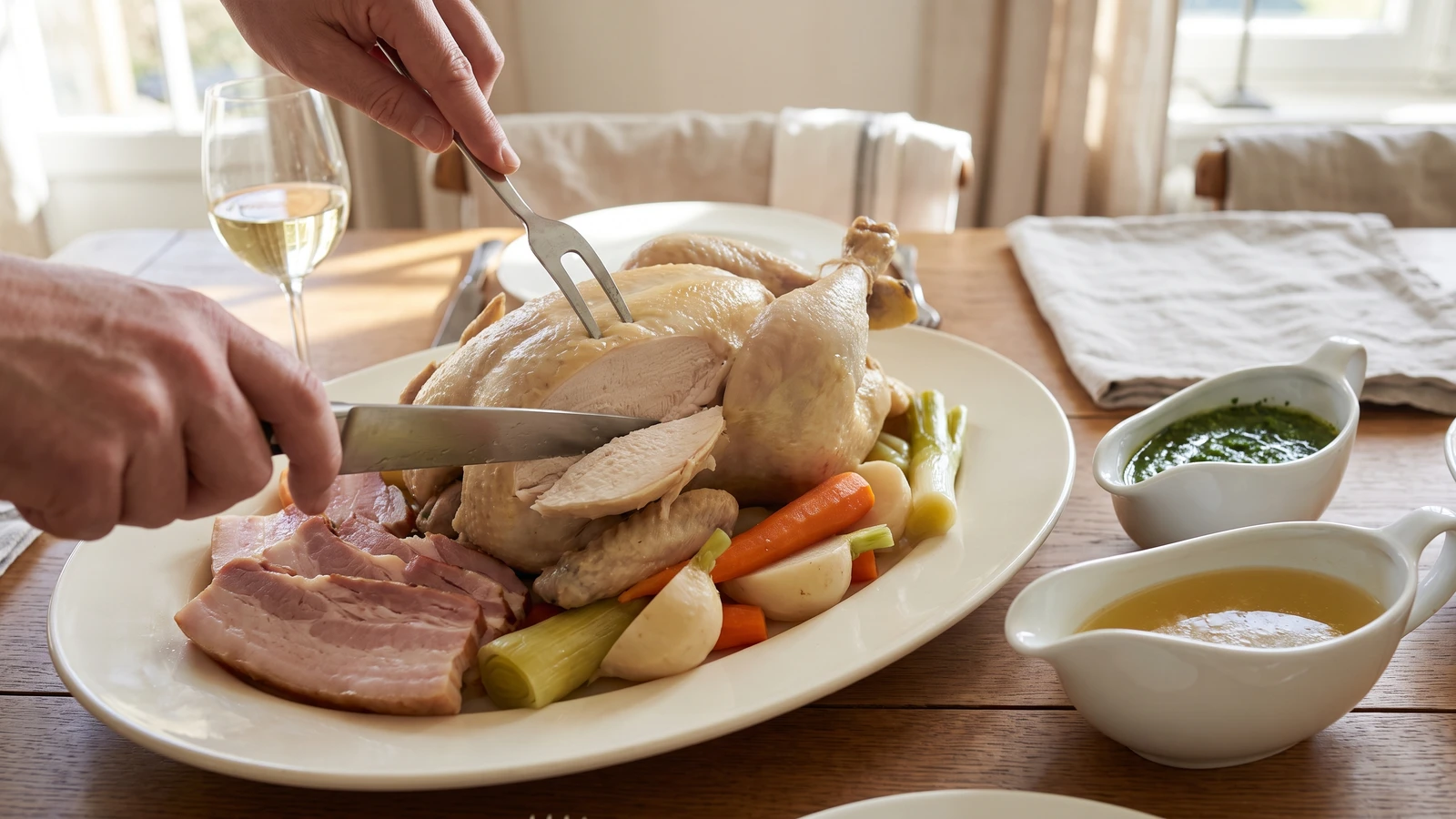
Poularde Bouillie à l’Anglaise turns a plump bird, unsmoked bacon, and pot-au-feu vegetables into a pale, tender feast, with parsley sauce and clear liquor served separately, all decided by one barely trembling poach.
Poularde Bouillie à l’Anglaise (English-style poached pullet) teaches restraint through one misleading verb. Bouillie says boiled, but the liquid must barely shiver; a rolling boil tightens the breast, tears the skin, and muddies the cooking liquor. That is the one truth to know before touching the pan.
The entry assumes a fond blanc (light white chicken stock) never off the fire and a saucier free to make parsley sauce while another cook watches the bird. At home, pale unsalted stock and the poularde’s fifteen-minute rest do those jobs. There is no salamander to imitate because the bird is meant to remain pale, not bronzed. One pullet with one pound of bacon is already right for four generous servings, so that proportion stays; only the stockpot and sauce volumes shrink. The staff was scaffolding. The gentle poach, bacon, pot-au-feu vegetables, parsley sauce, and clear liquor served separately are the dish.
Expect comfort without browning: delicate broth, sweet roots, salty bacon, moist white meat, and a butter-rich parsley sauce. If the pot boils, lift it from the heat and cool the liquor with reserved cold stock. Ça se rattrape. Establishing that first bare tremble, then holding it, is the step that matters most. One cook, one stove, one evening.
Poularde Bouillie à l’Anglaise belongs to the French grand-kitchen service table rather than to Lyon, Burgundy, or another regional larder. In this preparation, à l’anglaise identifies a British-influenced service of gently cooked fowl with parsley sauce, which French cooks joined to the vegetables and clear broth of pot-au-feu. Despite the word bouillie, the method never asks for a violent boil; the name describes moist cooking, while the tenderness depends upon a restrained poach.
Quantity
1, about 4 to 4½ lb (1.8 to 2 kg)
giblets removed
Quantity
1 lb (454 g)
preferably rind-on and not sugar-cured
Quantity
10 cups (2.4 L / about 2.4 kg)
pale, preferably unsalted, and kept cold
Quantity
4 medium, about 1 lb (450 g)
peeled and halved crosswise
Quantity
3 small, about 12 oz (340 g)
peeled and quartered
Quantity
2 medium, about 12 oz (340 g)
trimmed, washed thoroughly, and tied together
Quantity
2 stalks, about 4 oz (115 g)
halved crosswise
Quantity
1 large, about 8 oz (225 g)
peeled
Quantity
2
Quantity
1
6 parsley stems, 2 thyme sprigs, and 1 bay leaf
Quantity
2 tsp (10 ml / 12 g), divided
plus more after tasting
Quantity
4 tbsp (60 ml / 57 g), divided
Quantity
¼ cup (60 ml / 30 g)
Quantity
1½ cups (360 ml / about 370 g)
Quantity
½ packed cup (120 ml / 30 g)
washed
Quantity
½ tsp (2.5 ml / 1 g)
| Ingredient | Quantity |
|---|---|
| poularde or plump whole roasting chickengiblets removed | 1, about 4 to 4½ lb (1.8 to 2 kg) |
| unsmoked slab baconpreferably rind-on and not sugar-cured | 1 lb (454 g) |
| fond blancpale, preferably unsalted, and kept cold | 10 cups (2.4 L / about 2.4 kg) |
| carrotspeeled and halved crosswise | 4 medium, about 1 lb (450 g) |
| turnipspeeled and quartered | 3 small, about 12 oz (340 g) |
| leekstrimmed, washed thoroughly, and tied together | 2 medium, about 12 oz (340 g) |
| celeryhalved crosswise | 2 stalks, about 4 oz (115 g) |
| yellow onionpeeled | 1 large, about 8 oz (225 g) |
| whole cloves | 2 |
| bouquet garni6 parsley stems, 2 thyme sprigs, and 1 bay leaf | 1 |
| fine sea saltplus more after tasting | 2 tsp (10 ml / 12 g), divided |
| unsalted butter | 4 tbsp (60 ml / 57 g), divided |
| all-purpose flour | ¼ cup (60 ml / 30 g) |
| whole milk | 1½ cups (360 ml / about 370 g) |
| flat-leaf parsley leaveswashed | ½ packed cup (120 ml / 30 g) |
| finely ground white pepper | ½ tsp (2.5 ml / 1 g) |
Do not rinse the poularde. Pat it dry, tuck the wing tips underneath, and tie the legs together without cinching the breast. Test the bacon’s cure by frying a small trimming. If it tastes fiercely salty, place the whole slab in the poaching pot, cover it with cold water, simmer for five minutes, then drain and rinse the pot. This removes excess modern curing salt without taking away the bacon the dish requires.
Stud the onion with the cloves. Set the poularde breast-side up in a 7 to 8 quart heavy pot with the bacon, onion, celery, and bouquet garni. Add enough cold fond blanc to cover the bird by about 1 inch, holding back as much as 1 cup for temperature control. If the bird floats, lay a parchment cartouche and a small heatproof plate over it. Bring the stock up slowly over medium heat, uncovered, skimming away the grey foam as it gathers. Do not salt yet; the bacon must speak first.
When the liquor reaches 180 to 185°F (82 to 85°C), reduce the heat until the surface shows only a gentle current and an occasional small bubble. Partially cover the pot and hold it there for 25 minutes. Never let it roll. If boiling begins, lift the pot completely from the heat and pour a little reserved cold stock down the side until the agitation stops, then return it over lower heat. Ça se rattrape: one brief boil need not ruin the bird, but letting it continue will toughen the meat and cloud the liquor.
Add the carrots and turnips, nudging them beneath the liquor without piercing the poularde. Continue at the same bare tremble for 15 minutes, then add the tied leeks. Cook for another 20 to 35 minutes. Begin checking the bird after 60 minutes of total poaching time: an instant-read thermometer inserted into the deepest breast and inner thigh, without touching bone, must register at least 165°F (74°C). The vegetables should be tender but still hold their shape.
Lift the poularde onto a warmed platter and cover it loosely. Remove the bacon and vegetables, keeping them warm. If the bird is ready before a vegetable, leave that vegetable in the liquor until tender. Strain the cooking liquor through a fine sieve, skim away only the excess surface fat, and taste before adding salt. Reserve ½ cup for the parsley sauce and keep about 1½ cups hot for its own sauceboat. Let the poularde rest for 15 minutes while you make the sauce.
Drop the parsley leaves into a small pan of salted boiling water for 15 seconds, then transfer them immediately to cold water. Squeeze them thoroughly dry and chop them very finely. This brief blanching softens the raw edge and fixes the herb-green colour; leaving water in the parsley would thin the finished sauce.
Melt 2 tablespoons of the butter in a 2 quart saucepan over low heat. Stir in the flour and cook this white roux for two minutes without letting it colour. Remove the pan from the heat and whisk in the milk by thirds, smoothing each addition before the next, then whisk in the reserved ½ cup cooking liquor. Return the pan to gentle heat and cook for 8 to 10 minutes, stirring, until it reaches nappé, a coating consistency that leaves a clean line when you draw a finger across the back of the spoon. If lumps form, take the pan off the heat, whisk firmly, and pass the sauce through a sieve. Stir in the parsley, white pepper, and enough salt to bring it alive, then whisk in the remaining 2 tablespoons cold butter off the heat. If that finishing butter separates, whisk in a tablespoon of cold milk away from the heat. Ça se rattrape.
Remove the string from the poularde and set the bird breast-side up on the warm platter. Slice the bacon across the grain into pieces about ¼ inch thick and arrange them around the bird exactly as the preparation intends. Group the carrots, turnips, and leeks alongside without disguising them under sauce. Bring the parsley sauce and clear cooking liquor to the table in separate warmed sauceboats; neither is poured over the bird in advance. Carve at the table, passing both sauces freely. À table!
1 serving (about 780g)
Culinary guides, cultural storytelling, and the editorial depth that makes cooking meaningful.
Discover Culinary ExplorerChef Juliette
John Dory has the delicacy of sole and the firmness of turbot. A light flouring, a quick butter sauté, and nut-brown beurre noisette show exactly why looks never mattered.

Chef Juliette
Fresh haddock proves its delicacy in the meunière pan: a fine flour crust, moist pearly flakes, and beurre noisette sharpened with lemon and parsley, ready from one skillet in half an hour.

Chef Juliette
Éperlans à l’Anglaise turns small fish into a lesson in disciplined coating: boned smelts under a close, crisp crumb, pan-fried in clarified butter and finished with bright, half-melted maître d’hôtel butter.

Chef Juliette
Tiny smelts, shallot, mushrooms, white wine, gratin sauce, and fine bread raspings meet a fierce oven, where the fish must turn tender in the same breath the buttered crust bronzes.