
Chef Juliette
John Dory (St. Pierre)
John Dory has the delicacy of sole and the firmness of turbot. A light flouring, a quick butter sauté, and nut-brown beurre noisette show exactly why looks never mattered.
A cooking platform built around craft, culture, and the stories behind what we eat.
Created by Chef Juliette
Based on No. 1392, Pork Pie, from Le Guide Culinaire (1907) by Auguste Escoffier
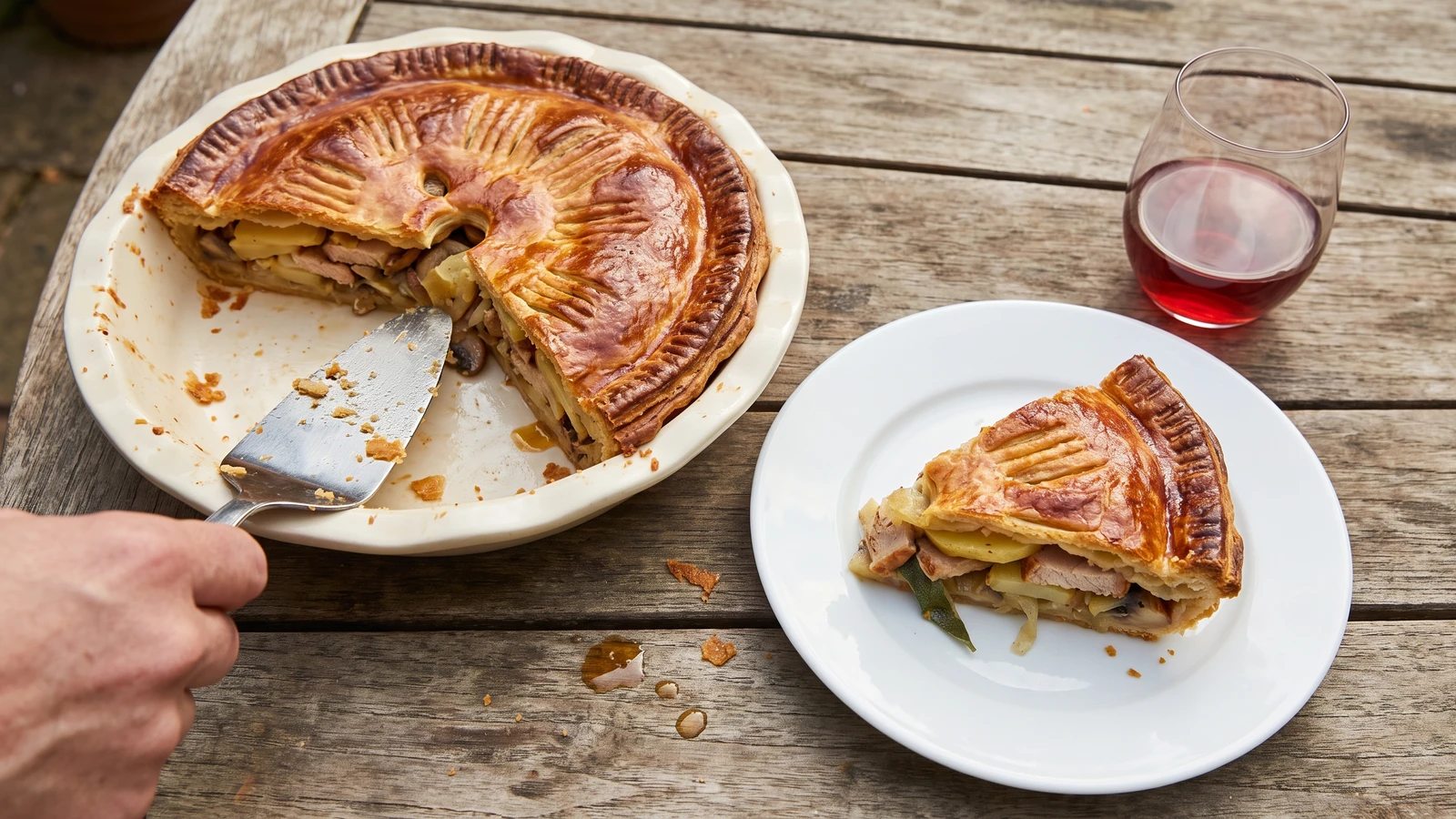
Tourte de porc layers seasoned pork, potato, onion, sage, and Ordinary or Dry Duxelle (No. 223) beneath a burnished paste lid, baking slowly until every stratum turns tender and savory.
Tourte de porc teaches the discipline of layering. Pork and potato share a dish but not a clock, so the slices must be thin enough to finish together beneath the sealed lid. The one true thing to know before touching a pan is this: cut every potato no thicker than 1/8 inch (3 mm), or the pork will be ready while the center stays stubborn.
The classical kitchen assumed Ordinary or Dry Duxelle (No. 223) waiting as a finished preparation, jambon cru shaved from a whole joint, and puff-paste trimmings left from other work. This home version takes the medium dish to two-thirds for four generous servings, uses deli-thin jambon cru and one cold all-butter pastry sheet, and keeps the Duxelle whole rather than stealing its method from its own entry. Making puff pastry from trimmings is brigade scaffolding here; the ham lining, equal weights of pork and potato, ordered layers, measured water, sealed lid, central slit, and slow bake are the dish. One cook, one stove, one evening.
When it comes out, the lid is fork-striped and bronze, the juices gleam at the vent, and each cut shows pork, potato, softened onion, sage, and dark mushroom in honest strata. Don't rush the bake because the pastry looks ready. Test through the central slit for a potato that yields without argument; that is the step that decides the tourte.
This tourte belongs to the French cuisine bourgeoise table rather than to a single provincial claim: it is a deep pie-dish preparation that passed readily from household ovens into the classical repertory. Its jambon cru lining and concentrated mushroom seasoning bring grand-kitchen discipline to the plain partnership of pork, potato, onion, and sage. It is often mistaken for an English raised pork pie, but this version has no hot-water-crust shell and no jelly; the dish supplies the walls, while paste covers only the top.
Quantity
1 pound (454 g)
cut across the grain into 1/4-inch (6 mm) collops
Quantity
1 teaspoon (5 ml / 6 g)
Quantity
1/2 teaspoon (2.5 ml / 1 g)
Quantity
1 tablespoon plus 1 teaspoon (20 ml / about 20 g) Ordinary or Dry Duxelle (No. 223)
Quantity
1 generous pinch (about 1/2 teaspoon / 0.5 g)
finely chopped
Quantity
1 generous pinch (about 1/2 teaspoon / 0.3 g)
finely chopped
Quantity
1 pound (454 g)
peeled and sliced 1/8 inch (3 mm) thick
Quantity
1 medium (about 1 cup / 150 g)
finely chopped
Quantity
4 ounces (about 8 thin slices / 115 g)
sliced nearly translucent
Quantity
6 tablespoons plus 1 teaspoon (95 ml / 95 g)
Quantity
1 sheet (about 9 ounces / 255 g)
Quantity
1
beaten
| Ingredient | Quantity |
|---|---|
| boneless pork shouldercut across the grain into 1/4-inch (6 mm) collops | 1 pound (454 g) |
| fine sea salt | 1 teaspoon (5 ml / 6 g) |
| freshly ground black pepper | 1/2 teaspoon (2.5 ml / 1 g) |
| Ordinary or Dry Duxelle | 1 tablespoon plus 1 teaspoon (20 ml / about 20 g) Ordinary or Dry Duxelle (No. 223) |
| flat-leaf parsleyfinely chopped | 1 generous pinch (about 1/2 teaspoon / 0.5 g) |
| fresh sagefinely chopped | 1 generous pinch (about 1/2 teaspoon / 0.3 g) |
| yellow waxy potatoespeeled and sliced 1/8 inch (3 mm) thick | 1 pound (454 g) |
| medium onionfinely chopped | 1 medium (about 1 cup / 150 g) |
| jambon cru, such as Bayonne hamsliced nearly translucent | 4 ounces (about 8 thin slices / 115 g) |
| cold water | 6 tablespoons plus 1 teaspoon (95 ml / 95 g) |
| chilled all-butter puff pastry | 1 sheet (about 9 ounces / 255 g) |
| large eggbeaten | 1 |
Set a rack in the lower-middle position and heat the oven to 350°F (180°C, or 160°C fan). Put a rimmed sheet pan in the oven to heat; the hot metal gives the covered dish immediate bottom heat and catches any juices that escape. Keep the puff pastry cold until the filling is assembled.
Cut the pork across the grain into collops, thin slices about 1/4 inch (6 mm) thick, and season them evenly with the salt and pepper. Slice the potatoes no thicker than 1/8 inch (3 mm), using a mandoline with its guard or a sharp knife. Keep them even. Thick slices remain firm long after the pork is cooked, while ragged thin edges collapse into the cooking liquid.
Line the bottom and sides of an 8-inch (20 cm) deep pie dish completely with the jambon cru, overlapping the slices slightly and carrying them to the rim. Leave no broad patches of bare ceramic. The ham is not decoration: it seasons the filling, holds the lower layers together, and gives the pie the savory enclosure that a bottom crust would otherwise supply.
Cover the bottom with half the pork collops in a close, even layer. Scatter over half the Ordinary or Dry Duxelle (No. 223), parsley, and sage, then cover with half the potatoes and half the onion. Repeat with the remaining pork, Duxelle, herbs, potatoes, and onion, keeping the final potato layer level so the pastry will sit neatly. Pour the cold water slowly down the inner side of the dish rather than over the seasonings. Press only lightly; the water needs small paths through the layers.
Lay the cold puff pastry over the dish and press it firmly against the rim all the way around, sealing without crushing the layers. Trim it to a neat 1/2-inch (1 cm) overhang. Gild the lid, meaning brush it evenly with beaten egg, then draw shallow streaks across it with the prongs of a fork. Cut a 1 1/2-inch (4 cm) slit in the center so steam can escape. Keep that as the only open vent; random holes let too much moisture out and dry the pork.
Set the pie on the heated sheet pan and bake for 1 hour 45 minutes to 2 hours. Begin checking through the central slit after 1 hour 35 minutes: a thin knife should pass through the potatoes to the bottom without catching, the filling should bubble at the vent, and the center should register at least 165°F (74°C). If the crust becomes deeply bronze before the potatoes yield, tent it loosely with foil without covering the vent and continue in 15-minute intervals. Ça se rattrape. The pastry's color does not decide the pie; the potato does.
Rest the tourte for 20 minutes before cutting. The juices settle into the potatoes during this pause, so the first serving arrives in layers rather than a flood. Serve warm for supper, or cool completely and chill it before packing for a picnic. Bring a chilled pie toward room temperature for about 30 minutes before serving so the pastry and pork recover their flavor. À table!
1 serving (about 340g)
Culinary guides, cultural storytelling, and the editorial depth that makes cooking meaningful.
Discover Culinary ExplorerChef Juliette
John Dory has the delicacy of sole and the firmness of turbot. A light flouring, a quick butter sauté, and nut-brown beurre noisette show exactly why looks never mattered.

Chef Juliette
Fresh haddock proves its delicacy in the meunière pan: a fine flour crust, moist pearly flakes, and beurre noisette sharpened with lemon and parsley, ready from one skillet in half an hour.

Chef Juliette
Éperlans à l’Anglaise turns small fish into a lesson in disciplined coating: boned smelts under a close, crisp crumb, pan-fried in clarified butter and finished with bright, half-melted maître d’hôtel butter.

Chef Juliette
Tiny smelts, shallot, mushrooms, white wine, gratin sauce, and fine bread raspings meet a fierce oven, where the fish must turn tender in the same breath the buttered crust bronzes.