Culinary Explorer

A cooking platform built around craft, culture, and the stories behind what we eat.
Discover Culinary Explorer
Bercy Butter

Bercy Butter

Created by Chef Juliette

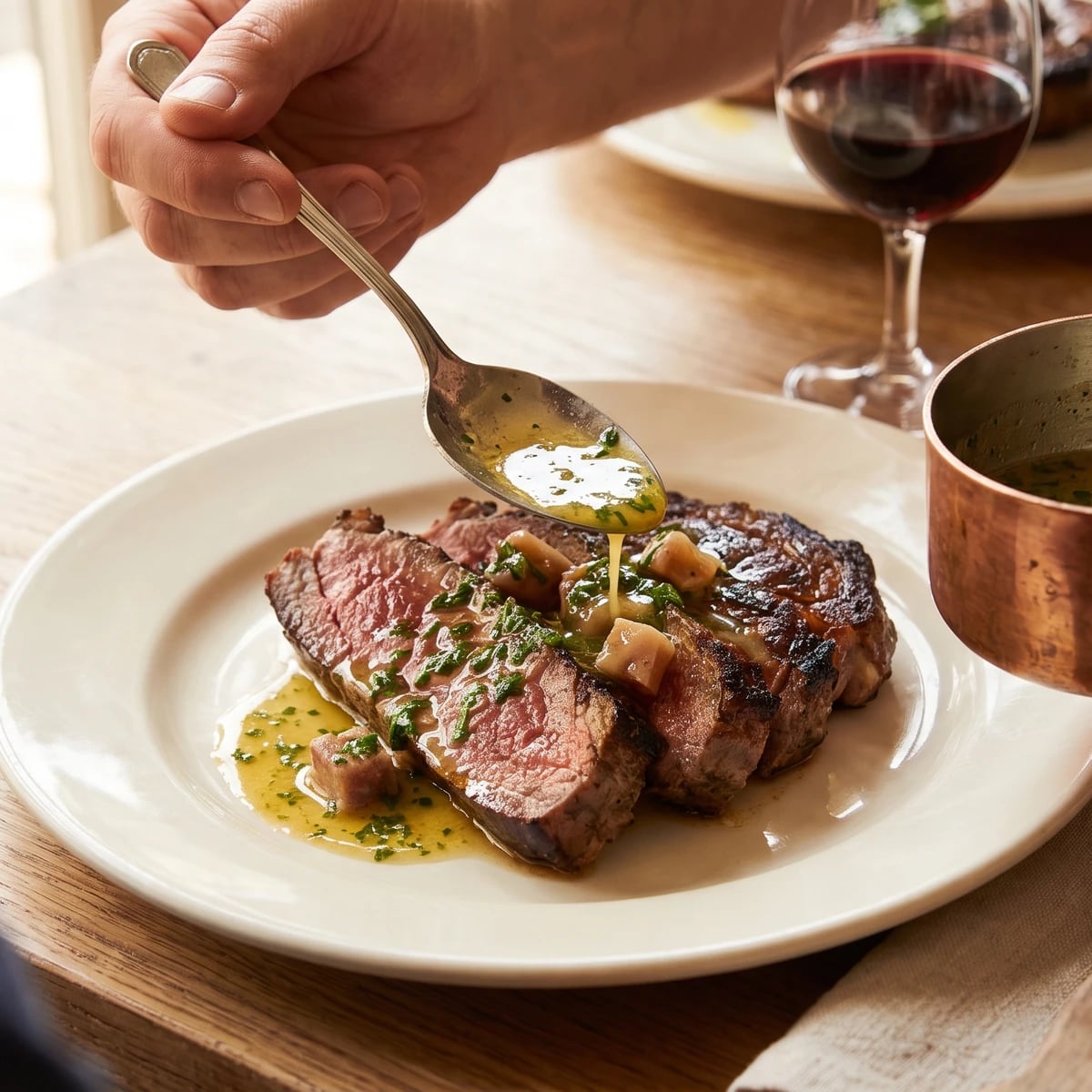
Beurre Bercy is the warm compound butter that teaches restraint: white wine and shallots reduced hard, then worked with creamed butter, parsley, and tender marrow until loose and glossy, never melted through.

Sauces & Condiments
French
Dinner Party
BBQ
Special Occasion
15 min
Active Time
10 min cook25 min total
YieldAbout 3/4 cup (180 ml), enough for 4 to 6 servings

Beurre Bercy (Bercy butter) teaches the central discipline of warm compound butter: control the temperature so the butter softens into a loose, glossy cream without melting into a clear pool of fat. The wine reduction brings acidity, the marrow brings depth, and the parsley and lemon keep all that richness awake.

The original assumed a saucier on staff, with blanched shallot and poached marrow ready the instant grilled beef left the fire. It calls for neither the stockpot nor the salamander. At home, one small saucepan and a heatproof bowl do the work, and I've cut every quantity in half while preserving the book's ratios. The result is enough for four to six portions, not a service pan waiting through dinner. Keeping separate pans and components ready all evening was brigade scaffolding, so that goes. Blanching the shallot, poaching the marrow, reducing the wine by half, and keeping the butter creamy are the dish itself, so those stay.

One cook, one stove, one evening. Before you touch the pan, know the one step that decides everything: cool the reduction until it is barely warm before adding the creamed butter. Too hot and the butter liquefies; if that happens, ça se rattrape, and the method shows you where.

Beurre Bercy takes its name from Bercy, the eastern Paris quarter shaped by wine warehouses, merchants, and the tables that fed them. Classical kitchens attached the district's name to several white-wine-and-shallot preparations; this butter, enriched with poached beef marrow, was intended principally for grilled beef. It should not be confused with the related sauces Bercy served with fish, which share the wine-and-shallot idea but belong to a different sauce family.

The technique, the tradition, and the story behind every dish.

Discover Culinary Explorer

Ingredients

dry white wine

Quantity

1/4 cup plus 2 teaspoons (70 ml / 70 g)

shallot

Quantity

1 1/2 tablespoons (22 ml / 14 g)

finely chopped

unsalted butter

Quantity

1/2 cup (120 ml / 113 g)

softened until creamy but not melted

flat-leaf parsley

Quantity

1/2 teaspoon (2.5 ml / 1 g)

finely chopped

raw beef marrow

Quantity

2 tablespoons (30 ml / 28 g)

cut into 1/4-inch (6 mm) cubes

water

Quantity

2 cups (475 ml / 475 g)

fine table salt

Quantity

3/4 teaspoon (3.75 ml / 4.5 g)

divided

black pepper

Quantity

1/16 teaspoon (0.3 ml / 0.1 g)

freshly ground

fresh lemon juice

Quantity

1/16 teaspoon (0.3 ml / 0.3 g)

Equipment Needed

  • 1-quart (1-liter) heavy-bottomed saucepan
  • Small fine-mesh strainer
  • Medium heatproof bowl
  • Flexible spatula or small whisk
  • Instant-read thermometer, optional

Instructions

  1. 1

    Cream the butter

    Work the softened butter against the side of a heatproof bowl with a flexible spatula until it is smooth, opaque, and creamy, with no firm lumps. It should yield easily but still hold the ridges left by the spatula. If it looks shiny or begins pooling, it is already too warm; set the bowl over cool water for a minute and keep stirring until the butter regains body.

  2. 2

    Blanch and poach

    Bring the water and 1/2 teaspoon of the salt to a boil in a small saucepan. Put the chopped shallot in a fine-mesh strainer, lower it into the water for 20 seconds, then drain and press it dry. Lower the water to the barest tremble and poach the marrow cubes for about 2 minutes, until opaque and tender but still holding their shape. Drain them carefully and blot away the water. A hard boil will melt their edges into the pot, so keep the poach gentle.

  3. 3

    Reduce the wine

    Empty and dry the saucepan, then add the wine and blanched shallot. Bring them to a lively simmer and reduce from 70 ml to about 35 ml, roughly 2 tablespoons plus 1 teaspoon. Watch the quantity, not the clock: the shallot should be tender and the liquid sharp-smelling and concentrated, without going dry. Scrape the reduction into the heatproof bowl and let it cool until barely warm, about 80 to 85°F (27 to 29°C).

  4. 4

    Work in butter

    Add the creamed butter to the barely warm reduction in three additions, stirring firmly with the spatula until each disappears before adding the next. Keep the bowl off direct heat. The Beurre Bercy is ready for its finish when it forms a loose, opaque cream with a full butter gloss, not a transparent layer of melted fat. If oily beads appear, stop immediately. Ça se rattrape: set the bowl over cool water and whisk until it turns opaque again; if needed, whisk in 1 teaspoon of cool water drop by drop.

    If the butter stays lumpy because the reduction cooled too far, set the bowl over barely warm water for five seconds at a time, stirring between each visit. Gentle correction keeps the emulsion intact.
  5. 5

    Fold and serve

    Fold in the parsley and poached marrow without crushing the cubes, then season with the remaining salt. At the moment of serving, stir in the pepper and lemon juice exactly as the source directs. Spoon the Beurre Bercy over grilled entrecôte, onglet, or another well-browned cut while the butter is loose and creamy. Never let it melt right through. À table!

Chef Tips

  • Choose a dry, clean white wine without obvious sweetness or heavy oak. Reduction magnifies what is in the glass, and Beurre Bercy needs acidity more than perfume.
  • Ask a butcher for cleaned raw beef marrow removed from the bones. There is no invisible substitute here: leaving it out gives you a pleasant shallot and parsley butter, but it is no longer the preparation the book sets down.
  • The butter should be soft enough to cream at about 65 to 70°F (18 to 21°C). A microwave creates melted pockets before the center softens, so let it come to temperature evenly and give it time.
  • Serve it with grilled beef that has rested and been blotted of excess juice. A wet surface thins the butter before it reaches the table; a browned, dry crust holds the glossy cream beautifully.
  • A lively red with good acidity suits the beef and marrow. The white wine belongs in the butter, but it need not dictate what goes into the glass.

Advance Preparation

  • The wine and shallot reduction can be made up to 1 day ahead, covered, and chilled. Bring it back to barely warm before working in the butter.
  • The marrow can be poached up to 1 day ahead, dried well, covered, and chilled separately. Let it lose its refrigerator chill before folding it into the butter.
  • Finish the Beurre Bercy shortly before serving. If it firms while the beef rests, stir it over barely warm water for a few seconds at a time. Refrigerate leftovers promptly and use within 2 days.

Frequently Asked Questions

Nutrition Information

1 serving (about 27g)

Calories
175 calories
Total Fat
19 g
Saturated Fat
11 g
Trans Fat
1 g
Unsaturated Fat
7 g
Cholesterol
50 mg
Sodium
110 mg
Total Carbohydrates
0 g
Dietary Fiber
0 g
Sugars
0 g
Protein
1 g

Note: Chef personas and recipes are created with AI assistance. Cook with care: follow safe food-handling practices, check doneness with a thermometer when needed, and adapt for allergies and your kitchen.

Where cooking meets culture.

Culinary guides, cultural storytelling, and the editorial depth that makes cooking meaningful.

Discover Culinary Explorer

More from Cold Sauces and Compound Butters

Browse the full collection