Culinary Explorer

A cooking platform built around craft, culture, and the stories behind what we eat.
Discover Culinary Explorer
Pilaw d’Agneau

Pilaw d’Agneau

Created by Chef Juliette

Based on No. 1381, Pilaw d’Agneau, from Le Guide Culinaire (1907) by Auguste Escoffier

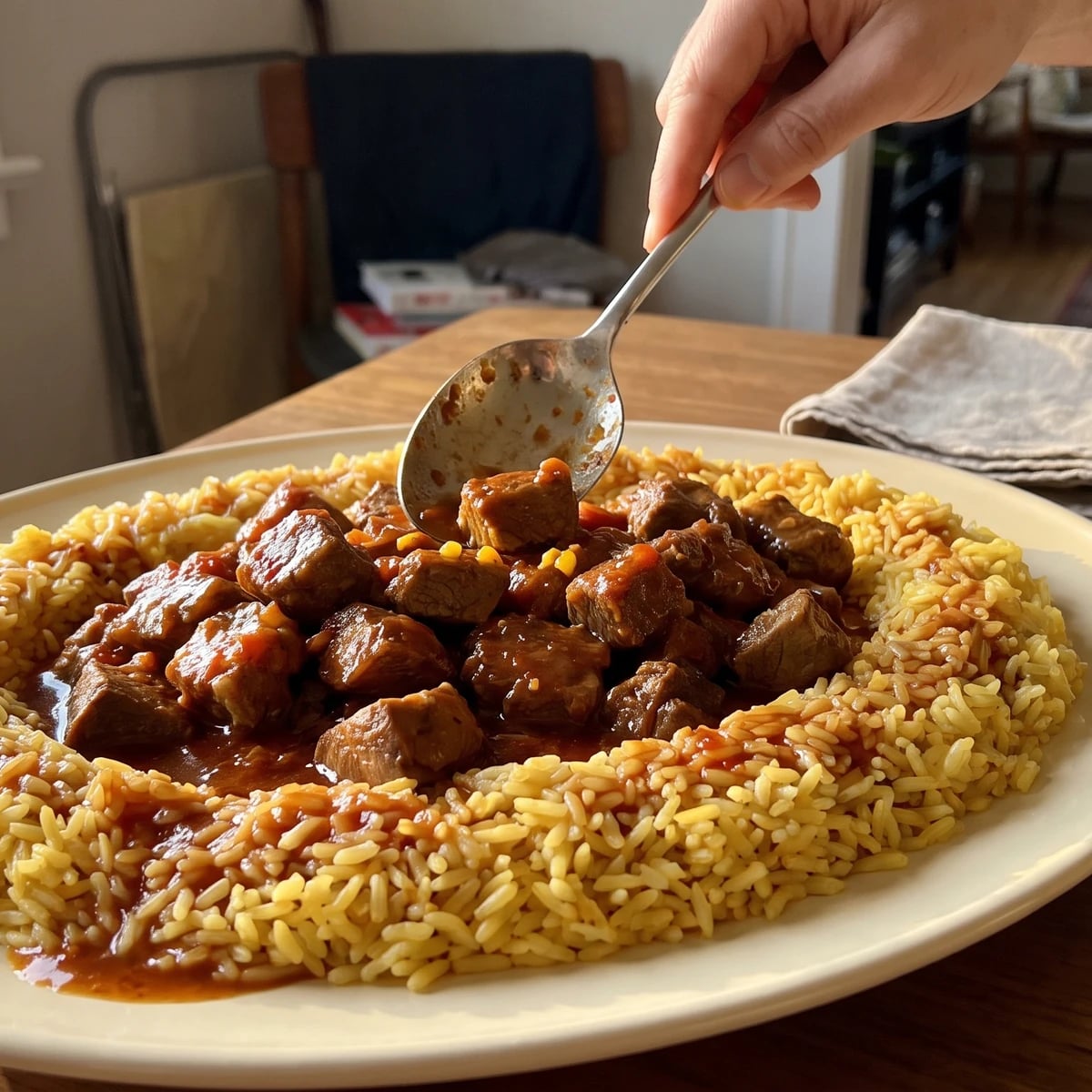
Pilaw d’Agneau turns tomato-rich lamb and separate, buttery pilaf rice into one generous platter, proving that deep browning and a shortened braise are the whole grammar of tender young lamb.

Main Dishes
French
Weeknight
Comfort Food
One Pot
25 min
Active Time
1 hr 35 min cook2 hr total
Yield4 servings

Pilaw d’Agneau (lamb pilaf in the French classical manner) teaches the discipline of stopping at tenderness. Its governing preparation, Pilaw de Mouton à la Turque (No. 1354), is a tomato-dominant navarin scented with saffron or ginger and served inside a border of pilaf rice, but young lamb is not small mutton. The one true thing to know before touching the pan is this: lamb must leave the braise as soon as it yields, because borrowed mutton timing will dry it.

The original entry assumed that the mutton formula was already waiting in the canon, with a saucier to tend the stew, stock never off the fire, another pair of hands for the rice, and molds ready for service. Your honest equivalents are good unsalted stock, reliable canned tomatoes, a cocotte, a lidded saucepan, and two serving spoons. A salamander has no work here because there is no gratin. The rigid mold and prolonged holding are brigade scaffolding and can go; deep browning, the tomato-dominant sauce, one prescribed seasoning, and properly cooked pilaf rice are the dish and must stay. One cook, one stove, one evening.

Done properly, the lamb sits in a glossy garnet sauce while distinct, buttered grains of rice catch it around the inner rim. Begin checking the meat early and trust the skewer rather than the clock. That shortened braise is the step that decides the dish.

Pilaw d’Agneau belongs to the Parisian classical repertoire, where French kitchens recast the idea of Turkish pilav through the structure of a navarin rather than reproducing Turkish cookery. The prescribed preparation is a tomato-dominant lamb stew scented with saffron or ginger, its usual vegetables exchanged for rice and often presented within a pilaf border for orderly service. The lamb version is not a separate composition from the mutton formula; its defining change is a shorter cooking time because young lamb reaches tenderness sooner.

The technique, the tradition, and the story behind every dish.

Discover Culinary Explorer

Ingredients

Pilaw de Mouton à la Turque

Quantity

1 home-scaled finished preparation (No. 1354)

executed with young lamb and the shortened timing specified here

boneless lamb shoulder

Quantity

2 pounds (900 g)

trimmed and cut into 1½-inch pieces

fine sea salt

Quantity

2 teaspoons (10 ml / 12 g)

divided

freshly ground black pepper

Quantity

1 teaspoon (5 ml / 2 g)

clarified butter

Quantity

2 tablespoons (30 ml / 28 g)

unsalted butter

Quantity

4 tablespoons (60 ml / 57 g)

divided

yellow onion for the lamb

Quantity

1 cup (240 ml / 150 g)

finely chopped

garlic

Quantity

2 cloves

finely chopped

tomato paste

Quantity

2 tablespoons (30 ml / 35 g)

plain flour

Quantity

2 tablespoons (30 ml / 16 g)

canned whole peeled tomatoes

Quantity

1¾ cups (420 ml / 400 g)

crushed by hand

unsalted chicken or light veal stock

Quantity

4¼ cups (1 L / 1 kg)

divided

bouquet garni

Quantity

1

saffron threads or ground ginger

Quantity

¼ teaspoon (1 ml / 0.1 g) saffron or 1 teaspoon (5 ml / 2 g) ginger

choose one seasoning, not both

long-grain white rice

Quantity

1½ cups (360 ml / 285 g)

yellow onion for the rice

Quantity

½ cup (120 ml / 75 g)

finely chopped

Equipment Needed

  • 5 to 6-quart heavy cocotte or Dutch oven
  • 3-quart saucepan with a tight-fitting lid
  • Wide oval serving platter
  • Tongs or a slotted spoon

Instructions

  1. 1

    Set the preparation

    Take Pilaw de Mouton à la Turque (No. 1354) as the governing preparation. The only changes are home-scale quantities for four, young lamb in place of mutton, and a shorter braise. Choose saffron or ginger, never both. If using saffron, steep it in 2 tablespoons (30 ml) of warm stock for ten minutes; if using ginger, reserve it for the tomato base. Dry the lamb thoroughly, season it with 1½ teaspoons of the salt and all the pepper, and reserve the remaining salt for the rice.

  2. 2

    Brown the lamb

    Heat the clarified butter in a wide, heavy cocotte over medium-high heat until it glistens. Brown the lamb in three uncrowded batches, leaving each piece undisturbed until two broad sides carry a deep bronze crust. Transfer each batch to a plate. If the meat releases liquid and begins turning grey, lift it out, boil away the moisture until the fat sizzles again, and resume browning. The brown glaze left on the pot is the fond, and the sauce needs every bit of it.

    Do not chase colour on every face of each cube. Two well-browned sides give more flavour than six pale ones, and the lamb spends less time drying over direct heat.
  3. 3

    Build tomato foundation

    Lower the heat to medium and melt 1 tablespoon of the unsalted butter in the cocotte. Add the onion and cook for 6 to 8 minutes until soft and golden at the edges, then add the garlic for 30 seconds. Stir in the tomato paste and cook until it darkens slightly; if using ginger, add it now. Singer the base, meaning dust it with the flour, and stir for 2 minutes so the flour loses its raw smell. Pour in 1¾ cups (420 ml) of stock gradually, scraping the fond from the pot floor, then add the crushed tomatoes, bouquet garni, and saffron infusion if using. The tomatoes must lead the sauce rather than merely tint it.

  4. 4

    Shorten the braise

    Return the lamb and its collected juices to the cocotte. Bring the sauce to a bare simmer, partially cover, and cook gently for 45 minutes before testing a piece. Continue in 10-minute intervals only until a skewer enters the lamb with little resistance and the cubes still hold their shape, usually 55 to 70 minutes in all. If the sauce tightens before the lamb is tender, add reserved stock a spoonful at a time; if the lamb becomes tender while the sauce is still loose, lift out the meat and reduce the sauce before returning it. Ça se rattrape. What cannot be rescued is lamb left simmering long after tenderness.

  5. 5

    Cook the pilaf

    Begin the rice during the lamb's final half hour. Melt 2 tablespoons of the unsalted butter in a lidded saucepan over medium-low heat and soften the rice onion for 4 minutes without browning it. Add the rice and nacrer it, coating the grains in butter until their edges look translucent and they make a faint dry sound against the pan. Add 2 cups (480 ml) of stock and the reserved ½ teaspoon salt, bring to a boil, cover tightly, and cook over the lowest heat for 15 minutes. Turn off the heat and leave the rice covered for 10 minutes, then fluff it gently. If the grains remain firm after absorbing the liquid, sprinkle over 2 tablespoons (30 ml) of hot reserved stock, cover, and rest for another 5 minutes.

    Do not stir the rice once the lid goes on. Stirring releases starch and turns distinct pilaf grains into a soft mass.
  6. 6

    Finish the sauce

    Discard the bouquet garni and check the sauce. It should coat the lamb and run slowly from a spoon, glossy but not pasty. Skim away any heavy excess of fat, then take the cocotte off the heat and monter au beurre, finishing the sauce by swirling in the remaining 1 tablespoon of cold unsalted butter. Taste for salt and pepper. Once the butter is incorporated, keep the sauce below a simmer so its gloss remains intact.

  7. 7

    Shape and serve

    Spoon the rice onto a warmed oval platter and use the backs of two spoons to form a broad, loose ring. A rigid mold is service scaffolding, not a requirement; do not pack the grains tightly. Fill the center with the lamb, spoon the tomato-rich sauce generously over it, and let a little sauce meet the inner edge of the rice. Serve at once. À table!

Chef Tips

  • Use lamb shoulder, not leg. Shoulder has enough connective tissue to become succulent during the shortened braise, while lean leg can pass from tender to dry before the sauce is ready.
  • Choose saffron for a floral, honeyed warmth or ginger for a firmer, peppery note. The source allows either according to circumstance, but combining them blurs the clean seasoning the preparation intends.
  • Good canned whole tomatoes are the honest choice whenever fresh tomatoes are pale or watery. Crush them yourself so the sauce retains a little body; tired fresh tomatoes give neither sweetness nor depth.
  • Pour a supple young Côtes du Rhône or another gently tannic French red. Tomato can make a stern, heavily oaked wine taste hard, while a softer red sits comfortably beside the saffron or ginger.

Advance Preparation

  • The lamb and tomato sauce may be braised a day ahead. Stop cooking as soon as the meat is tender, cool it promptly, and chill it in its sauce; reheat gently and add the final cold butter only before serving.
  • The onions may be chopped and the lamb portioned earlier in the day. Cook the pilaf rice shortly before serving because chilled rice loses the loose, buttered texture this presentation needs.

Frequently Asked Questions

Nutrition Information

1 serving (about 600g)

Calories
1015 calories
Total Fat
57 g
Saturated Fat
27 g
Trans Fat
2 g
Unsaturated Fat
28 g
Cholesterol
205 mg
Sodium
1550 mg
Total Carbohydrates
75 g
Dietary Fiber
4 g
Sugars
7 g
Protein
51 g

Note: Chef personas and recipes are created with AI assistance. Cook with care: follow safe food-handling practices, check doneness with a thermometer when needed, and adapt for allergies and your kitchen.

Where cooking meets culture.

Culinary guides, cultural storytelling, and the editorial depth that makes cooking meaningful.

Discover Culinary Explorer

More from Relevés and Entrées - House Lamb

Browse the full collection