
Chef Juliette
John Dory (St. Pierre)
John Dory has the delicacy of sole and the firmness of turbot. A light flouring, a quick butter sauté, and nut-brown beurre noisette show exactly why looks never mattered.
A cooking platform built around craft, culture, and the stories behind what we eat.
Created by Chef Juliette
Based on No. 1372, Côtelettes d’Agneau de Lait Maréchale, from Le Guide Culinaire (1907) by Auguste Escoffier
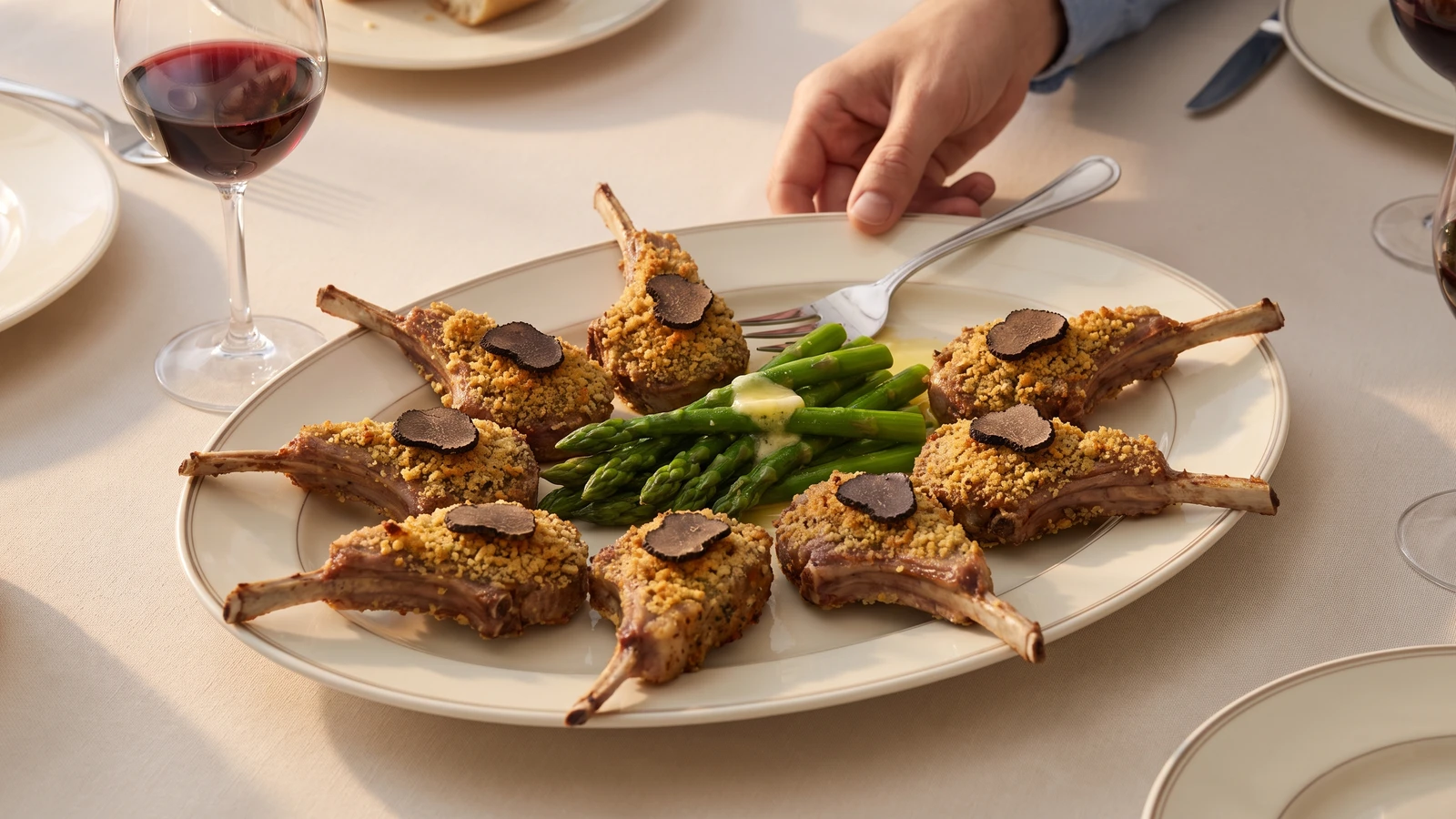
Côtelettes Maréchale turns panure à l’anglaise into ceremony: golden milk-fed lamb, black truffle on every cutlet, and butter-glossed asparagus gathered in the middle for a generous dinner-party platter.
Côtelettes d’Agneau de Lait Maréchale (milk-fed lamb cutlets Maréchale-style) teaches one exact lesson: panure à l’anglaise, an egg-and-breadcrumb coat, becomes a close golden crust only when it meets clarified butter already hot. Put the cutlets into merely warm fat and the crumbs drink butter, loosen, and go heavy. Heat first, then fry.
The grand kitchen could call on a saucier, a stock never off the fire, and a salamander, but this entry uses none of them. Its true assumptions were a prepared Anglaise on the station, clarified butter ready on the range, asparagus trimmed by another pair of hands, and warm plates waiting at service. At home, a 30 cm skillet, a saucepan, and a low oven replace that brigade. I have reduced the quantity to eight small cutlets for four and organized the garnish so one cook can manage it. That is the scaffolding we change. The fine crumb coating, clarified-butter frying, truffle crown, and butter-cohered asparagus are the dish itself, and they stay.
The finished Maréchale is generous and precise: crisp gold around tender lamb, black truffle warmed by each cutlet, and vivid asparagus tips shining in butter at the center of the platter. Before the first cutlet meets the pan, the breading must be dry to the touch and the clarified butter properly hot. That is the moment that decides the dish.
Côtelettes d’Agneau de Lait Maréchale belongs to the Parisian grande-cuisine table rather than to a lamb-raising province; Maréchale is a classical mode of dressing small, tender pieces with breadcrumbing, butter frying, and a mark of truffle. The formula carried the practical panure à l’anglaise into formal service by arranging the cutlets as a crown around a seasonal green garnish. Here the asparagus tips and fine truffle slice on every cutlet are not decoration added at whim, but the identifiers separating Maréchale from an ordinary crumbed chop.
Quantity
8 cutlets (about 1½ pounds / 680 g total)
evenly trimmed and about 1.5 cm thick
Quantity
½ cup (120 ml / 65 g)
Quantity
½ cup (120 ml / 120 g) Anglaise (for Egg-and-bread-crumbing) (No. 174)
prepared and cold
Quantity
1½ cups (360 ml / 100 g)
Quantity
1 cup (240 ml / 215 g)
for shallow-frying
Quantity
32 spears (about 1½ pounds / 680 g)
tips cut 6 cm long; stalks reserved for another dish
Quantity
3 tablespoons (45 ml / 43 g)
for the asparagus
Quantity
1 small truffle (about ½ ounce / 15 g drained)
cut into 8 fine slices
Quantity
1 tablespoon (15 ml / 18 g)
divided, mostly for the asparagus water
| Ingredient | Quantity |
|---|---|
| bone-in milk-fed lamb rib cutletsevenly trimmed and about 1.5 cm thick | 8 cutlets (about 1½ pounds / 680 g total) |
| plain flour | ½ cup (120 ml / 65 g) |
| Anglaise (for Egg-and-bread-crumbing)prepared and cold | ½ cup (120 ml / 120 g) Anglaise (for Egg-and-bread-crumbing) (No. 174) |
| fine fresh white breadcrumbs | 1½ cups (360 ml / 100 g) |
| clarified unsalted butterfor shallow-frying | 1 cup (240 ml / 215 g) |
| medium green asparagus spearstips cut 6 cm long; stalks reserved for another dish | 32 spears (about 1½ pounds / 680 g) |
| unsalted butterfor the asparagus | 3 tablespoons (45 ml / 43 g) |
| whole black truffle, fresh or preservedcut into 8 fine slices | 1 small truffle (about ½ ounce / 15 g drained) |
| fine sea saltdivided, mostly for the asparagus water | 1 tablespoon (15 ml / 18 g) |
Heat the oven to 95°C (200°F) and set a wire rack over a rimmed tray inside it. Pat the lamb cutlets thoroughly dry. If their meat varies greatly in thickness, place them between sheets of baking paper and tap only the thickest parts until each cutlet is an even 1.5 cm; agneau de lait is tender already, so this is evening the cooking, not tenderizing the meat. Set out three shallow dishes for flour, Anglaise, and breadcrumbs, and have the sliced truffle covered nearby.
Bring a wide saucepan of water to a full boil and salt it generously with most of the measured salt. Add the asparagus tips and cook for 2 to 4 minutes, depending on thickness, until vivid green and tender enough for a knife to enter with slight resistance. Drain at once, cool briefly under cold water, and dry very well. Hold them on a clean towel; water left on the tips will later dilute the butter instead of letting it cling.
Coat each cutlet lightly in flour and tap away every loose patch. Pass it through the prepared Anglaise (for Egg-and-bread-crumbing) (No. 174), covering the meat and its edges completely, then let the excess drain before laying it in the fine breadcrumbs. Press the crumbs on gently, without building a thick shell. Transfer the cutlets to a rack and refrigerate them uncovered for 15 minutes so the coat settles and dries. If a bare patch appears, touch it with a little Anglaise and press on fresh crumbs. Ça se rattrape.
Pour enough clarified butter into the heavy skillet to make a layer about 5 mm deep and heat it to 170°C (340°F). Without a thermometer, drop in a pinch of breadcrumb: it should sizzle hard at once and turn gold gradually, not sit quietly and not blacken in seconds. Warm fat gives a greasy coat; smoking fat burns it. If the butter begins to smoke, take the skillet off the heat and let it settle before you continue.
Lower four cutlets into the hot butter, placing them away from you, and leave space between them. Fry the first side without nudging for 2 to 3 minutes, until the coat has set into an even deep gold. Turn once and cook the second side for about 2 minutes, until the thickest part reaches 63°C (145°F). Transfer them to the rack in the low oven and repeat with the remaining cutlets, skimming away loose crumbs and restoring the butter level as needed. If the crust browns before the center is ready, lower the heat and finish the cutlet on the rack in a 160°C (325°F) oven. If the coat begins to lift, stop moving it and let that side set before turning; both failures can be rescued.
As the last cutlets finish, melt the unsalted butter in the emptied asparagus saucepan over medium heat. Add the dried tips with a small pinch of the remaining salt and roll them gently through the butter for 2 minutes, until hot, glossy, and gathered by a thin buttery coating. This is what cohered with butter means here: bound and shining, not swimming. If water seeps from the asparagus and the butter looks thin, lift out the tips, boil away the water until the butter foams cleanly, then return them for a final toss.
Arrange the eight cutlets in a close circle on a warm oval platter, with the bones radiating outward. Lay one fine truffle slice on the meat of each hot cutlet so its aroma opens with the lamb’s warmth. Heap the buttered asparagus tips generously in the middle and spoon their clinging butter over them. Serve immediately, while the crust is crisp and the truffle is fragrant. À table!
1 serving (about 240g)
Culinary guides, cultural storytelling, and the editorial depth that makes cooking meaningful.
Discover Culinary ExplorerChef Juliette
John Dory has the delicacy of sole and the firmness of turbot. A light flouring, a quick butter sauté, and nut-brown beurre noisette show exactly why looks never mattered.

Chef Juliette
Fresh haddock proves its delicacy in the meunière pan: a fine flour crust, moist pearly flakes, and beurre noisette sharpened with lemon and parsley, ready from one skillet in half an hour.

Chef Juliette
Éperlans à l’Anglaise turns small fish into a lesson in disciplined coating: boned smelts under a close, crisp crumb, pan-fried in clarified butter and finished with bright, half-melted maître d’hôtel butter.

Chef Juliette
Tiny smelts, shallot, mushrooms, white wine, gratin sauce, and fine bread raspings meet a fierce oven, where the fish must turn tender in the same breath the buttered crust bronzes.