
Chef Juliette
John Dory (St. Pierre)
John Dory has the delicacy of sole and the firmness of turbot. A light flouring, a quick butter sauté, and nut-brown beurre noisette show exactly why looks never mattered.
A cooking platform built around craft, culture, and the stories behind what we eat.
Created by Chef Juliette
Based on No. 1368, Carré d’Agneau à la Toscane, from Le Guide Culinaire (1907) by Auguste Escoffier
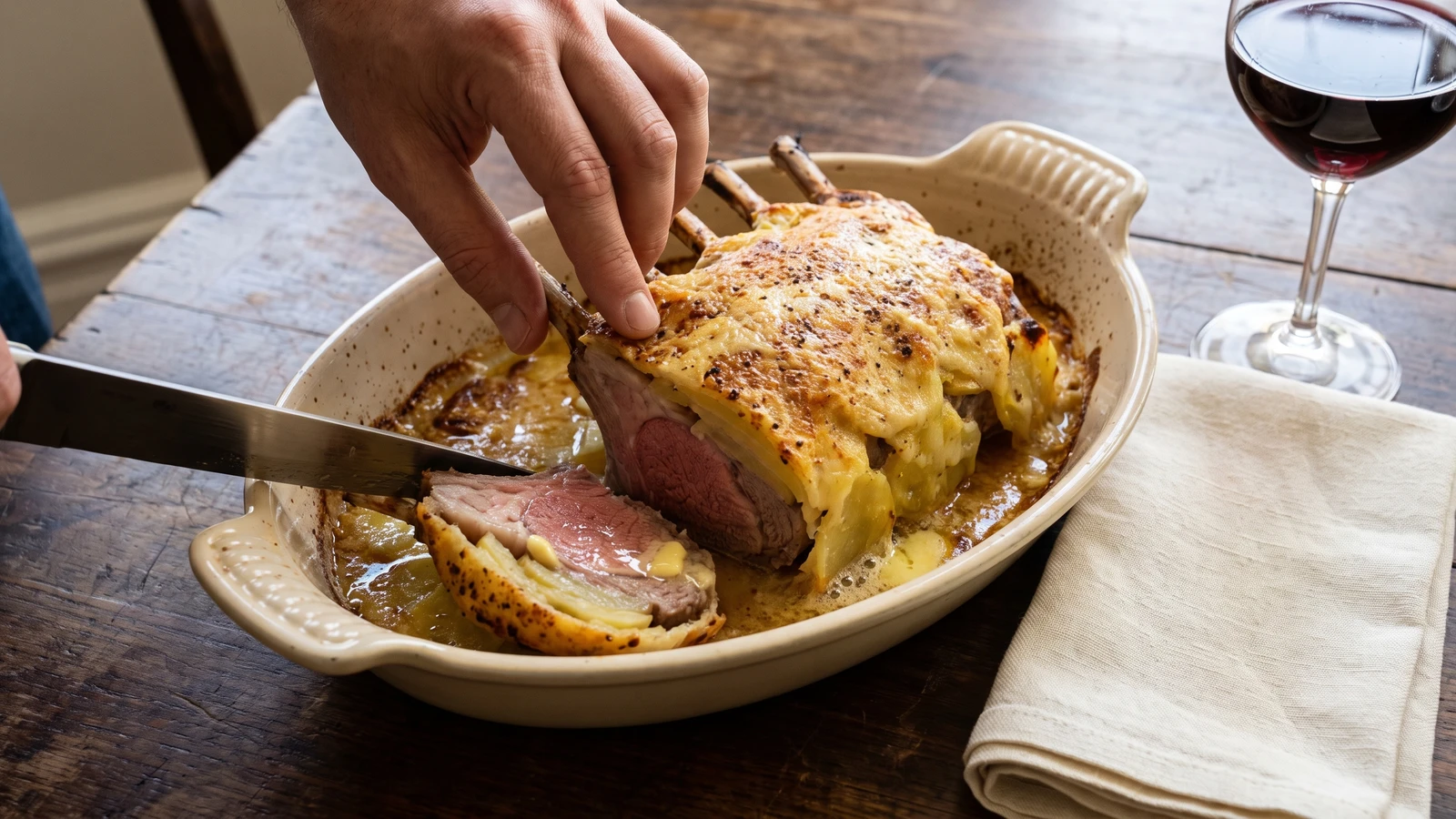
A butter-browned rack enclosed between two crisp potato layers under Parmesan, carried to the table in its baking dish with every savory juice held inside.
Carré d’Agneau à la Toscane (rack of lamb sealed between buttered potato layers) teaches one severe little lesson: the potato base must become a close, unbroken crust before the lamb can surrender its juices. If that foundation leaks, the underside turns sodden. If it holds, you cut through Parmesan bronze, buttery potato, and rosy lamb in one magnificent slice. The seal is the dish.
The original entry assumed a butcher had shortened the rib bones and removed every cartilaginous portion, a separate cook had the Pommes de Terre Anna (No. 2203) ready, and a fierce, steady oven would set the bottom without discussion. It needs no saucier, stockpot, or salamander. At home, ask the butcher for one eight-rib rack ready for roasting, use a single home-scale batch of the referenced potato preparation, and give the base a short head start on a preheated sheet in a snug oval gratin dish. That brief pre-setting replaces brigade timing, not technique. One cook, one stove, one evening.
The separate potato mould and turning-out procedure are scaffolding here because this dish goes straight from oven to table. What stays is the lamb set in real butter, the double potato enclosure, and the Parmesan crust. A separate sauce would smother the idea, so none is invented. Before the lamb goes in, make that base grip as one sheet. That is the step that decides the dish.
Carré d’Agneau à la Toscane belongs to the French classical dining room, where an à la name often described a garnish or composition rather than a dish borrowed intact from the named place. Here Toscane is an Italian-facing French menu name, signaled by Parmesan over lamb enclosed in Pommes de Terre Anna (No. 2203), itself a Parisian potato preparation. This is not Tuscan farmhouse lamb: it is a grand-kitchen construction deliberately served in its earthenware dish, a practice that lets it pass naturally to the French home table.
Quantity
1 rack (about 1¾ to 2 lb / 800 to 900 g)
chine bone and cartilage removed, rib bones shortened
Quantity
1 recipe Pommes de Terre Anna (No. 2203), about 5 cups (1.25 L / 900 g)
ready for its oven stage and divided into two equal portions
Quantity
4 tablespoons (60 ml / 57 g)
divided
Quantity
½ cup (125 ml / 45 g)
finely grated
Quantity
1¾ teaspoons (8.75 ml / 10 g)
Quantity
1 teaspoon (5 ml / 2 g)
| Ingredient | Quantity |
|---|---|
| eight-rib rack of lambchine bone and cartilage removed, rib bones shortened | 1 rack (about 1¾ to 2 lb / 800 to 900 g) |
| Pommes de Terre Annaready for its oven stage and divided into two equal portions | 1 recipe Pommes de Terre Anna (No. 2203), about 5 cups (1.25 L / 900 g) |
| unsalted butterdivided | 4 tablespoons (60 ml / 57 g) |
| Parmesanfinely grated | ½ cup (125 ml / 45 g) |
| fine sea salt | 1¾ teaspoons (8.75 ml / 10 g) |
| freshly ground black pepper | 1 teaspoon (5 ml / 2 g) |
Heat the oven to 425°F (220°C), or 400°F (200°C) with a fan, with a heavy rimmed baking sheet on the lower-middle rack. Confirm that the butcher has removed the chine bone and firm cartilage, leaving a neat fat cap and rib bones about 3 inches (7.5 cm) long. Dry the lamb thoroughly, then season every meaty surface with the salt and pepper. Leave it uncovered while the oven heats; a dry surface lets the butter take hold.
Raidir the lamb, meaning set and lightly color its surface in butter without cooking the center. Melt 3 tablespoons (45 ml / 43 g) of the butter in a heavy skillet over medium-high heat. When the foam subsides, set in the rack fat-side down and cook for 3 to 4 minutes, then color the two meaty ends and the bone side for about 1 minute each. The lamb should be lightly golden and firm outside, still raw within. If the butter begins to blacken, lift out the lamb, wipe the pan, lower the heat, and resume with a little of the reserved butter. The color already gained is not lost.
Use the remaining butter to coat a shallow 12 by 8-inch (30 by 20 cm) oval gratin dish. Bring the Pommes de Terre Anna (No. 2203) to the dish at the pre-oven stage directed in its own entry. Use one half to form a compact base about ½ inch (1.25 cm) thick, bringing it slightly up the sides and pressing firmly so there are no open seams. Set the dish on the hot baking sheet for 8 to 10 minutes, until the base grips the dish and moves as one sheet when nudged gently at the edge. If a patch still slides, press it closed and bake for 3 minutes more. Ça se rattrape. Do not add the lamb until the base holds.
Set the lamb bone-side down and fat-cap up on the firm potato base, leaving the cleaned rib handles exposed. Cover the loin with the remaining Pommes de Terre Anna (No. 2203), bringing the upper layer down to meet the base and pressing the seam closed around both sides. Keep the enclosure even rather than excessively thick. If the covering tears, borrow a little potato from a thicker patch and press it over the opening before baking. Scatter the Parmesan evenly over the entire upper layer.
Return the dish to the hot baking sheet and bake for 25 to 32 minutes, following the strong oven heat called for by the Pommes de Terre Anna (No. 2203). The Parmesan should be deep gold, the potato cap crisp at its ridges, and a thin knife should pass through the potatoes without resistance. Begin checking the lamb after 22 minutes by inserting an instant-read thermometer horizontally through the meaty end, never down through the sealed crust. Remove the dish at 125 to 130°F (52 to 54°C) for rosy lamb after resting, or at 138 to 140°F (59 to 60°C) for a finished temperature near 145°F (63°C). If the crust darkens before the lamb is ready, cover only the potato cap loosely with foil. If the lamb is ready but the top remains pale, use the broiler for 60 to 90 seconds, watching without distraction.
Rest the rack uncovered in its gratin dish for 12 to 15 minutes. Do not tent it, or the crisp potato surface softens. Carry the dish to the table exactly as it stands, then cut between the rib bones with a sharp slicing knife, using a broad spatula to lift each chop with its share of the upper and lower potato crust. Spoon out every bronzed piece left at the edges. Never apologize at your own table. À table!
1 serving (about 340g)
Culinary guides, cultural storytelling, and the editorial depth that makes cooking meaningful.
Discover Culinary ExplorerChef Juliette
John Dory has the delicacy of sole and the firmness of turbot. A light flouring, a quick butter sauté, and nut-brown beurre noisette show exactly why looks never mattered.

Chef Juliette
Fresh haddock proves its delicacy in the meunière pan: a fine flour crust, moist pearly flakes, and beurre noisette sharpened with lemon and parsley, ready from one skillet in half an hour.

Chef Juliette
Éperlans à l’Anglaise turns small fish into a lesson in disciplined coating: boned smelts under a close, crisp crumb, pan-fried in clarified butter and finished with bright, half-melted maître d’hôtel butter.

Chef Juliette
Tiny smelts, shallot, mushrooms, white wine, gratin sauce, and fine bread raspings meet a fierce oven, where the fish must turn tender in the same breath the buttered crust bronzes.