
Chef Juliette
John Dory (St. Pierre)
John Dory has the delicacy of sole and the firmness of turbot. A light flouring, a quick butter sauté, and nut-brown beurre noisette show exactly why looks never mattered.
A cooking platform built around craft, culture, and the stories behind what we eat.
Created by Chef Juliette
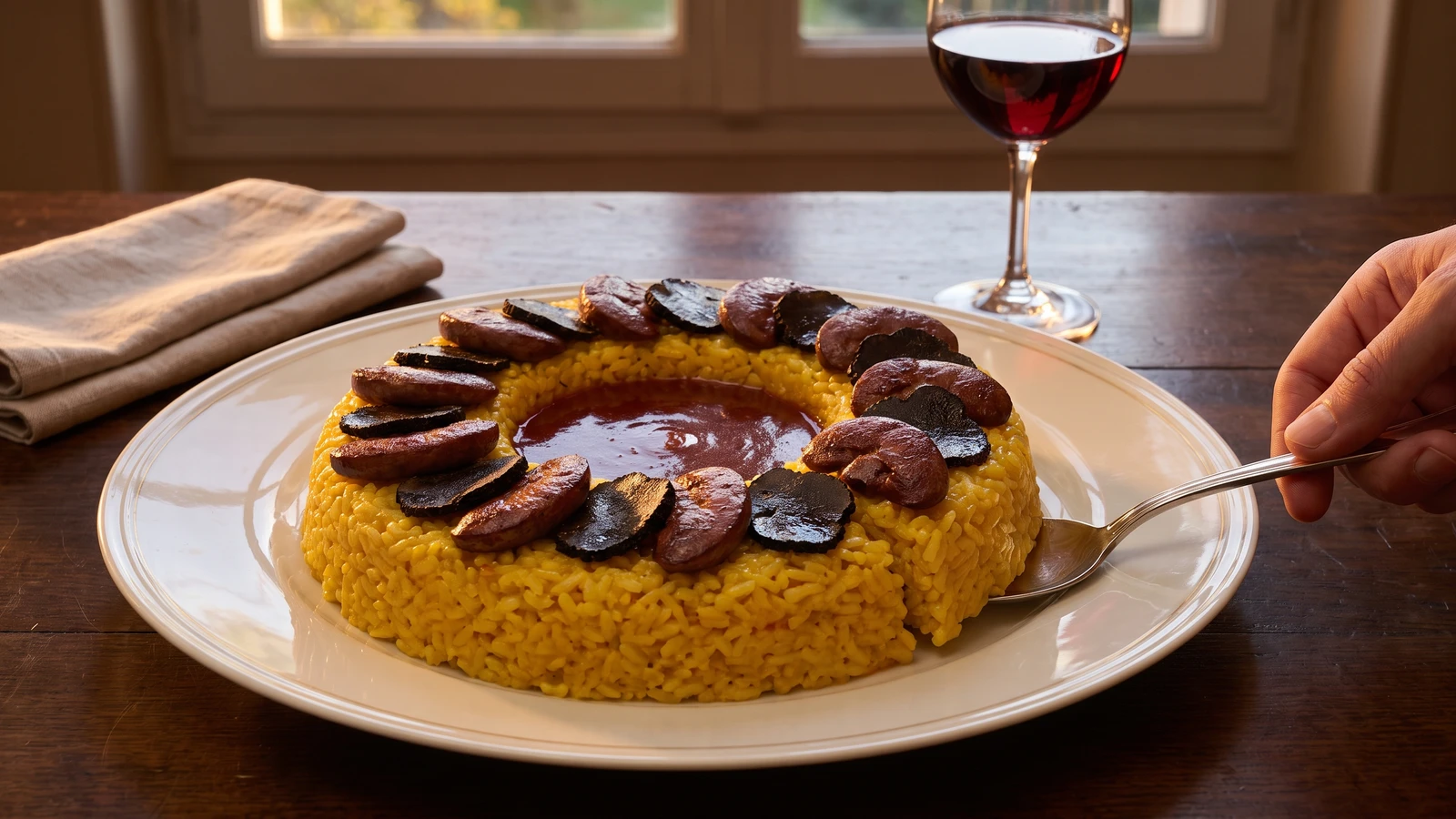
Based on No. 1339, Turban de Rognons à la Piémontaise, from Le Guide Culinaire (1907) by Auguste Escoffier
A saffron risotto crown carries butter-seared kidneys and black truffle beneath a glossy tomatéd half-glaze, a grand-kitchen composition made practical through timing, one hot mould, and one decisive pan.
Turban de Rognons à la Piémontaise (a saffron-risotto crown with butter-seared kidneys, black truffle, and tomatéd half-glaze) teaches orchestration. The one true thing to know before touching a pan is that kidneys will not wait: the sauce must be finished and the rice hot in its mould before they meet the butter. Get that order right and the grand shape becomes calm work.
The original assumed a saucier on staff, a stock never off the fire, and a hot cupboard beside the salamander to hold the Savarin-mould. Nothing in this dish is gratinéed, so the salamander itself has no work here. At home, a wide saucepan makes the half-glaze, a low oven replaces the hot cupboard, and a smooth 6-cup ring replaces the brigade border mould. One cook, one stove, one evening.
The separate sauce station and large service portions were scaffolding, and they can go. The saffron rizotto à la Piémontaise, the quick butter fry, the alternating truffle, and the tomatéd half-glaze are the dish, and they stay. The source's word, Tomatéd, means the tomato purée must be plainly perceptible in both shade and flavour; it does not mean turning the half-glaze into tomato sauce. For four servings, a single reduction from gelatin-rich veal stock supplies the required body without maintaining several brigade sauce pots.
The source calls for mutton kidneys. Use them when your butcher can provide them; the same weight of smaller lamb kidneys is the honest modern equivalent, milder and quicker to cook. A preserved black truffle supplies both the fine slices and its own juice in place of bottled truffle essence. Equipment and availability have changed, but the deciding step hasn't: sear the kidneys last, in real butter, fast enough to bronze them before they toughen.
Turban de rognons à la piémontaise belongs to the Parisian grand-kitchen table, where a turban was an even crown of rice or another garnish turned from a Savarin-mould and used to organize meat and sauce on one platter. Piémontaise describes the saffron-and-Parmesan rice garnish through which French cooks adopted northern Italian rice practice; it does not mean the kidney dish began in Piedmont. The alternating truffle and tomatéd half-glaze place the finished composition firmly within the French sauce canon, where offal could occupy the center of formal service without disguise.
Quantity
4 medium mutton kidneys or 8 small lamb kidneys (about 1 lb / 450 g total)
outer membranes removed, halved lengthwise, and white cores trimmed
Quantity
7 tablespoons (105 ml / 99 g)
divided
Quantity
3 tablespoons (45 ml / 42 g)
Quantity
1½ cups (360 ml / 300 g)
Quantity
½ cup (120 ml / 75 g)
very finely diced
Quantity
3½ cups (840 ml / 840 g)
for the rizotto
Quantity
½ teaspoon (2.5 ml / 0.15 g)
Quantity
¾ cup (180 ml / 75 g)
finely grated
Quantity
4 cups (960 ml / 960 g)
for the half-glaze
Quantity
3 tablespoons (45 ml / 50 g)
Quantity
1 (about 0.9 oz / 25 g), with 1 tablespoon (15 ml / 15 g) of its juice reserved
thinly sliced
Quantity
2 teaspoons (10 ml / 12 g)
divided
Quantity
¾ teaspoon (3.75 ml / 1.5 g)
divided
| Ingredient | Quantity |
|---|---|
| mutton kidneys or small lamb kidneysouter membranes removed, halved lengthwise, and white cores trimmed | 4 medium mutton kidneys or 8 small lamb kidneys (about 1 lb / 450 g total) |
| unsalted butterdivided | 7 tablespoons (105 ml / 99 g) |
| clarified butter | 3 tablespoons (45 ml / 42 g) |
| Carnaroli or Arborio rice | 1½ cups (360 ml / 300 g) |
| yellow onionvery finely diced | ½ cup (120 ml / 75 g) |
| unsalted light veal or chicken stockfor the rizotto | 3½ cups (840 ml / 840 g) |
| saffron threads | ½ teaspoon (2.5 ml / 0.15 g) |
| Parmigiano-Reggianofinely grated | ¾ cup (180 ml / 75 g) |
| gelatin-rich unsalted brown veal stockfor the half-glaze | 4 cups (960 ml / 960 g) |
| double-concentrated tomato purée | 3 tablespoons (45 ml / 50 g) |
| preserved black trufflethinly sliced | 1 (about 0.9 oz / 25 g), with 1 tablespoon (15 ml / 15 g) of its juice reserved |
| fine sea saltdivided | 2 teaspoons (10 ml / 12 g) |
| freshly ground black pepperdivided | ¾ teaspoon (3.75 ml / 1.5 g) |
Pull every trace of outer membrane from the kidneys, split them lengthwise, and cut away the hard white cores without gouging out the surrounding flesh. Pat the halves completely dry and keep them covered in the cold. Slice the truffle as finely as your knife allows and reserve 1 tablespoon (15 ml / 15 g) of its juice separately. Keep both cold until the final minutes.
Reserve ½ cup (120 ml / 120 g) of the brown veal stock. Whisk the remaining stock with the tomato purée in a wide saucepan and bring it to a lively simmer. Reduce uncovered for 35 to 45 minutes, skimming when needed, until about 1¼ cups (300 ml / 300 g) remain and the sauce coats the back of a spoon in a glossy film. The tomato must be clearly present but still supported by veal stock; that is tomatéd. If the reduction becomes too tight, loosen it with the reserved stock. Hold it off the heat without adding salt, truffle juice, or butter yet.
Warm the light stock and saffron together until the liquid turns a deep butter gold, then hold it just below a simmer. Melt 2 tablespoons (30 ml / 28 g) of the unsalted butter in a heavy saucepan, add the onion, and cook gently until soft and translucent without browning. Stir in the rice and cook for 2 minutes, turning every grain through the butter until its edges look translucent. Add the saffron stock about 1 cup (240 ml / 240 g) at a time, stirring often and waiting until each addition is nearly absorbed before adding the next. Hold back the final ½ cup (120 ml / 120 g) until you know the rice needs it.
After 17 to 20 minutes, the rice should be tender with a small firm point at its center and thick enough to mound rather than flow. Remove it from the heat and beat in 3 tablespoons (45 ml / 42 g) of unsalted butter and the Parmigiano-Reggiano, then season from the measured salt and pepper. This rizotto must be firmer than one served in a bowl because it has a shape to hold. If it is loose, return it to gentle heat for a minute or two, stirring until it gathers around the spoon; if it is too stiff, fold in the reserved hot stock one tablespoon at a time.
Heat the oven to 200°F (95°C). Brush the Savarin-mould thoroughly with 1 tablespoon (15 ml / 14 g) of softened unsalted butter, paying attention to the inner ring. Spoon in the hot rizotto and press it lightly, just firmly enough to remove gaps without crushing the grains. Cover loosely with buttered parchment or foil and hold it in the low oven for no more than 15 minutes. This is the home equivalent of the hot cupboard, and it gives you time to finish the sauce and kidneys without letting the crown cool.
Return the half-glaze to gentle heat. Stir in the reserved truffle juice, the home equivalent of the source's truffle essence, and let it warm for 1 minute without a hard boil. Remove the pan from the heat and whisk in the final 1 tablespoon (15 ml / 14 g) of unsalted butter until the sauce gleams, then season carefully from the measured salt and pepper. If the butter separates into an oily rim, take the pan fully off the heat and whisk in a teaspoon of cold stock or water. Ça se rattrape.
Warm a large heavy skillet over high heat until properly hot, then add half the clarified butter. Season the kidney halves immediately before cooking and lay them cut-side down in one uncrowded layer, working in two batches when using smaller lamb kidneys. Fry quickly until the cut faces are deep bronze, about 2 minutes, then turn and cook the rounded sides for 1 to 2 minutes more, adding the remaining clarified butter for the second batch. The kidneys should be just firm and cooked through, reaching 160°F (71°C) at the thickest point. If they release liquid and the pan begins to boil, lift them out, tip away the liquid, reheat the pan until the butter sizzles, and return them briefly to brown. They can still be saved, but they cannot be left to simmer.
Warm a round serving platter with hot water and dry it well. Invert the platter over the Savarin-mould, turn both together, wait 15 seconds, and lift the mould straight up. If the rice clings, wrap the outside of the mould with a hot damp towel for 20 seconds and try again. If the crown cracks, press the seam together with a warmed spoon; the kidneys and truffle will cover the repair. Arrange the kidney halves in a circle on the turban, alternating each with a fine slice of truffle exactly as the source directs. Pour the glossy tomatéd half-glaze into the center and serve at once. À table!
1 serving (about 470g)
Culinary guides, cultural storytelling, and the editorial depth that makes cooking meaningful.
Discover Culinary ExplorerChef Juliette
John Dory has the delicacy of sole and the firmness of turbot. A light flouring, a quick butter sauté, and nut-brown beurre noisette show exactly why looks never mattered.

Chef Juliette
Fresh haddock proves its delicacy in the meunière pan: a fine flour crust, moist pearly flakes, and beurre noisette sharpened with lemon and parsley, ready from one skillet in half an hour.

Chef Juliette
Éperlans à l’Anglaise turns small fish into a lesson in disciplined coating: boned smelts under a close, crisp crumb, pan-fried in clarified butter and finished with bright, half-melted maître d’hôtel butter.

Chef Juliette
Tiny smelts, shallot, mushrooms, white wine, gratin sauce, and fine bread raspings meet a fierce oven, where the fish must turn tender in the same breath the buttered crust bronzes.