Culinary Explorer

A cooking platform built around craft, culture, and the stories behind what we eat.
Discover Culinary Explorer
Pieds de Mouton Poulette

Pieds de Mouton Poulette

Created by Chef Juliette

Based on No. 1326, Pieds de Mouton Poulette, from Le Guide Culinaire (1907) by Auguste Escoffier

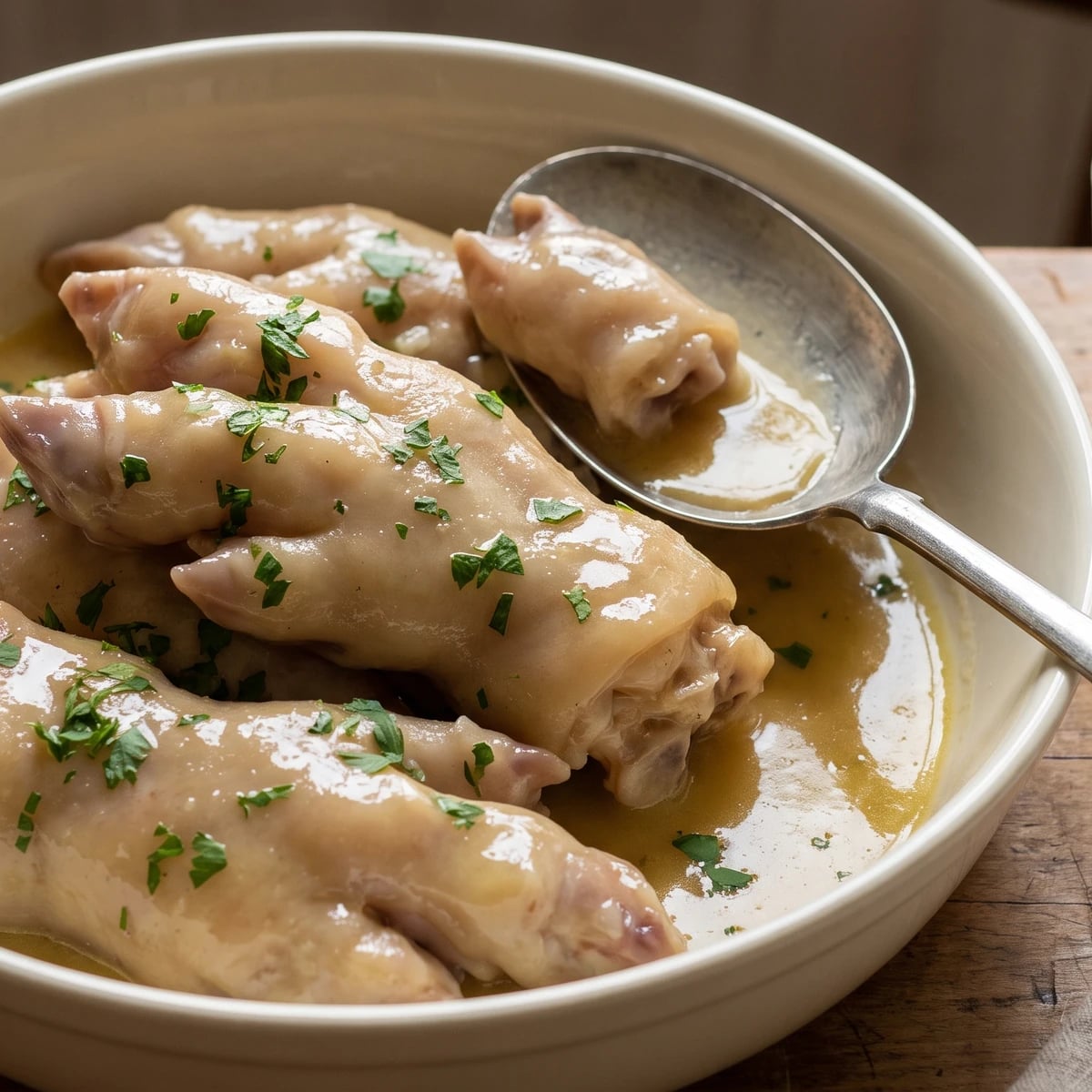
Freshly simmered lamb trotters, drained hot and folded through Sauce Poulette, prove that a small velouté still demands full attention: temper the yolk, keep it below a boil, and serve at once.

Main Dishes
French
Comfort Food
Weeknight
Budget Friendly
30 min
Active Time
3 hr 15 min cook3 hr 45 min total
Yield4 servings

Pieds de mouton poulette (sheep’s trotters in poulette sauce) teaches the discipline of the liaison, the egg-yolk-and-cream finish that turns a velouté satin-soft without letting it boil. The one true thing to know before touching a pan is this: heat becomes gentle the instant the yolk enters. Hold the sauce below its first bubble and it will cling to every gelatinous fold of the freshly cooked trotters.

The source begins where a brigade pantry did, with twenty trotters already cooked, thoroughly drained, and a finished pan of Sauce Poulette waiting in the hands of a saucier. For four people, eight small trotters keep the same proportion, while the original two-thirds pint of sauce becomes about two-thirds cup, enough to coat rather than drown them. A small pale roux and good unsalted chicken stock replace the stockpot that never left the fire. One cook, one stove, one evening.

The separate cooking and sauce stations were brigade scaffolding, so they can go. Fresh cooking, patient drainage, and the liaison are the dish itself, and all three stay. The decisive moment comes after tempering: stir the sauce over the lowest heat until it coats the spoon, then pull it before the first bubble appears.

Pieds de mouton à la poulette belong to Parisian cuisine bourgeoise and the tripier’s trade, where specialists handled the singeing and scraping while household and traiteur kitchens supplied the final sauce. From that practical division of labor, the dish entered the codified grand repertoire without losing its thrifty table origins. Despite the name, poulette does not promise chicken meat; it identifies the pale velouté finished with yolk, lemon, butter, and parsley, a sauce long paired with offal and vegetables.

The technique, the tradition, and the story behind every dish.

Discover Culinary Explorer

Ingredients

cleaned lamb or mutton trotters

Quantity

8 small (about 4¾ lb / 2.2 kg)

singed, scraped, and split lengthwise by the butcher

cold water

Quantity

4 quarts (3.8 L / 3.8 kg), plus more for blanching

all-purpose flour

Quantity

¼ cup (60 ml / 30 g)

for the blanc

white wine vinegar

Quantity

½ cup (120 ml / 120 g)

yellow onion

Quantity

1 medium (about 6 oz / 170 g)

peeled and quartered

carrot

Quantity

1 medium (about 4 oz / 115 g)

scrubbed and roughly chopped

bouquet garni of parsley stems, thyme, and bay leaf

Quantity

1

fine sea salt

Quantity

1 tablespoon plus ¼ teaspoon (16 ml / 20 g), plus more to taste

divided

unsalted butter

Quantity

4 teaspoons (20 ml / 19 g)

divided

all-purpose flour

Quantity

2 teaspoons (10 ml / 5 g)

for the roux

light unsalted chicken stock

Quantity

½ cup plus up to 2 tablespoons (150 ml / 150 g)

divided

large egg yolk

Quantity

1

additional large egg yolk (optional)

Quantity

1

reserved only if needed to rescue a curdled sauce

heavy cream

Quantity

3 tablespoons (45 ml / 45 g)

divided, with 1 tablespoon reserved for rescue if needed

fresh lemon juice

Quantity

2 teaspoons (10 ml / 10 g)

flat-leaf parsley

Quantity

2 tablespoons (30 ml / 8 g)

finely chopped

ground white pepper

Quantity

⅛ teaspoon (0.6 ml / 0.3 g)

Equipment Needed

  • 8-quart heavy stockpot
  • Parchment paper for a cartouche
  • Wide colander or draining rack
  • 1-quart heavy saucepan
  • Fine-mesh sieve
  • Wide sauté pan
  • Instant-read thermometer
  • 2-quart deep serving bowl or timbale

Instructions

  1. 1

    Blanch the trotters

    Inspect the trotters closely and remove any stray hairs with clean tweezers. Put them in the stockpot, cover generously with cold water, and bring to a boil. Boil for 5 minutes, then drain and rinse the trotters under cold running water, rubbing away every trace of grey scum. Wash the pot before continuing. This first blanch cleans the flavor and gives the finished sauce a pale, clear foundation.

    The butcher should do the singeing, scraping, and splitting. If the feet arrive woolly, scorched, or carrying the hoof casing, hand them back; those jobs require equipment a home kitchen needn’t imitate.
  2. 2

    Cook in a blanc

    Whisk the ¼ cup flour with the vinegar and about 1 cup of the cold water until completely smooth. Pour this into the clean pot, add the remaining measured water, onion, carrot, bouquet garni, and 1 tablespoon salt, then lower in the blanched trotters. This blanc, an acidulated and lightly floured cooking liquor, keeps the flesh pale while the long simmer softens its collagen. Bring it only to a bare tremble, skim during the first 20 minutes, and press a round of parchment onto the surface to keep the trotters submerged. Cook for 2½ to 3 hours, adding boiling water if needed, until a skewer passes through the thick heel without resistance and the joints bend freely. A hard boil knocks the feet apart before their connective tissue has turned tender, so patience, not violence.

  3. 3

    Drain them thoroughly

    Lift the trotters carefully into a wide colander and let them drain in a single layer for at least 10 minutes. Blot any pockets of cooking liquor with a clean towel while keeping the pieces warm. Do not rinse them. The source’s instruction to use freshly cooked, well-drained trotters is load-bearing: cold feet seize the sauce, and wet ones dilute its small, exact quantity.

  4. 4

    Build the velouté

    Melt 2 teaspoons of the butter in a small heavy saucepan over medium-low heat. Stir in the 2 teaspoons flour and cook for 2 minutes without allowing it to color; this pale roux must lose its raw flour smell while staying ivory. Whisk in ½ cup chicken stock a little at a time, making each addition smooth before adding the next. Simmer gently for 6 to 8 minutes, whisking often, until the velouté, stock thickened with pale roux, lightly naps the back of a spoon. If it lumps, pass it through a fine sieve and continue. Ça se rattrape.

  5. 5

    Temper the liaison

    Whisk the required egg yolk with 2 tablespoons of the cream in a heatproof bowl. Add the hot velouté one spoonful at a time while whisking, then pour the liaison back into the saucepan. Stir continuously over the lowest heat until the sauce becomes glossy and coats the spoon more fully, reaching about 170 to 175°F (77 to 80°C), then remove it before a bubble appears. Whisk in the lemon juice, remaining 2 teaspoons butter, white pepper, ¼ teaspoon salt, and half the parsley. You should have about ⅔ cup (160 ml) of Sauce Poulette; loosen it with reserved stock only if it no longer flows from the spoon. If tiny grains appear, lift the pan off the heat, whisk in the reserved cold cream, and strain. If it actually boils and curdles, strain it, whisk the optional yolk with that cold cream, temper it with the strained sauce, and thicken again over gentler heat. Ça se rattrape.

  6. 6

    Toss and serve

    Set the warm, well-drained trotters in a wide sauté pan over the lowest heat and pour over the Sauce Poulette. Shake and turn them gently for 1 to 2 minutes, just until every piece wears a glossy coating; keep the sauce below a simmer because the yolk remains delicate. Transfer everything to a warmed timbale or deep round serving bowl, spoon over the sauce left in the pan, and scatter with the remaining parsley. Serve immediately. À table!

Chef Tips

  • Order the trotters in advance and ask specifically for lamb or mutton feet that are cleaned, singed, scraped, and split lengthwise. Frozen trotters are an honest choice when properly prepared fresh ones aren’t available; thaw them completely in the refrigerator before blanching.
  • The sauce quantity is deliberately restrained. Eight trotters receive about ⅔ cup, preserving the source’s proportion of twenty trotters to ⅔ pint. Drain them with conviction, because there isn’t spare sauce to absorb cooking water.
  • Use unsalted chicken stock with a clean, light flavor. A dark roasted stock muddies the ivory Sauce Poulette, while a salty carton becomes harsh as the velouté cooks down.
  • Pour a brisk dry white, such as Bourgogne Aligoté or Muscadet. Its acidity meets the gelatin and butter cleanly, while the parsley and lemon keep the plate lively.
  • Refrigerate leftovers within 2 hours and use them within 2 days. Reheat over very low heat with a spoonful of stock, stirring gently and never allowing the yolk-finished sauce to boil.

Advance Preparation

  • The trotters are best cooked and sauced in one session, exactly as the source advises. If the schedule forces a pause, cook them one day ahead, cool them quickly in strained cooking liquor, refrigerate, then reheat at a bare simmer and drain thoroughly before making the sauce.
  • The pale roux and stock base can be cooked up to 4 hours ahead. Press parchment directly against its surface and refrigerate; reheat gently, then add the liaison, lemon, butter, and parsley only when the trotters are ready.

Frequently Asked Questions

Nutrition Information

1 serving (about 250g)

Calories
470 calories
Total Fat
29 g
Saturated Fat
12 g
Trans Fat
1 g
Unsaturated Fat
13 g
Cholesterol
250 mg
Sodium
530 mg
Total Carbohydrates
2 g
Dietary Fiber
0 g
Sugars
1 g
Protein
50 g

Note: Chef personas and recipes are created with AI assistance. Cook with care: follow safe food-handling practices, check doneness with a thermometer when needed, and adapt for allergies and your kitchen.

Where cooking meets culture.

Culinary guides, cultural storytelling, and the editorial depth that makes cooking meaningful.

Discover Culinary Explorer

More from Relevés and Entrées - MUTTON, GRASS LAMB AND HOUSE LAMB

Browse the full collection