Culinary Explorer

A cooking platform built around craft, culture, and the stories behind what we eat.
Discover Culinary Explorer
Sheep’s Trotters

Sheep’s Trotters

Created by Chef Juliette

Based on No. 1324, Sheep’s Trotters, from Le Guide Culinaire (1907) by Auguste Escoffier

Pieds de mouton au blanc teach the quiet power of a protected poach: properly prepared trotters, held beneath a flour-and-lemon blanc until pale, supple, and rich with their own gelatin.

Main Dishes
French
Comfort Food
Budget Friendly
Weeknight
20 min
Active Time
3 hr cook3 hr 20 min total
Yield4 servings

Pieds de mouton au blanc (sheep's trotters poached in a flour-and-lemon liquor) teach one quiet principle: the cooking medium protects as surely as it tenderizes. The blanc is not a sauce, and its flour is not there to make gravy. Suspended in acidulated water, it guards the trotters' pale colour while patient heat turns their collagen supple.

A saucier, a stock never off the fire, and a salamander are not what the original entry assumed. Its brigade assumption was a purveyor delivering rough feet, a trained hand to singe them over spirits, remove the hoof cases, split and bone them, and a five-quart batch of cooking liquor ready for the service pot. At home, a tripier (offal butcher) does the dangerous knife work, a culinary torch replaces the open spirit flame for stray bristles, and twelve feet poach in three quarts of Special Court-bouillon, or Blanc (No. 167). The equipment and scale changed because they are scaffolding. The blanc, continuous stirring before the boil, and complete submersion stay because they are the dish. One cook, one stove, one evening.

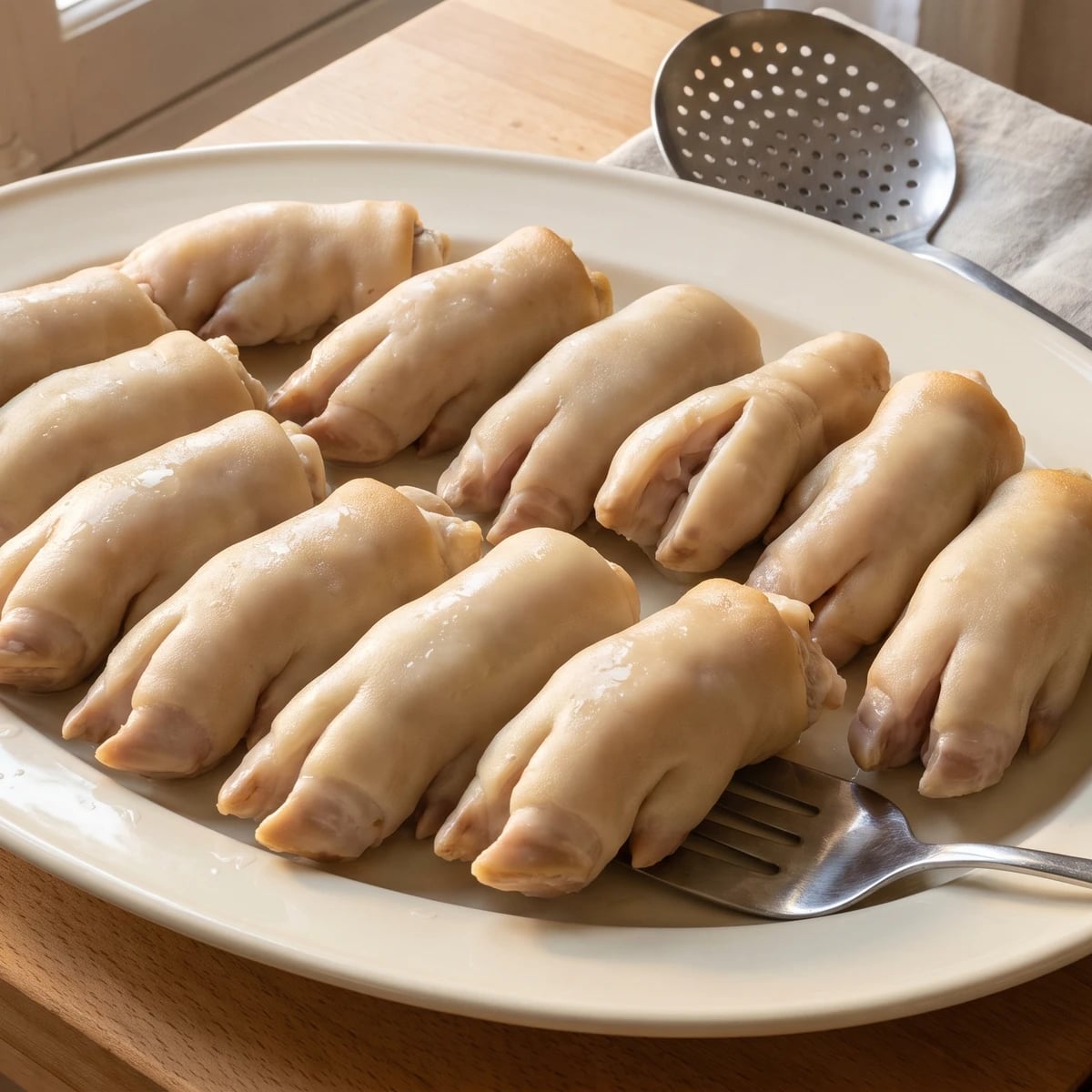
The reward is pale, softly gleaming meat with the tender resilience of properly cooked gelatin, modest food handled with complete attention. Before you touch the heat, remember the step that decides everything: keep the flour evenly suspended as the blanc reaches the boil, then keep every trotter beneath it.

Pieds de mouton au blanc belong to the Parisian tripier trade and the national classical kitchen, where cooks valued sheep's feet not for abundant meat but for the gelatin held in skin, tendon, and joint. The blanc carried a market technique into codified kitchen practice: unlike a fish court-bouillon, it uses flour and acid to protect pale offal and certain vegetables from darkening while they cook. The flour does not make a serving sauce; the blanc is protective cooking liquor, drained away once its work is done.

The technique, the tradition, and the story behind every dish.

Discover Culinary Explorer

Ingredients

prepared sheep's trotters

Quantity

12 (about 4 lb / 1.8 kg)

singed, hoof cases and cleft tufts removed, split lengthwise and boned

Special Court-bouillon, or Blanc

Quantity

3 qt (2.84 L / about 2.9 kg) Special Court-bouillon, or Blanc (No. 167)

Equipment Needed

  • 5 to 6 qt (4.7 to 5.7 L) narrow, heavy saucepan with lid
  • Fine-mesh strainer and balloon whisk
  • Kitchen parchment cut into a cartouche
  • Wide metal skimmer
  • Culinary torch and metal tweezers, only for missed bristles

Instructions

  1. 1

    Prepare the trotters safely

    Begin with trotters already split and boned by a tripier or experienced butcher. Inspect every cleft for a missed tuft and every fold for stray bristles. Pull any tuft with metal tweezers; if bristles remain, pass a culinary torch quickly over the dry skin, well away from anything flammable, then rub the surface firmly with clean lint-free linen. Never use an open dish of spirits at home. If the butcher cannot remove the hoof cases and bones, don't improvise with a cleaver: the small, slippery joints demand trained knife work, and this preparation specifically calls for boned trotters.

  2. 2

    Bring up the blanc

    Pour the Special Court-bouillon, or Blanc (No. 167) into a narrow 5 to 6 quart heavy pot. Set it over medium heat and stir continuously with a whisk, reaching across the entire bottom, until the liquor comes to a full boil. The flour must remain suspended or the protection becomes patchy. If you find paste on the pot floor or see lumps forming, take the pot off the heat immediately, whisk hard, pass the blanc through a fine-mesh strainer, and return it to the heat. Ça se rattrape.

    Use a narrow pot rather than a broad cocotte. The same quantity of blanc rises higher, so the trotters stay covered without diluting the book's proportions.
  3. 3

    Immerse the trotters

    As soon as the blanc boils, lower in the trotters one at a time. Stir gently between additions so the flour cannot settle beneath the packed feet, then let the liquor return just to the boil. Reduce the heat immediately to the barest tremble. Lay a parchment cartouche directly against the surface and, if the trotters still float, hold it down with a small heatproof plate. Exposed skin darkens, so complete submersion is part of the technique, not decoration.

  4. 4

    Poach until supple

    Cover the pot slightly ajar and poach for 2½ to 3 hours, checking every 30 minutes that the liquid only trembles and the parchment remains wet. The trotters are ready when their joints flex freely and a thin skewer passes through the thickest fold of skin and tendon with almost no resistance. If they remain firm, continue in 20-minute intervals. If the liquid boils hard and the skins begin to split, lower the heat at once and leave the pieces undisturbed until the liquor settles; partially softened trotters tear most easily when handled.

    Tenderness, not the clock, decides the finish. A trotter that still resists the skewer needs more gentle cooking, however long it has already spent in the pot.
  5. 5

    Drain and serve

    Lift the trotters with a wide skimmer, supporting each one from beneath, and let them drain for 5 minutes. Do not rinse them; rinsing removes their delicate gelatinous sheen. Arrange three per person on a warmed platter and serve immediately. Discard the blanc rather than reducing it, because it was built to protect the trotters, not to become their sauce. The source preparation stops here, so breading, grilling, or adding another sauce would make a different entry. À table!

Chef Tips

  • Order from a tripier or butcher who understands the full request: singed, hoof cases removed, cleft tufts removed, split lengthwise, and boned. Confirm every point before cooking day; a merely cleaned, bone-in foot is not the preparation specified here.
  • The flour in the blanc is a protective suspension, not a roux. Stir continuously as it heats, keep the trotters submerged, and never reduce the used liquor into a sauce.
  • Once the pot settles to a bare tremble, the cooking is quiet. Check it every half hour, but don't keep lifting the parchment or prodding the skins; patient heat does the work.
  • A brisk, dry white wine suits the trotters' gelatinous richness. Keep the glass simple and cold, because the dish itself is deliberately spare.

Advance Preparation

  • Arrange the butcher's preparation in advance. The hoof removal, splitting, and boning are specialist work and should be finished before the trotters reach your cutting board.
  • The Special Court-bouillon, or Blanc (No. 167) may be prepared earlier the same day according to its own entry. Whisk it thoroughly as it returns to the boil.
  • The trotters may be poached one day ahead. Cool them submerged in strained blanc, transfer them promptly to the refrigerator, and reheat them gently in the same liquor for 15 to 20 minutes. Use within 2 days.

Frequently Asked Questions

Nutrition Information

1 serving (about 200g)

Calories
420 calories
Total Fat
25 g
Saturated Fat
10 g
Trans Fat
1 g
Unsaturated Fat
14 g
Cholesterol
190 mg
Sodium
700 mg
Total Carbohydrates
2 g
Dietary Fiber
0 g
Sugars
0 g
Protein
46 g

Note: Chef personas and recipes are created with AI assistance. Cook with care: follow safe food-handling practices, check doneness with a thermometer when needed, and adapt for allergies and your kitchen.

Where cooking meets culture.

Culinary guides, cultural storytelling, and the editorial depth that makes cooking meaningful.

Discover Culinary Explorer

More from Relevés and Entrées - MUTTON, GRASS LAMB AND HOUSE LAMB

Browse the full collection