
Chef Juliette
John Dory (St. Pierre)
John Dory has the delicacy of sole and the firmness of turbot. A light flouring, a quick butter sauté, and nut-brown beurre noisette show exactly why looks never mattered.
A cooking platform built around craft, culture, and the stories behind what we eat.
Created by Chef Juliette
Based on No. 1265, Rognon de Veau en Casserole, from Le Guide Culinaire (1907) by Auguste Escoffier
Whole veal kidneys, trimmed to a veil of fat, turned patiently in butter and finished with veal gravy: cocotte cooking at its clearest, gentle heat doing all the work.
Rognon de Veau en Casserole (whole veal kidney gently cooked in a cocotte) teaches one discipline above all: tenderness comes from low, patient heat, not speed. Keep the butter pale and turn the kidney often. Fierce sizzling tightens the lobes before the center cooks, while a quiet pan lets the thin coat of fat protect them.
The original entry assumed a saucier on staff, a stockpot never off the fire, and a small flameproof earthenware cocotte. Those are brigade scaffolding, not the dish. At home, a 9-inch enameled cast-iron cocotte gives the same steady heat, and good prepared veal gravy, or low-salt veal demi-glace diluted to pouring consistency, stands honestly for the ready veal jus. The entry is already proportioned per kidney, so two kidneys share the home cocotte for four, with its butter and gravy doubled in the original ratio. One cook, one stove, one evening.
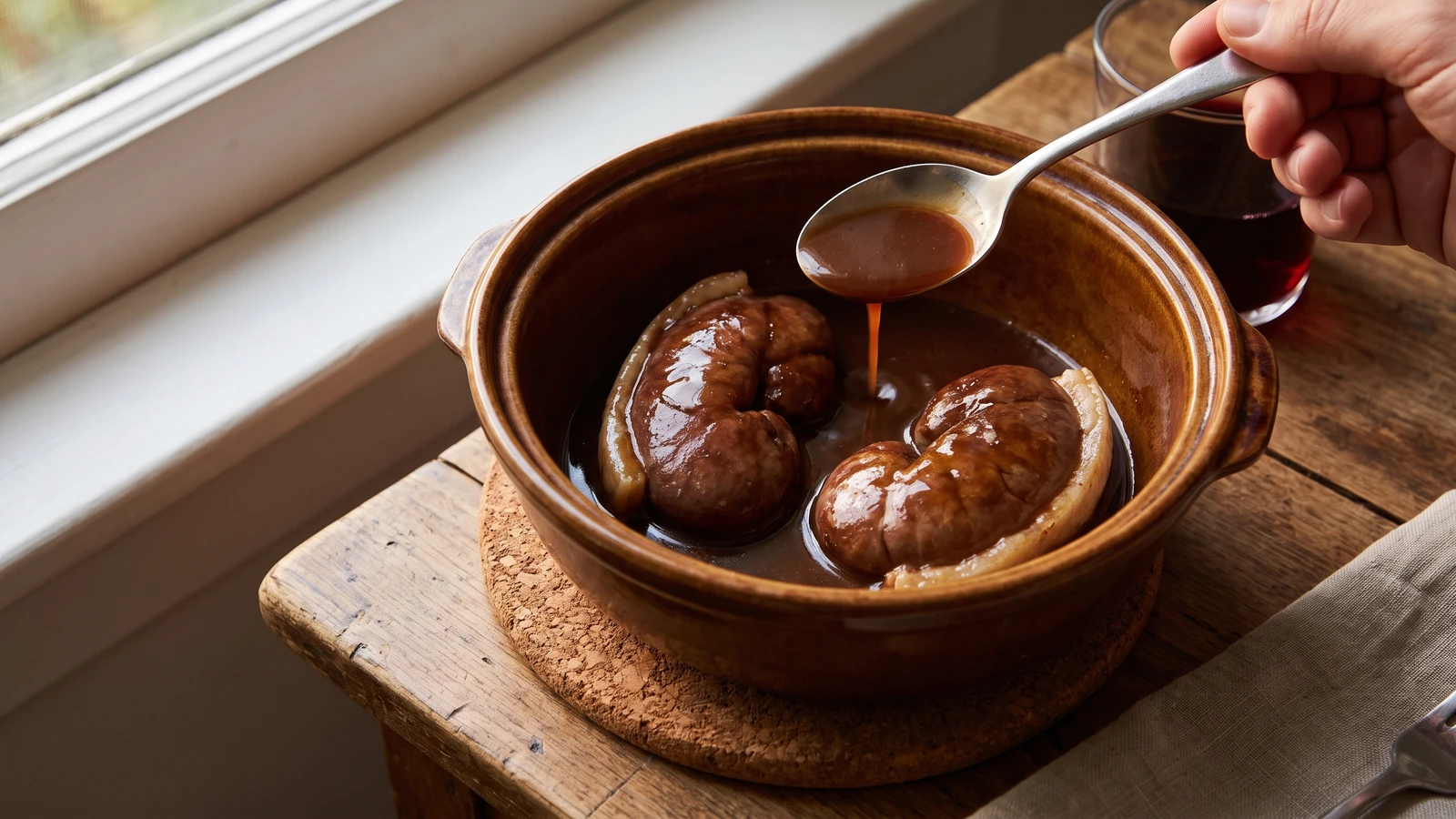
The kidneys arrive deep chestnut and butter-glossed, with just enough mahogany gravy to pool beneath them. What stays is the gentle thirty-minute cooking, frequent turning, and last-minute basting. Once the kidneys are trimmed to their thin veil of fat, the step that matters is heat: the butter must foam quietly and never scorch.
Rognon de veau en casserole belongs to the cuisine bourgeoise of Paris and the broader French household table, where tender calf's offal was cooked whole and carried directly to the table in its own cocotte. Classical kitchens adopted that domestic method and supported it with veal jus from the standing stockpot, but the preparation never required mustard, wine, or mushrooms. Here, en casserole names the vessel and its gentle turning method, not a long stew under liquid.
Quantity
2 whole (about 1½ pounds / 680 g total)
trimmed but left whole with a thin coat of exterior fat
Quantity
¾ teaspoon (3.75 ml / 4.5 g)
Quantity
½ teaspoon (2.5 ml / 1 g)
Quantity
4 tablespoons (60 ml / 56 g)
Quantity
2 tablespoons (30 ml / 30 g)
warmed; low-salt veal demi-glace diluted to this final amount is the home equivalent
Quantity
1 to 2 teaspoons (5 to 10 ml / 5 to 10 g)
for loosening the gravy if necessary
| Ingredient | Quantity |
|---|---|
| whole veal kidneystrimmed but left whole with a thin coat of exterior fat | 2 whole (about 1½ pounds / 680 g total) |
| fine sea salt | ¾ teaspoon (3.75 ml / 4.5 g) |
| freshly ground black pepper | ½ teaspoon (2.5 ml / 1 g) |
| unsalted butter | 4 tablespoons (60 ml / 56 g) |
| good prepared veal gravywarmed; low-salt veal demi-glace diluted to this final amount is the home equivalent | 2 tablespoons (30 ml / 30 g) |
| hot water (optional)for loosening the gravy if necessary | 1 to 2 teaspoons (5 to 10 ml / 5 to 10 g) |
Keep the kidneys cold while you work. Pull away the papery outer membrane and trim off hard knobs of fat, visible vessels, and the projecting ureter, but leave an even coat of exterior fat about ⅛ inch (3 mm) thick. Keep each kidney whole; splitting or butterflying it changes the cooking method. Pat the surfaces thoroughly dry, then season all over with the salt and pepper just before cooking. Clean the knife, board, and your hands before continuing.
Set a 9-inch (22 cm) cocotte over low heat for one minute. Add the butter and let it melt until it foams lightly while remaining butter-gold, with no brown flecks. Place the kidneys in the cocotte with a little room between them and turn each once to coat it. The butter should murmur, not crackle.
Cook the kidneys uncovered over very low heat for about 30 minutes, turning them carefully with tongs every 3 to 4 minutes so every lobe spends time against the warm cocotte. Keep the butter at a quiet foam throughout. If it begins browning rapidly, lift the cocotte off the burner for a minute, lower the heat, and continue turning. Ça se rattrape while the butter still smells nutty; a hard sizzle is your warning to act before it becomes bitter.
After 25 minutes, insert an instant-read thermometer into the thickest lobe without touching the firm central core. Continue gently until it reaches 160°F (71°C), usually close to the full 30 minutes; if it is not there, cook in 2-minute intervals and keep turning rather than raising the heat. At the last minute, arroser (baste) the kidneys with the warm veal gravy, turning them once so it coats their surfaces. If the gravy sits in a thick mound, loosen it with hot water one teaspoon at a time; if it is loose, let it bubble for no more than 30 seconds so it clings.
Carry the cocotte straight to the table as it stands and set it on a trivet. Spoon the butter and veal gravy over the kidneys, then cut each kidney in half across its lobes for four portions, leaving any dense white center behind. Serve immediately while the meat is supple and the gravy still gleams. À table!
1 serving (about 140g)
Culinary guides, cultural storytelling, and the editorial depth that makes cooking meaningful.
Discover Culinary ExplorerChef Juliette
John Dory has the delicacy of sole and the firmness of turbot. A light flouring, a quick butter sauté, and nut-brown beurre noisette show exactly why looks never mattered.

Chef Juliette
Fresh haddock proves its delicacy in the meunière pan: a fine flour crust, moist pearly flakes, and beurre noisette sharpened with lemon and parsley, ready from one skillet in half an hour.

Chef Juliette
Éperlans à l’Anglaise turns small fish into a lesson in disciplined coating: boned smelts under a close, crisp crumb, pan-fried in clarified butter and finished with bright, half-melted maître d’hôtel butter.

Chef Juliette
Tiny smelts, shallot, mushrooms, white wine, gratin sauce, and fine bread raspings meet a fierce oven, where the fish must turn tender in the same breath the buttered crust bronzes.