Culinary Explorer

A cooking platform built around craft, culture, and the stories behind what we eat.
Discover Culinary Explorer
Côte de Veau Zingara

Côte de Veau Zingara

Created by Chef Juliette

Based on No. 1261, Côte de Veau Zingara, from Le Guide Culinaire (1907) by Auguste Escoffier

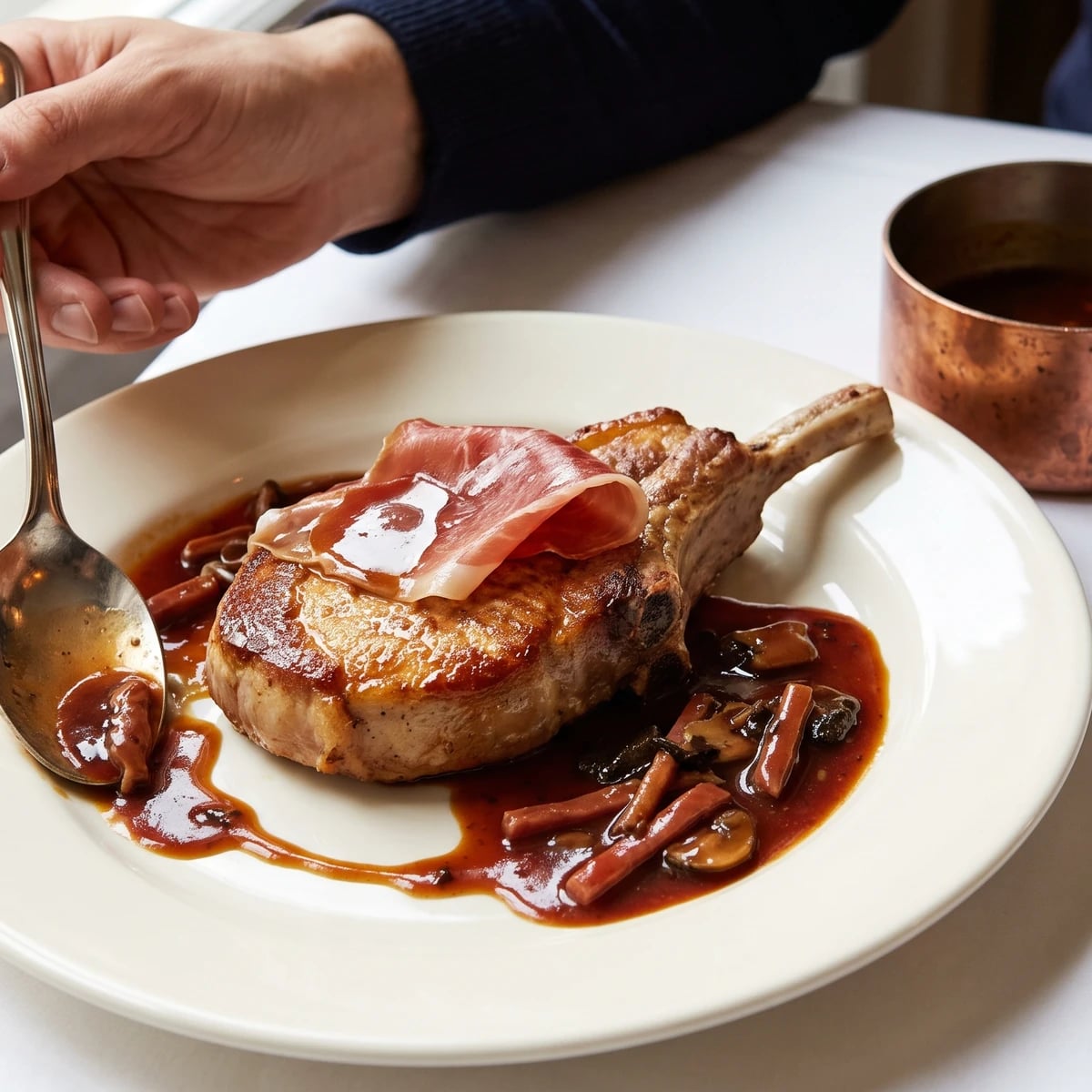
Côte de Veau Zingara sets a butter-browned veal chop beneath warm jambon cru, with sharp red-brown Zingara sauce pooling around it and a fine julienne of tongue, mushroom, and black truffle running through every spoonful.

Main Dishes
French
Dinner Party
Comfort Food
35 min
Active Time
35 min cook1 hr 10 min total
Yield4 servings

Côte de Veau Zingara (butter-cooked veal chop with ham and Zingara sauce) teaches the order of a composed pan dish: establish the sauce, cook the meat without bullying it, then bring both together at the last minute. The one true thing is this: the wine and mushroom liquor must reduce before the demi-glace enters. Skip that reduction and the sauce is watery and blunt; do it properly and the tomato turns the half-glaze sharp, red-brown, and alive.

The original entry assumed a saucier beside you, veal stock never off the fire, a ready demi-glace, and another pair of hands to toss the ham while the chop cooked. At home, a sound prepared veal demi-glace replaces the permanent sauce pot, and the book's "few tablespoonfuls" becomes three tablespoons each of wine and mushroom liquor, reduced to three tablespoons total so the instruction is measurable. The sauce formula already gives enough for four chops, so its proportions stay intact; only the chop and ham are repeated four times. Simultaneous pans are brigade scaffolding and can go. The preliminary reduction, butter-cooked veal, ham cut to its shape, and one-ounce julienne of tongue, mushroom, and truffle are the dish, so they stay. One cook, one stove, one evening.

When it lands, the chop is bronze at the edge, the ham supple, and the sauce gleams around rather than over them. Cut the julienne fine and keep the final boil to seconds, but before you touch the pan, remember the deciding step: reduce the wine and mushroom liquor cleanly by half.

Côte de Veau Zingara belongs to the Parisian classical dining-room repertoire, where a simply cooked chop became a composed dish through a prepared sauce and a precise garnish. In this formula, Zingara sauce is defined by tomato-tinted demi-glace and a fine julienne of cooked tongue, mushroom, and truffle, a combination that traveled from grand kitchens into bourgeois entertaining because the sauce could be prepared before the meat. Its name is an old European menu label, not evidence that the preparation belongs to Romani cooking, and the distinction matters.

The technique, the tradition, and the story behind every dish.

Discover Culinary Explorer

Ingredients

bone-in veal rib chops

Quantity

4 chops (about 1½ lb / 680 g total)

¾ to 1 inch thick

fine sea salt

Quantity

1 teaspoon (5 ml / 6 g)

freshly ground white pepper

Quantity

½ teaspoon (2.5 ml / 1 g)

unsalted butter

Quantity

8 tablespoons (120 ml / 113 g)

divided, with 2 tablespoons held in reserve

jambon cru (dry-cured ham)

Quantity

4 slices (about 4 oz / 115 g total)

thin but not paper-thin, trimmed to the shape of the chops

small white button mushrooms

Quantity

¾ cup (180 ml / 55 g)

wiped clean

water

Quantity

½ cup (120 ml / 120 g)

for the mushroom cooking liquor

dry white wine

Quantity

3 tablespoons (45 ml / 44 g)

prepared veal demi-glace (half-glaze)

Quantity

Scant ½ cup (115 ml / 120 g)

diluted to sauce consistency if purchased as a concentrate

smooth plain tomato sauce

Quantity

2 tablespoons (30 ml / 30 g)

veal stock

Quantity

1 tablespoon (15 ml / 15 g)

cooked veal or beef tongue

Quantity

1 tablespoon (15 ml / 7 g)

cut julienne

fresh or preserved black truffle

Quantity

1 tablespoon (15 ml / 7 g)

drained if preserved and cut julienne

Equipment Needed

  • 12-inch heavy skillet
  • 1-quart heavy saucepan
  • Fine-mesh strainer
  • 2-cup heatproof measuring jug
  • Instant-read thermometer
  • Sharp chef's knife

Instructions

  1. 1

    Make the mushroom liquor

    Put the mushrooms, water, 1 tablespoon of the butter, and a small pinch of the measured salt in a 1-quart saucepan. Cover, bring to a gentle simmer, and cook for 5 to 6 minutes, until the mushrooms are tender and the liquid smells distinctly of them. Strain without pressing. Measure 3 tablespoons (45 ml) of the cooking liquor for the sauce. Select 2 tablespoons (30 ml / 14 g) of the cooked mushrooms and cut them julienne, into slender matchstick rods about 1 inch long. Reserve the remaining mushrooms and liquor for another dish.

    Keep the tongue, mushroom, and truffle rods fine and reasonably even. Julienne means matchsticks, and here the cut is not decoration: it lets every spoonful of sauce carry all three garnishes.
  2. 2

    Build the Zingara sauce

    Combine the white wine and 3 tablespoons of mushroom cooking liquor in the clean saucepan. Boil briskly until the original 6 tablespoons have reduced to 3 tablespoons; pour the liquid into a heatproof measure once if your eye is uncertain. Add the demi-glace, tomato sauce, veal stock, 2 tablespoons of mushroom julienne, and all the tongue and truffle julienne. Bring the sauce to a full boil for only 10 to 15 seconds, then take it off the heat. It should be nappant, coating the back of a spoon while still flowing freely. If it remains loose like broth, strain out the julienne, reduce the liquid alone, and return the garnish. If it tightens into a paste, loosen it teaspoon by teaspoon with the remaining mushroom liquor. Ça se rattrape. Cover and hold off the heat.

    Taste only after reducing. Demi-glace can carry plenty of salt, and seasoning before the sauce concentrates is an excellent way to oversalt it.
  3. 3

    Shape ham and season

    Trim each slice of jambon cru into the same oval as the meaty part of its chop, leaving the bone uncovered. Pat the veal completely dry, then season both sides with the remaining salt and white pepper. Warm a serving platter or four plates with hot water and dry them thoroughly. Set the sauce, ham, and veal beside the stove before cooking begins, because the finish moves quickly.

  4. 4

    Cook the veal

    Heat a heavy 12-inch skillet over medium-high heat and add 2 tablespoons of butter. When the foam subsides and the butter smells nutty but has not gone dark, lay in two chops without crowding. Leave them undisturbed for 4 to 5 minutes, until the first side is deeply butter-gold. Turn, lower the heat to medium, and baste repeatedly with the foaming butter for another 3 to 5 minutes. Check the thickest part without touching the bone; the centre must reach 145°F (63°C). Transfer the chops to the warm platter, cover loosely, and repeat with 2 more tablespoons of butter and the remaining chops. If the butter turns black or smells acrid, lift out the meat, wipe the skillet carefully, and begin again with some of the reserved butter. Burned butter cannot be negotiated with.

    A dry chop browns; a wet one steams. Pat the surface again just before it meets the butter if moisture has gathered while the meat waited.
  5. 5

    Toss the ham

    Wipe any dark specks from the skillet and return it to medium heat. Add 1 tablespoon of butter, then toss the ham slices in it for 15 to 20 seconds per side, working in batches if necessary. They should become supple, glossy, and warmed through, not crisp. If a slice curls, press it gently with a spatula for a few seconds. Lay one piece of ham neatly over each rested chop.

  6. 6

    Sauce and serve

    Return the Zingara sauce to medium heat only until one clear bubble rises, then taste and correct the seasoning. Set a veal chop on each warm plate with its ham aligned on top. Spoon a few tablespoons of sauce around each chop, distributing the tongue, mushroom, and truffle julienne evenly. The sauce surrounds the meat rather than burying its browned surface. Serve at once. À table!

Chef Tips

  • Buy pale, firm veal rib chops with a modest rim of fat and leave the bone attached. Technique first: an evenly cut chop from a sound butcher will serve you better than a costly chop hacked thin at one end and thick at the other.
  • Use prepared veal demi-glace already brought to sauce consistency, not straight commercial concentrate. It should taste deeply of veal and coat a spoon without tasting sticky or fiercely salty; dilute concentrate according to its directions before measuring it.
  • Jambon cru means dry-cured ham, not fresh raw pork. Choose slices with enough body to survive a quick toss in butter. Paper-thin ham curls and crisps before it can lie neatly over the chop.
  • A small preserved whole black truffle is the classical pantry's honest answer when fresh truffle is unavailable. Drain it and cut it finely. Truffle oil is too forceful here and cannot supply the texture of the julienne.
  • Serve with pommes purée or buttered noodles, something quiet enough to receive the sauce. A light red Burgundy or a cru Beaujolais has the freshness for the tomato and enough delicacy for the veal.

Advance Preparation

  • The mushroom cooking liquor and all three juliennes can be prepared up to 1 day ahead. Chill the liquor and each garnish separately in covered containers so the pale mushrooms do not absorb the truffle's colour.
  • The Zingara sauce can be completed up to 6 hours ahead, cooled promptly, and refrigerated. Reheat it gently at service, giving it only the brief final bubble; loosen it with reserved mushroom liquor if chilling has tightened the demi-glace.
  • Trim the ham and season the chops up to 1 hour before cooking, keeping the veal refrigerated until about 20 minutes before it meets the pan. Cook the chops only at service, since reheating would cost the tenderness the whole dish depends upon.

Frequently Asked Questions

Nutrition Information

1 serving (about 205g)

Calories
550 calories
Total Fat
42 g
Saturated Fat
22 g
Trans Fat
1 g
Unsaturated Fat
19 g
Cholesterol
180 mg
Sodium
1450 mg
Total Carbohydrates
4 g
Dietary Fiber
1 g
Sugars
1 g
Protein
37 g

Note: Chef personas and recipes are created with AI assistance. Cook with care: follow safe food-handling practices, check doneness with a thermometer when needed, and adapt for allergies and your kitchen.

Where cooking meets culture.

Culinary guides, cultural storytelling, and the editorial depth that makes cooking meaningful.

Discover Culinary Explorer

More from Relevés and Entrées - VEAL

Browse the full collection