
Chef Juliette
John Dory (St. Pierre)
John Dory has the delicacy of sole and the firmness of turbot. A light flouring, a quick butter sauté, and nut-brown beurre noisette show exactly why looks never mattered.
A cooking platform built around craft, culture, and the stories behind what we eat.
Created by Chef Juliette
Based on No. 1226, Escalopes de Ris de Veau à la Favorite, from Le Guide Culinaire (1907) by Auguste Escoffier
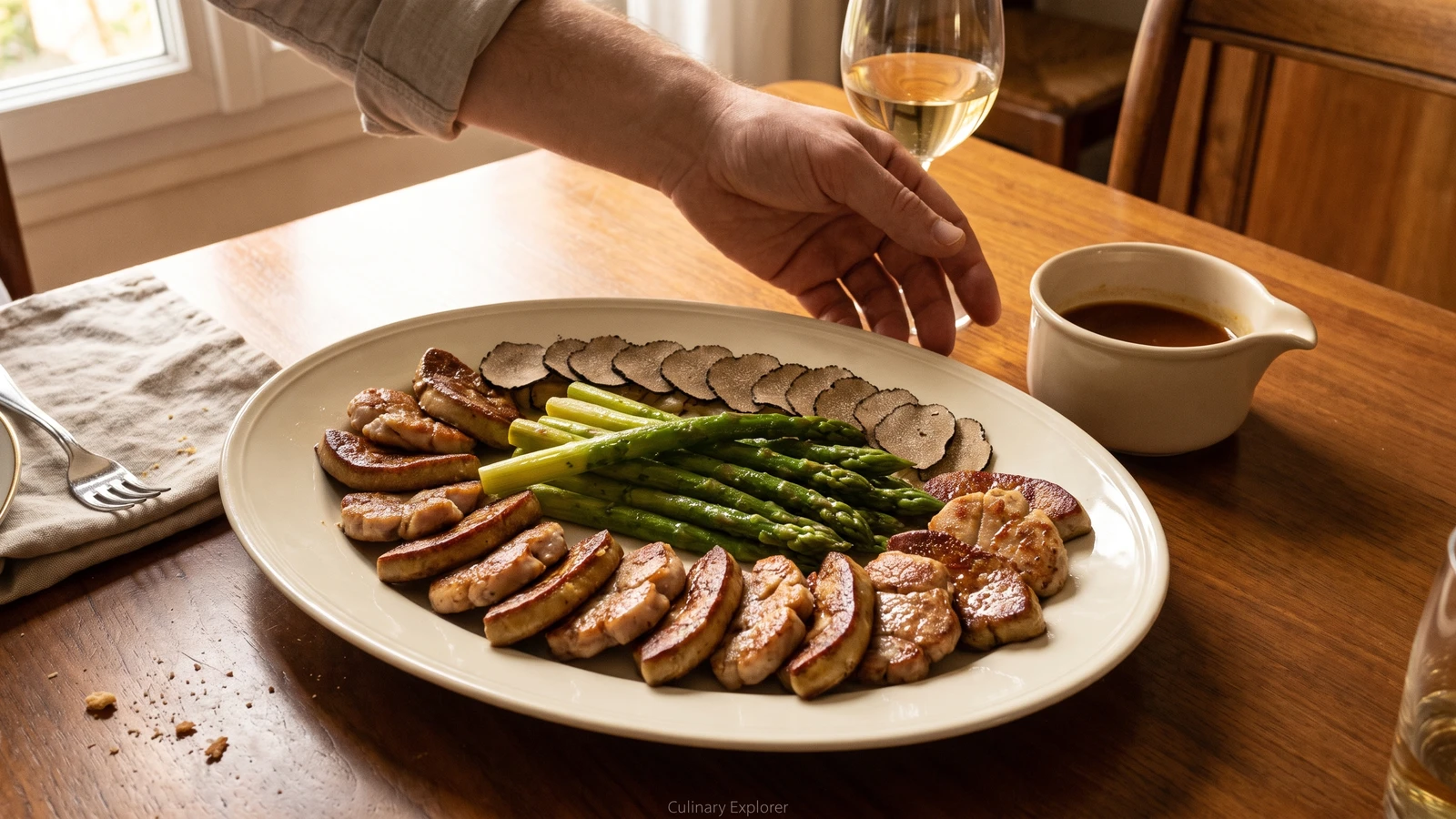
Veal sweetbreads browned in clarified butter alternate with foie gras beneath black truffle, while buttered asparagus fills the centre and truffle-scented Madeira sauce waits beside the platter: grand composition made workable at home.
Escalopes de Ris de Veau à la Favorite (slices of veal sweetbread in the Favorite style) teaches the discipline of composition: every element must arrive together, yet each must remain itself. The sweetbread should be bronzed outside and yielding within, the foie gras just set, the asparagus vividly green beneath its butter, and the Madeira sauce deep enough to follow rather than bury them. The one true thing to know before touching a pan is this: cold, firmly pressed sweetbread makes clean escalopes; warm or loosely pressed sweetbread tears.
The brigade version assumed several hands, a saucier on staff, stock never off the fire, and a hot pass. A salamander was common equipment, but it has no rightful work here. At home, one small saucepan of reduced Madeira sauce replaces the saucier, gelatin-rich unsalted veal stock replaces the perpetual stockpot, a weighted tray replaces the pressing board, and a low oven briefly holds the platter and browned sweetbreads. Separate truffle essence becomes the reserved juice from a whole preserved black truffle, which supplies both perfume and the required crown without changing the dish's intent.
Make the sauce and asparagus first, brown the sweetbreads next, and sear the foie gras last. This sequencing replaces the brigade's extra hands; the equal sweetbread-and-foie ring, buttered asparagus centre, sliced-truffle crown, and separately served sauce all stay, because they are the dish. One cook, one stove, one evening. Press the sweetbreads flat and chill them completely before slicing. That is the step that decides the whole composition.
Escalopes de Ris de Veau à la Favorite belongs to Parisian cuisine classique, where à la Favorite named a composed garnish of costly ingredients rather than a regional cooking style. Its alternating ring, truffle crown, buttered asparagus centre, and separately served Madeira sauce reflect the grand-kitchen practice of making garnishes part of the architecture before such compositions passed to formal bourgeois tables. Despite the sound of ris, no rice is involved: ris de veau is calf sweetbread, especially the rounded thymus lobe prized because blanching and pressure turn it into neat, tender slices.
Quantity
3 large, about 1½ pounds (680 g) total, prepared according to Blanchings (No. 273)
cooled, drained, trimmed, and pressed
Quantity
12 ounces (340 g)
kept very cold
Quantity
¼ cup (60 ml / 30 g)
Quantity
7 tablespoons (105 ml / 98 g)
divided
Quantity
24 tips, about 8 ounces (225 g)
cut to 3 inches (7.5 cm)
Quantity
3 tablespoons (45 ml / 42 g)
Quantity
1 whole truffle, about 1 ounce (30 g), plus 2 tablespoons (30 ml / 30 g) reserved packing juice
truffle thinly sliced
Quantity
2½ cups (600 ml / 600 g)
chilled and visibly jellied
Quantity
½ cup (120 ml / 120 g)
Quantity
1 tablespoon (15 ml / 18 g)
divided
Quantity
½ teaspoon (2.5 ml / 1 g)
divided
| Ingredient | Quantity |
|---|---|
| veal heart sweetbreadscooled, drained, trimmed, and pressed | 3 large, about 1½ pounds (680 g) total, prepared according to Blanchings (No. 273) |
| raw foie gras lobekept very cold | 12 ounces (340 g) |
| all-purpose flour | ¼ cup (60 ml / 30 g) |
| clarified unsalted butterdivided | 7 tablespoons (105 ml / 98 g) |
| green asparagus tipscut to 3 inches (7.5 cm) | 24 tips, about 8 ounces (225 g) |
| unsalted butter | 3 tablespoons (45 ml / 42 g) |
| preserved black truffle with packing juicetruffle thinly sliced | 1 whole truffle, about 1 ounce (30 g), plus 2 tablespoons (30 ml / 30 g) reserved packing juice |
| rich unsalted veal stockchilled and visibly jellied | 2½ cups (600 ml / 600 g) |
| medium-dry Madeira | ½ cup (120 ml / 120 g) |
| fine sea saltdivided | 1 tablespoon (15 ml / 18 g) |
| finely ground white pepperdivided | ½ teaspoon (2.5 ml / 1 g) |
Begin with the veal heart sweetbreads already prepared according to Blanchings (No. 273). Drain them, pat them very dry, and pull away any loose membrane or tough sinew without tearing the lobes. Set them between two parchment-lined trays, place about 4 pounds (1.8 kg) of evenly distributed weight on top, and chill for 1½ to 2 hours. They should become firm, level, and compact rather than crushed. Cut the cold sweetbreads across the lobes into 12 escalopes about ⅜ inch (1 cm) thick, choosing the cleanest slices for the platter, then return them to the cold.
Reserve ¼ cup (60 ml) of the veal stock for adjustments. Bring the remaining stock to a lively simmer in a small, wide saucepan and reduce it to about 1¼ cups (300 ml). Add the Madeira and continue reducing until about 1 cup (240 ml) remains and the sauce reaches nappe, meaning it coats the back of a spoon in a thin, glossy layer. Strain it into a clean saucepan and hold it off the heat. If it becomes sticky or salty, loosen it a spoonful at a time with the reserved unsalted stock; if it remains thin, reduce it further before the truffle juice goes in. Ça se rattrape.
Slice the preserved truffle into very thin rounds and keep them covered so their perfume stays put. Cut the cold foie gras into 12 escalopes with roughly the same footprint and thickness as the sweetbread slices. Mix the flour with ¼ teaspoon of the salt and a pinch of white pepper, but do not dredge the foie yet. Lay the foie on a chilled plate and return it to the cold; it must meet the pan firm, not soft.
Cook the asparagus tips à l’anglaise, in generously salted boiling water, until vividly green and just tender when pierced at the cut end, about 2 to 4 minutes depending on thickness. Drain them thoroughly and wipe the pan dry. Return the asparagus over low heat with the whole butter, rolling the tips until the butter clings in a bright, even glaze. If water gathers beneath them, lift out the asparagus, reduce the liquid for 30 seconds, then return them to the pan. Hold them in a covered warm bowl, never over direct heat.
Heat the oven to 200°F (95°C) and warm an oval serving platter inside. Season the sweetbread escalopes lightly with salt and white pepper. Heat 4 tablespoons of the clarified butter in a heavy skillet over medium-high heat and sauté the slices in two uncrowded batches, about 2 to 3 minutes per side, until deeply golden and fully hot at the centre with a gentle spring beneath a fingertip. Transfer them to the warm platter in one layer. If the butter darkens or smells scorched, wipe out the pan and use the reserved clarified butter; burnt fat cannot be hidden beneath Madeira sauce.
Wipe the skillet clean and heat it until properly hot. Dredge the cold foie gras lightly in the seasoned flour, tapping off every excess, then sauté it in a thin film of the remaining clarified butter, working in batches. Give each slice about 30 to 45 seconds per side, just until amber-gold outside and barely set within. If the foie begins shedding a puddle of fat before it colours, lift it immediately to a chilled plate, pour off the rendered fat, chill the slices for 5 minutes, and reheat the clean pan before trying again. Ça se rattrape, but only if you stop early.
Arrange the 12 sweetbread escalopes and 12 foie gras escalopes alternately around the warm platter, making one generous circle. Lay the sliced truffle in an overlapping crown along the top of that ring, then heap the butter-glossed asparagus tips neatly in the centre. Rewarm the Madeira sauce to a bare simmer, take it off the heat, and stir in the reserved truffle juice. Taste once for salt, pour the sauce into a warmed sauceboat, and serve it separately so the composition reaches the table intact. À table!
1 serving (about 360g)
Culinary guides, cultural storytelling, and the editorial depth that makes cooking meaningful.
Discover Culinary ExplorerChef Juliette
John Dory has the delicacy of sole and the firmness of turbot. A light flouring, a quick butter sauté, and nut-brown beurre noisette show exactly why looks never mattered.

Chef Juliette
Fresh haddock proves its delicacy in the meunière pan: a fine flour crust, moist pearly flakes, and beurre noisette sharpened with lemon and parsley, ready from one skillet in half an hour.

Chef Juliette
Éperlans à l’Anglaise turns small fish into a lesson in disciplined coating: boned smelts under a close, crisp crumb, pan-fried in clarified butter and finished with bright, half-melted maître d’hôtel butter.

Chef Juliette
Tiny smelts, shallot, mushrooms, white wine, gratin sauce, and fine bread raspings meet a fierce oven, where the fish must turn tender in the same breath the buttered crust bronzes.