
Chef Juliette
Selle de Veau (Relevé)
A half saddle of veal, bacon-barded and braised by short moistening, emerges bronze and succulent, with the concentrated veal glaze that makes this grand relevé worthy of the home table.
A cooking platform built around craft, culture, and the stories behind what we eat.
Created by Chef Juliette
Based on No. 1193, Loin of Veal, from Le Guide Culinaire (1907) by Auguste Escoffier
Longe de veau braisée turns the chump end into a burnished, sliceable joint with a supple gravy, proving that the quiet braise, not fierce roasting, gives veal its deepest succulence.
Longe de veau braisée (braised loin of veal) teaches one true thing: a braise succeeds by restraint, not by drowning or boiling. The chump end, the quasi, takes deep colour first, then cooks in only enough liquid to reach partway up the joint. What comes to the table is sliceable veal, not stew, with a glossy jus born from its own fond.
The original kitchen assumed a brigade-sized joint, a broad braisière, a stockpot never off the fire, a saucier to skim and reduce, and a salamander for the final glaze. Here a 3-pound quasi serves four. A Dutch oven and parchment replace constant basting, low-sodium stock strengthened with gelatin supplies the body of long-simmered stock, one saucepan handles the reduction, and your broiler gives the final glaze. Repeated basting and extra pans were brigade scaffolding and can go; deep browning, a quiet braise, the reduced jus, and that burnished glaze are the dish and must stay. One cook, one stove, one evening.
When it is right, the veal is tender enough for a carving knife but still holds a handsome slice, its thin cap of fat bronzed and its gravy amber, concentrated, and supple. Before you touch the pan, remember the step that decides everything: keep the braising liquid at a bare tremble. If it boils, lower the oven and add a little cool stock. Ça se rattrape.
French butchers divide the loin more precisely than English labels often suggest: the caudal quasi, or chump end, carries the pelvis and haunch, while the forward portion holds the fillet and was commonly sold with the kidney and its fat attached. At the cuisine bourgeoise table and in the grand service of Paris, these large joints appeared as relevés, substantial courses whose braising liquor mattered as much as their carving. Roasting remained possible, but braising was prized because pale veal emerged more succulent and furnished its own deeply flavored jus.
Quantity
1 joint, 3 lb (1.35 kg)
tied, with a thin fat cap
Quantity
2 1/4 teaspoons (11 ml / 13 g)
Quantity
1 teaspoon (5 ml / 2 g)
Quantity
3/4 cup (180 ml / 85 g)
cut into small dice
Quantity
5 tablespoons (75 ml / 70 g)
divided, with 2 tablespoons chilled
Quantity
1 large (about 3/4 cup / 90 g)
cut into 1/2-inch dice
Quantity
1 medium (about 1 cup / 150 g)
cut into 1/2-inch dice
Quantity
1 stalk (about 1/2 cup / 60 g)
cut into 1/2-inch dice
Quantity
2 cloves
lightly crushed
Quantity
3/4 cup (180 ml / 180 g)
Quantity
2 1/2 cups (600 ml / 600 g)
divided
Quantity
2 teaspoons (10 ml / 6 g)
Quantity
1
made with 2 parsley stems, 2 thyme sprigs, and 1 bay leaf
| Ingredient | Quantity |
|---|---|
| boneless chump-end veal loin (quasi)tied, with a thin fat cap | 1 joint, 3 lb (1.35 kg) |
| fine sea salt | 2 1/4 teaspoons (11 ml / 13 g) |
| freshly ground white or black pepper | 1 teaspoon (5 ml / 2 g) |
| unsmoked lardonscut into small dice | 3/4 cup (180 ml / 85 g) |
| unsalted butterdivided, with 2 tablespoons chilled | 5 tablespoons (75 ml / 70 g) |
| carrotcut into 1/2-inch dice | 1 large (about 3/4 cup / 90 g) |
| yellow onioncut into 1/2-inch dice | 1 medium (about 1 cup / 150 g) |
| celerycut into 1/2-inch dice | 1 stalk (about 1/2 cup / 60 g) |
| garliclightly crushed | 2 cloves |
| dry white wine | 3/4 cup (180 ml / 180 g) |
| unsalted light veal stock or chicken stockdivided | 2 1/2 cups (600 ml / 600 g) |
| unflavored powdered gelatin (optional) | 2 teaspoons (10 ml / 6 g) |
| bouquet garnimade with 2 parsley stems, 2 thyme sprigs, and 1 bay leaf | 1 |
Pat the veal completely dry. Leave its thin, soft fat cap in place, trimming only hard surface tendon or thick excess fat, then tie the joint at 1-inch intervals if the butcher has not done it. Season all over with the salt and pepper and leave it for 30 minutes while you prepare the aromatics. Mix the gelatin into the cold stock and let it stand for 5 minutes; omit it only when your stock already sets firmly in the cold.
Heat the oven to 300°F (150°C). Render the lardons in a 5 to 6-quart Dutch oven over medium-low heat until their fat runs and their edges turn golden, 6 to 8 minutes. Lift them into a bowl, leaving the fat behind. Add 2 tablespoons of the butter, increase the heat to medium, and brown the veal on every side, beginning with the fat cap, for 10 to 12 minutes in all. Let each surface become a deep hazelnut colour before turning it. If the butter darkens too quickly, lower the heat and move the joint to a cooler part of the pot. If the fond turns black, lift out the meat, wipe the pot clean, add fresh butter, and resume. Ça se rattrape, but scorched fond must never enter the gravy.
Transfer the browned veal to a plate. Add 1 tablespoon of butter to the pot, followed by the carrot, onion, celery, and garlic. Cook over medium heat for 8 to 10 minutes, stirring often, until the vegetables soften and take patches of gold. Pour in the wine and scrape the pot floor thoroughly, dissolving every good brown trace into the liquid. Boil until the wine is reduced by half. Add 2 cups of the stock, the rendered lardons, and the bouquet garni, then bring the liquid only to a gentle simmer.
Return the veal to the pot with its fat cap facing upward. The liquid should reach roughly one-third of the way up the joint; add some of the reserved stock if needed, but do not submerge the meat. Lay a round of baking parchment directly over the joint and liquid, cover tightly, and place the pot in the oven. Braise for 1 hour 30 minutes to 1 hour 50 minutes, basting once halfway through, until a thin skewer enters the thickest part with little resistance and an instant-read thermometer registers 160 to 165°F (71 to 74°C). The liquid should barely tremble. If it bubbles hard, reduce the oven by 25°F (15°C) and add 1/4 cup of cool reserved stock; fierce heat tightens the veal and clouds the jus.
Lift the veal onto a rimmed metal tray and cover it loosely. Strain the braising liquid through a fine sieve into a saucepan without pressing the vegetables, which would make the jus cloudy, then skim away excess surface fat. Boil steadily until reduced to about 1 1/4 cups and nappant (able to coat the back of a spoon), 12 to 20 minutes. Reserve 3 tablespoons of this unbuttered jus for glazing. Take the saucepan off the heat and whisk the remaining 2 tablespoons of chilled butter into the rest, a small piece at a time. If the sauce looks oily, put 1 tablespoon of cool stock into a clean saucepan and whisk the broken sauce into it gradually. Ça se rattrape. If it is too thick, loosen it with reserved stock; if thin, reduce it before adding the butter.
Heat the broiler and place the tray so the veal will sit about 6 inches from the element. Brush the joint with half the reserved unbuttered jus and broil until the surface shines and begins to bronze, 60 to 90 seconds. Brush again and return it briefly for a second coat. This is the home equivalent of the salamander: quick, close heat that sets the glaze without recooking the centre. Watch without leaving the stove, because a glossy glaze becomes burnt sugar in moments.
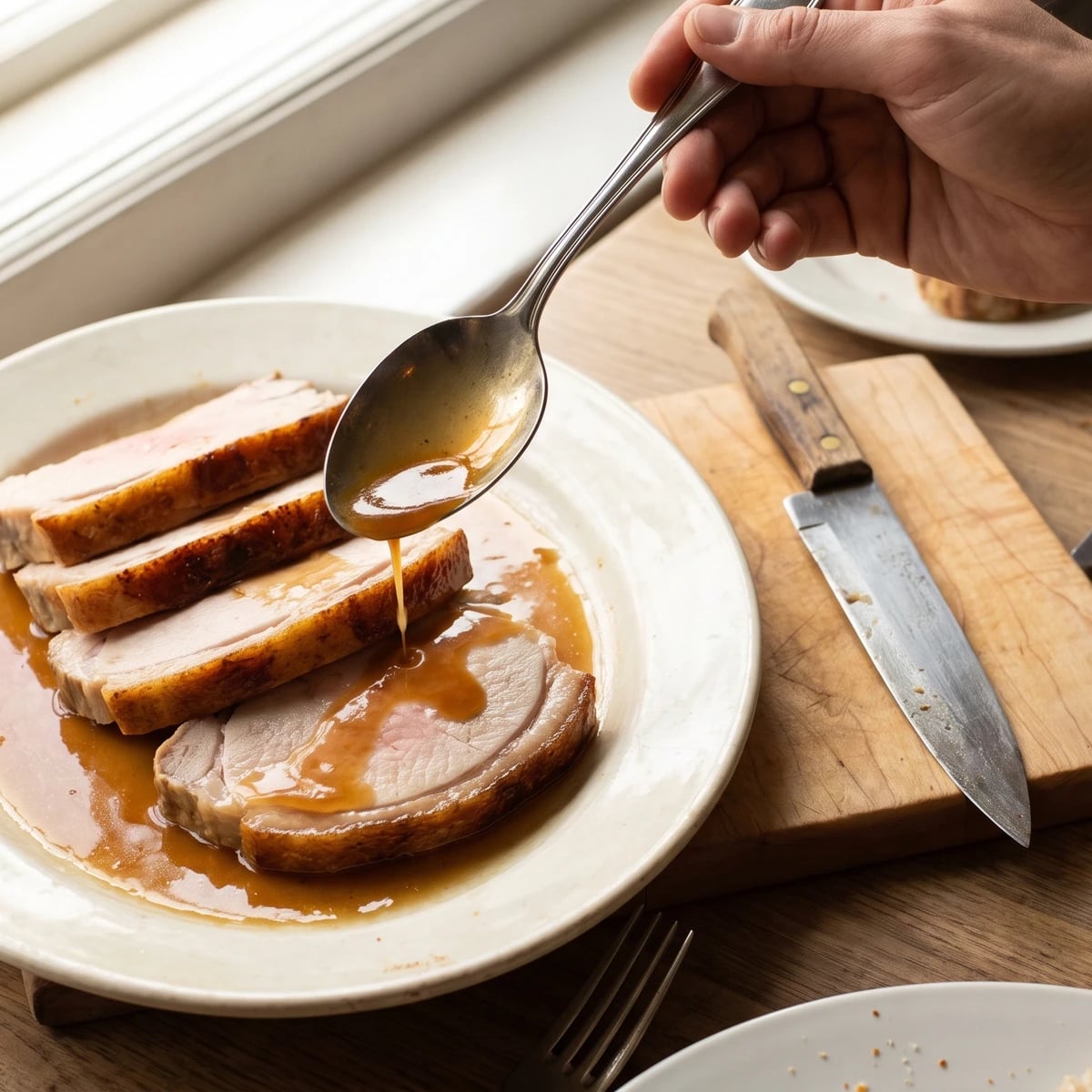
Let the glazed veal settle for 5 minutes, remove the twine, and carve it across the grain into slices about 1/2 inch thick. Spoon a shallow pool of the warm jus onto an oval platter, arrange the veal over it, and coat the centre slices with a little more. Bring the remaining jus separately so everyone can claim another spoonful. Never apologize at your own table. À table!
1 serving (about 360g)
Culinary guides, cultural storytelling, and the editorial depth that makes cooking meaningful.
Discover Culinary Explorer
Chef Juliette
A half saddle of veal, bacon-barded and braised by short moistening, emerges bronze and succulent, with the concentrated veal glaze that makes this grand relevé worthy of the home table.

Chef Juliette
A bronzed saddle of veal between two patterned vegetable domes, with clear, glossy braising jus passed at the table: classical structure translated for four, patient enough for a celebration and possible on one stove.

Chef Juliette
A veal saddle braised until tender, its fillets cut into collops and rebuilt with paprika Béchamel and truffle, then flashed beneath fierce heat until the ivory sauce glazes.

Chef Juliette
A veal saddle becomes edible architecture: Soubise and ham tucked into the carved loin, truffled Parmesan soufflé rising above it, and reduced braising liquor served alongside.