
Chef Juliette
John Dory (St. Pierre)
John Dory has the delicacy of sole and the firmness of turbot. A light flouring, a quick butter sauté, and nut-brown beurre noisette show exactly why looks never mattered.
A cooking platform built around craft, culture, and the stories behind what we eat.
Created by Chef Juliette
Based on No. 1188, Selle de Veau à la Romanoff, from Le Guide Culinaire (1907) by Auguste Escoffier
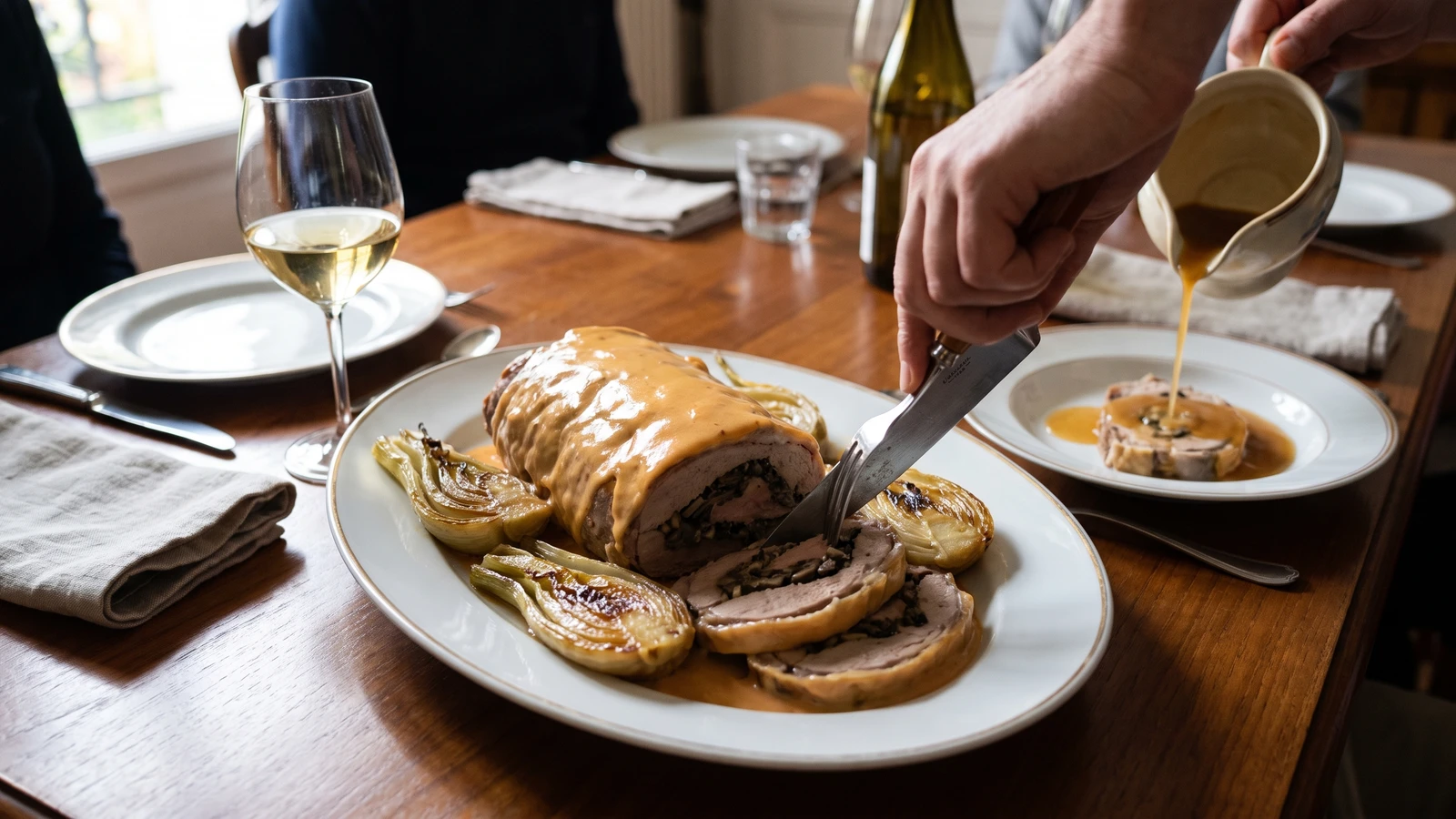
Selle de Veau à la Romanoff rebuilds a braised saddle with creamed mushrooms between the collops, coral-tinged Béchamel, tender fennel, and clear jus, its grandeur resting on one precise butter.
Selle de Veau à la Romanoff (Romanoff-style saddle of veal) teaches how a rich dish keeps its balance. Before you touch a pan, know this one true thing: the beurre d'écrevisse (crayfish butter) carries it. It should perfume and lightly tint the Béchamel without turning it oily, while the veal, mushrooms, fennel, and clear jus each remain distinct.
The original assumed a full saddle for banquet service, a saucier reducing the braising liquor while another hand cut and rebuilt the fillets, stock never off the fire, and a salamander waiting nearby. For four, we use a center-cut saddle that fits a covered roasting pan, one saucepan of good unsalted stock, and sauces worked in sequence. The salamander stays out of it: the Béchamel is a warm mask, not a browned gratin.
Simultaneous pans and extra hands were brigade scaffolding, so they go. The crayfish-butter ratio, creamed mushrooms between the collops, reconstructed joint, braised fennel border, and separate defatted jus are the dish, so they stay. One cook, one stove, one evening. Make the beurre d'écrevisse over the gentlest heat you own, then whisk it into the Béchamel off the heat; that final emulsion is the step that decides Romanoff.
Selle de Veau à la Romanoff belongs to the Parisian grand-kitchen canon, where a titled name often signaled courtly fashion rather than a regional farmhouse preparation. The Romanoff spelling points toward the Romanov court, but the title never imposed one fixed garnish across French cookery; in this entry, crayfish butter, mushrooms, fennel, and a formally reconstructed saddle define it. The sliced-and-rebuilt method passed from banquet service into private dining because it preserved the ceremony of a whole joint while making each portion easy to serve.
Quantity
1 (4½ to 5 pounds / 2 to 2.3 kg)
tied
Quantity
3 teaspoons (15 ml / 18 g)
divided
Quantity
1¼ teaspoons (6 ml / 2.5 g)
divided
Quantity
3 tablespoons (45 ml / 42 g)
Quantity
1 large (about 1½ cups / 360 ml / 200 g)
sliced
Quantity
1 large (about 1 cup / 240 ml / 120 g)
sliced
Quantity
4 cups (960 ml / 960 g)
divided
Quantity
1
Quantity
4 (about 1¼ pounds / 570 g)
trimmed and halved lengthwise
Quantity
2 tablespoons (30 ml / 28 g)
Quantity
4½ cups (1.06 L / 340 g)
finely minced
Quantity
2 tablespoons (30 ml / 28 g)
Quantity
¼ cup (60 ml / 60 g)
Quantity
8 (about 1 pound / 450 g)
tail meat removed and reserved; shells dried and crushed
Quantity
½ cup (120 ml / 113 g)
Quantity
¼ cup (60 ml / 57 g)
Quantity
¼ cup (60 ml / 30 g)
Quantity
2 cups (480 ml / 495 g)
heated
Quantity
¼ teaspoon (1.25 ml / 0.5 g)
Quantity
⅛ teaspoon (0.6 ml / 0.25 g)
Quantity
⅛ teaspoon (0.6 ml / 0.25 g)
| Ingredient | Quantity |
|---|---|
| bone-in center-cut veal saddletied | 1 (4½ to 5 pounds / 2 to 2.3 kg) |
| fine sea saltdivided | 3 teaspoons (15 ml / 18 g) |
| freshly ground black pepperdivided | 1¼ teaspoons (6 ml / 2.5 g) |
| clarified butter | 3 tablespoons (45 ml / 42 g) |
| yellow onionsliced | 1 large (about 1½ cups / 360 ml / 200 g) |
| carrotsliced | 1 large (about 1 cup / 240 ml / 120 g) |
| unsalted light veal stock or unsalted chicken stockdivided | 4 cups (960 ml / 960 g) |
| bouquet garni of parsley stems, thyme, and bay | 1 |
| small fennel bulbstrimmed and halved lengthwise | 4 (about 1¼ pounds / 570 g) |
| unsalted butter for the fennel | 2 tablespoons (30 ml / 28 g) |
| cremini or button mushroomsfinely minced | 4½ cups (1.06 L / 340 g) |
| unsalted butter for the mushrooms | 2 tablespoons (30 ml / 28 g) |
| heavy cream | ¼ cup (60 ml / 60 g) |
| whole cooked freshwater crayfishtail meat removed and reserved; shells dried and crushed | 8 (about 1 pound / 450 g) |
| unsalted butter for the beurre d'écrevisse | ½ cup (120 ml / 113 g) |
| unsalted butter for the Béchamel | ¼ cup (60 ml / 57 g) |
| all-purpose flour | ¼ cup (60 ml / 30 g) |
| whole milkheated | 2 cups (480 ml / 495 g) |
| ground white pepper | ¼ teaspoon (1.25 ml / 0.5 g) |
| freshly grated nutmeg | ⅛ teaspoon (0.6 ml / 0.25 g) |
| cayenne pepper | ⅛ teaspoon (0.6 ml / 0.25 g) |
Crush the dried crayfish heads and shells into coarse rubble with a mortar or food processor. Melt the ½ cup butter in a small heavy saucepan over very low heat, add the shells, and cook for 15 minutes with only an occasional lazy bubble, stirring often. The butter should turn orange-red and smell sweet, never toasted. Strain it through a fine sieve lined with cheesecloth, pressing firmly, then let the sediment settle and pour off the clear coloured butter. Measure 4 tablespoons (60 ml / 57 g) and reserve it. If the shells begin catching, lift the pan from the heat immediately and strain without scraping up the dark sediment; the clear butter above it is still usable.
Heat the oven to 325°F (165°C). Pat the veal completely dry and season it with 2 teaspoons of the salt and 1 teaspoon of the black pepper. Heat the clarified butter in a covered roasting pan or oval cocotte over medium-high heat, then brown the saddle patiently on every accessible side, about 12 to 15 minutes. Lift it out. Add the onion and carrot to the same pan and cook until lightly bronzed, scraping without disturbing the brown film underneath.
Pour 3 cups of the stock into the pan and scrape every bit of fond from the bottom. Add the bouquet garni and return the saddle with its fat side uppermost; the liquid should rise no more than one-third of the way up the meat. Cover tightly and braise for 1 hour 15 minutes to 1 hour 45 minutes, basting twice, until the centre of the loin reaches 140 to 142°F (60 to 61°C). It will reach a safe 145°F (63°C) as it rests. If the liquid boils hard, lower the oven; if the pan threatens to dry, add a little hot water. A saddle is tender loin, not stewing meat, so stop while it remains juicy.
While the veal cooks, melt the 2 tablespoons butter for the fennel in a wide sauté pan. Set the fennel halves cut-side down and let them colour lightly for 4 minutes. Add the remaining 1 cup stock, ¼ teaspoon salt, and ⅛ teaspoon black pepper. Cover and cook at a bare simmer for 25 to 35 minutes, until a knife slips through the core without resistance. Uncover and reduce the liquor until it glazes the fennel. If the liquid disappears while the cores remain firm, add ¼ cup water, cover again, and continue gently.
Melt the 2 tablespoons butter for the mushrooms in a broad pan over medium-high heat. Add the minced mushrooms, ¼ teaspoon salt, and the remaining ⅛ teaspoon black pepper. Cook until their water has evaporated and the mince begins to take a little colour, about 10 minutes. Add the cream and reduce until the mushrooms form a moist, close paste that holds the track of the spoon. If the mixture remains loose, keep cooking; flour would mute the mushrooms and make the filling heavy. Cover and keep warm.
Melt the ¼ cup butter in a saucepan over medium-low heat. Stir in the flour to make a roux, the cooked butter-and-flour foundation, and cook for 2 minutes without allowing it to colour. Whisk in the hot milk gradually, making each addition smooth before adding the next. Simmer gently for 8 to 10 minutes, stirring along the pan floor, until the Béchamel coats a spoon in a generous layer. Season it firmly with the remaining ½ teaspoon salt, white pepper, nutmeg, and cayenne. If it lumps, whisk vigorously and pass it through a fine sieve. Hold it covered directly on the surface, but do not add the beurre d'écrevisse yet.
Transfer the veal to a board, cover it loosely, and rest it for 20 minutes. Strain the braising liquor into a fat separator or narrow jug, discard the vegetables and bouquet garni, and remove every visible trace of grease. Boil the clear liquor until reduced to about 1 cup, glossy enough to cling lightly to a spoon but still fluid enough to pour. Strain it once more into a warm sauceboat. If it becomes salty before it gains body, stop reducing and serve it lighter; balance matters more than forcing it to syrup.
Remove the strings and set the saddle bone on a warmed, ovenproof serving platter. Run a sharp boning knife close against the backbone and ribs to lift the two long loin fillets away intact, including the smaller tenderloin strips if present. Slice the fillets across the grain into even collops about ½ inch (1.25 cm) thick, keeping every slice in its original order. That order is what lets the fillets return to the bone looking whole.
Reheat the Béchamel gently until it just begins to move, then take it completely off the heat. Whisk in exactly 4 tablespoons of the reserved beurre d'écrevisse, one tablespoon at a time. This preserves the source proportion of four ounces of crayfish butter per quart of Béchamel. Never boil it after the butter enters. If orange droplets bead on the surface or the sauce turns greasy, put 1 tablespoon cold milk in a clean bowl and whisk in the broken sauce by spoonfuls until it comes together. Ça se rattrape.
Spread a rounded teaspoon of the warm mushroom mixture on the cut face of each collop, then lean the slices together in their original sequence and return both reconstructed fillets to the saddle bone. If the veal has cooled, cover it loosely and warm it for 5 minutes in a 275°F (135°C) oven before saucing. Coat the entire upper surface generously with the crayfish-finished Béchamel, but do not brown it. Arrange the glazed fennel halves as a border and carry the platter to the table, with the clear reduced jus served separately. À table!
1 serving (about 750g)
Culinary guides, cultural storytelling, and the editorial depth that makes cooking meaningful.
Discover Culinary ExplorerChef Juliette
John Dory has the delicacy of sole and the firmness of turbot. A light flouring, a quick butter sauté, and nut-brown beurre noisette show exactly why looks never mattered.

Chef Juliette
Fresh haddock proves its delicacy in the meunière pan: a fine flour crust, moist pearly flakes, and beurre noisette sharpened with lemon and parsley, ready from one skillet in half an hour.

Chef Juliette
Éperlans à l’Anglaise turns small fish into a lesson in disciplined coating: boned smelts under a close, crisp crumb, pan-fried in clarified butter and finished with bright, half-melted maître d’hôtel butter.

Chef Juliette
Tiny smelts, shallot, mushrooms, white wine, gratin sauce, and fine bread raspings meet a fierce oven, where the fish must turn tender in the same breath the buttered crust bronzes.