Culinary Explorer

A cooking platform built around craft, culture, and the stories behind what we eat.
Discover Culinary Explorer
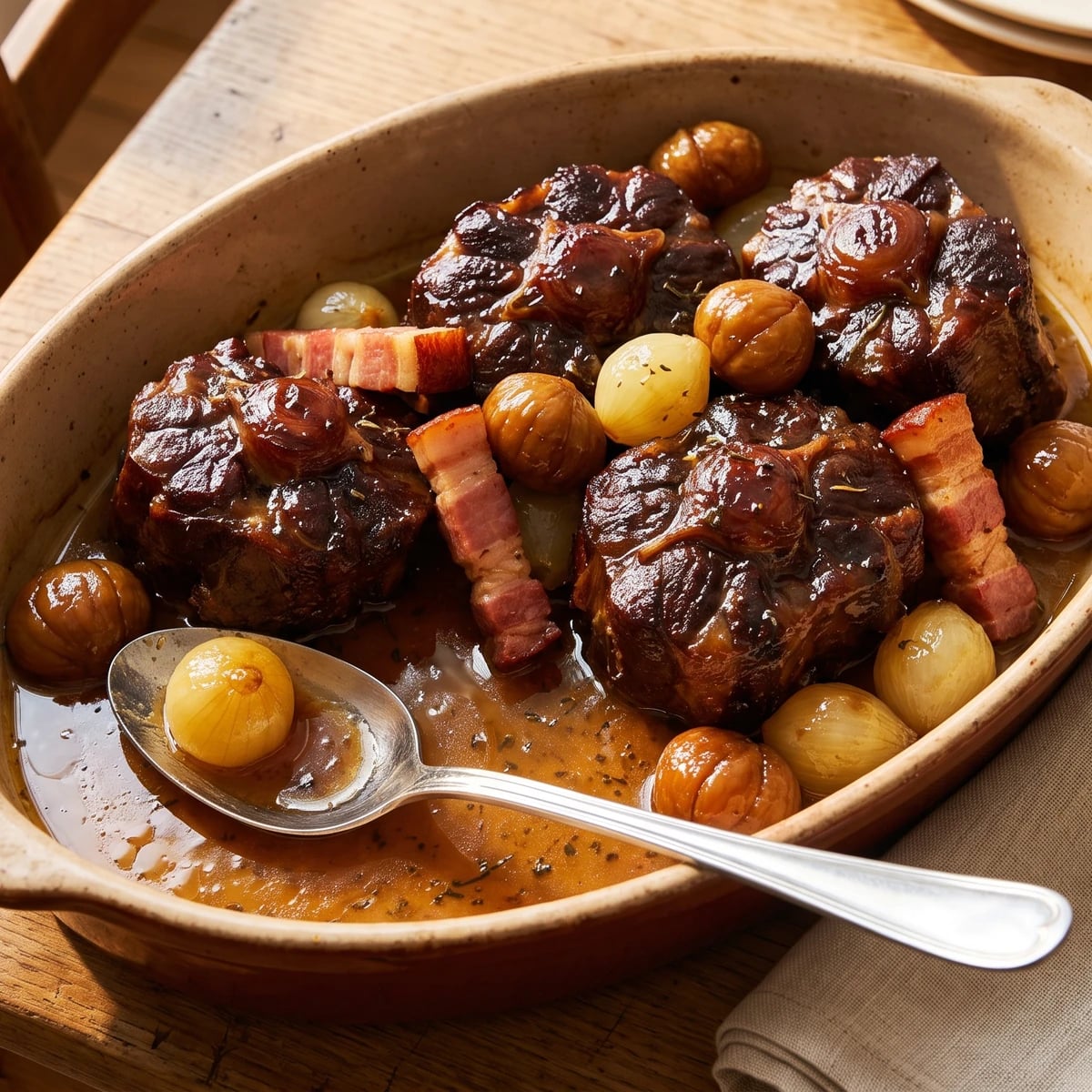
Queue de Bœuf à l’Auvergnate

Queue de Bœuf à l’Auvergnate

Created by Chef Juliette

Based on No. 1159, Queue de Bœuf à l’Auvergnate, from Le Guide Culinaire (1907) by Auguste Escoffier

Queue de Bœuf à l’Auvergnate turns humble oxtail into a silken white-wine braise, then sets glazed chestnuts, buttered pearl onions, and bacon around it. Brown the joints hard, because the fond becomes the sauce.

Main Dishes
French
Comfort Food
Dinner Party
Make Ahead
45 min
Active Time
4 hr 30 min cook5 hr 15 min total
Yield4 servings

Queue de Bœuf à l’Auvergnate (oxtail braised in white wine, Auvergne style) teaches the first law of a braise: the fond is not residue, it is the sauce waiting to be released. Brown the sections until every broad face is dark mahogany, and the wine, stock, and long gentle cooking will turn that crust into a deep, glossy jus. Begin pale and no amount of reducing at the end can put the missing flavor back.

The original kitchen assumed a braising pan that held the meat exactly, excellent stock never off the fire, and a saucier available to strain, degrease, reduce, and glaze. Your equivalents are a snug Dutch oven, rich unsalted stock, a fine sieve, and ten attentive minutes at the finish. The general six-hour marinade intended for large solid cuts is omitted here because the tail is already sectioned; its measured wine goes directly onto the fond and reduces before the stock is added. Repeated oven glazing is brigade scaffolding too, useful for a whole showpiece but pointless on joints already cut for serving. A salamander has no useful work here.

What remains is the dish itself and must stay: hard browning, a proper wine reduction, slow braising, and three garnishes cooked separately so the bacon keeps its edges, the onions remain whole, and the chestnuts do not dissolve into the sauce. When it is right, the oxtail loosens at a touch and the chestnuts shine beneath an amber-brown glaze. Guard the browning first. Everything after that can be adjusted.

Queue de Bœuf à l’Auvergnate belongs to the classical à l’Auvergnate family, named for Auvergne in the Massif Central and particularly its southern chestnut country, where chestnuts and cured pork shared the household larder. In the grand repertoire, those familiar foods became a composed garnish of glazed chestnuts, bacon, and small onions arranged around braised meat. The name describes that regional garnish as classical kitchens codified it; it does not mean every Auvergnat household prepared oxtail in this identical arrangement.

The technique, the tradition, and the story behind every dish.

Discover Culinary Explorer

Ingredients

Ordinary Braisings (No. 247)

Quantity

1 home-scale application

used as the braising method for the oxtail

beef oxtail

Quantity

5 lb (2.25 kg)

separated at the joints into 2-inch (5 cm) sections

fine sea salt

Quantity

2½ teaspoons (12 ml / 15 g)

divided

freshly ground black pepper

Quantity

1 teaspoon (5 ml / 2 g)

beef dripping or clarified butter

Quantity

2 tablespoons (30 ml / 28 g)

carrots

Quantity

1 cup (240 ml / 150 g)

thickly sliced

yellow onion

Quantity

1 cup (240 ml / 150 g)

thickly sliced

garlic

Quantity

2 cloves

lightly crushed

unsmoked bacon rind or lean bacon heel

Quantity

1½ oz (45 g)

blanched

bouquet garni of parsley stems, thyme, and bay

Quantity

1

dry white wine

Quantity

3 cups (720 ml / 720 g)

rich unsalted beef stock

Quantity

4¼ cups (1 L / 1 kg)

heated

thick-cut lean unsmoked bacon

Quantity

1¼ cups (300 ml / 180 g)

cut into small rectangles

large peeled cooked chestnuts

Quantity

2½ cups (600 ml / 350 g)

preferably vacuum-packed

beef consommé

Quantity

2 cups (480 ml / 480 g)

small pearl onions

Quantity

24, about 2 cups (480 ml / 300 g)

peeled

unsalted butter

Quantity

4 tablespoons (60 ml / 57 g)

divided

granulated sugar

Quantity

1 teaspoon (5 ml / 4 g)

arrowroot

Quantity

1 tablespoon (15 ml / 8 g)

cold water

Quantity

2 tablespoons (30 ml / 30 g)

hot water (optional)

Quantity

Up to 1 cup (240 ml / 240 g)

only if needed during braising

Equipment Needed

  • 4½ to 5-quart (4.3 to 4.7 L) heavy cocotte or Dutch oven
  • Wide skillet for browning in batches
  • Fine-mesh sieve and fat separator or deep measuring jug
  • 3-quart (2.8 L) ovenproof earthenware cocotte for serving, optional

Instructions

  1. 1

    Prepare the oxtail

    Heat the oven to 300°F (150°C). Pat every oxtail section thoroughly dry, paying attention to the damp creases around the bone, then season with 2 teaspoons of the salt and all the pepper. Dry meat takes color; damp meat releases water and delays the fond you need.

  2. 2

    Brown the joints hard

    Heat the beef dripping or clarified butter in a snug heavy cocotte over medium-high heat. Brown the oxtail in two or three batches, turning each section until its broad faces are dark mahogany, about 12 minutes per batch. Leave space between the pieces. If liquid begins collecting because the pot was crowded, lift out half the meat, let the moisture cook away, and resume once the fat is hot again. Ça se rattrape. Transfer the browned sections to a tray.

    Do not confuse dark browning with burnt black specks. Mahogany fond tastes of roasted meat; black fond makes the entire braise bitter.
  3. 3

    Color the braising base

    Lower the heat to medium. Add the sliced carrots, yellow onion, and blanched bacon rind to the same pot, turning them through the rendered fat until they color evenly, 8 to 10 minutes. Add the garlic for the final minute. Keep the vegetables moving so every surface browns rather than one side scorching against the pot floor.

  4. 4

    Reduce wine and moisten

    Pour in the white wine and scrape the pot floor until every browned morsel has dissolved into it. Boil briskly until the wine reduces to about 1 cup (240 ml) and looks lightly syrupy, 15 to 20 minutes. Apply Ordinary Braisings (No. 247) at this home scale: return the oxtail, add the bouquet garni, and pour in enough hot beef stock to cover the closely packed joints. Bring the liquid only to a bare simmer.

  5. 5

    Braise at a tremble

    Cover the cocotte tightly and place it in the oven for 3½ to 4 hours. Turn and baste the exposed sections once each hour, keeping the liquid at a quiet tremble. Add a little hot water only if the braising liquor falls below halfway up the meat. The oxtail is ready when a thin knife enters the thickest meat without resistance and the flesh loosens from the bone but still holds its shape.

  6. 6

    Prepare the bacon

    During the final hour of braising, put the bacon rectangles in a small saucepan, cover them with cold water, and bring them to a boil for 2 minutes. Drain and dry them, then cook in a dry skillet over medium heat until the edges are bronze and the fat is translucent, 6 to 8 minutes. Keep them supple rather than brittle. Lift them out and reserve.

  7. 7

    Glaze the chestnuts

    Set the chestnuts in a wide saucepan and add enough beef consommé to cover them. Hold at the gentlest simmer for 10 minutes, until hot and tender but intact, then lift them out with a slotted spoon. Add 2 tablespoons of the butter, the sugar, and 3 tablespoons of the consommé to a clean skillet. Let the liquid reduce until glossy, add the chestnuts, and roll the pan gently until they shine. If they begin to crumble, stop turning them and spoon the glaze over instead; the flavor is safe, and the large pieces still belong in the garnish.

  8. 8

    Cook the pearl onions

    Put the pearl onions in a small sauté pan with the remaining 2 tablespoons butter, the remaining ½ teaspoon salt, and enough water to come halfway up their sides. Cover with a round of parchment or a lid and simmer gently for 15 to 20 minutes, until a knife enters easily. Uncover and roll the onions through the reducing butter until they are glossy with a few pale-gold faces. Do not let them collapse.

  9. 9

    Finish the braising jus

    Lift the tender oxtail onto a tray. Strain the braising liquor through a fine sieve into a saucepan, pressing lightly on the vegetables, then let it stand for 5 minutes and remove the fat from the surface. Boil until reduced to about 2 cups (480 ml) and concentrated enough to coat a spoon. Mix the arrowroot with the cold water, whisk it into the gently simmering jus a little at a time, and stop as soon as the sauce lightly naps the spoon. If it tightens too far, loosen it with reserved chestnut consommé; if it remains thin, reduce it before adding more arrowroot. Do not boil it hard once thickened.

  10. 10

    Assemble in the cocotte

    Arrange the oxtail sections in a warmed earthenware cocotte or return them to the cleaned braising pot. Tuck the glazed chestnuts, pearl onions, and bacon rectangles between the joints, then spoon over enough jus to coat everything and pool generously beneath. Cover and warm in the oven for 10 minutes. Serve the remaining sauce alongside. Repeated glazing would add ceremony but no flavor to meat already portioned at its joints. Bring the cocotte directly to the table. À table!

Chef Tips

  • Ask the butcher to separate the oxtail cleanly at its natural joints. Sawed fragments leave bone grit in the sauce, while sections much thicker than 2 inches (5 cm) cook unevenly.
  • Use a dry, unoaked white wine with enough acidity to survive reduction. A white Saint-Pourçain keeps the bottle near the dish's Auvergne home when you can find one; otherwise choose a sound dry white you would happily drink.
  • Vacuum-packed peeled chestnuts are the honest home equivalent here. They remain whole more reliably than canned chestnuts, while saving the peeling that once occupied another pair of hands in a brigade.
  • The pot matters more than its pedigree. Oxtail packed closely in a 4½ to 5-quart cocotte needs less stock and produces a stronger jus than the same meat swimming in an oversized roasting pan.
  • Serve with plain mashed potatoes or buttered cabbage and a light Saint-Pourçain red. The chestnuts already bring sweetness and substance, so the accompaniment should stay quiet.

Advance Preparation

  • The oxtail and its strained jus are better prepared a day ahead. Cool them promptly in shallow containers, refrigerate separately, and lift away the firm fat from the cold sauce before reheating gently.
  • Glaze the chestnuts and cook the pearl onions up to one day ahead, then refrigerate them in separate covered containers. Warm them gently in a spoonful of jus so the chestnuts remain whole.
  • The completed braise keeps for up to three days under refrigeration. Reheat it covered at 300°F (150°C), loosening the sauce with a little consommé if its natural gelatin has set it too firmly.

Frequently Asked Questions

Nutrition Information

1 serving (about 600g)

Calories
1110 calories
Total Fat
63 g
Saturated Fat
25 g
Trans Fat
2 g
Unsaturated Fat
35 g
Cholesterol
255 mg
Sodium
2700 mg
Total Carbohydrates
53 g
Dietary Fiber
8 g
Sugars
15 g
Protein
82 g

Note: Chef personas and recipes are created with AI assistance. Cook with care: follow safe food-handling practices, check doneness with a thermometer when needed, and adapt for allergies and your kitchen.

Where cooking meets culture.

Culinary guides, cultural storytelling, and the editorial depth that makes cooking meaningful.

Discover Culinary Explorer

More from Relevés and Entrées - Ox Tails

Browse the full collection