
Chef Juliette
John Dory (St. Pierre)
John Dory has the delicacy of sole and the firmness of turbot. A light flouring, a quick butter sauté, and nut-brown beurre noisette show exactly why looks never mattered.
A cooking platform built around craft, culture, and the stories behind what we eat.
Created by Chef Juliette
Based on No. 1143, Upper Fillet and Ribs of Beef (Relevé), from Le Guide Culinaire (1907) by Auguste Escoffier
Bone-in contrefilet teaches the first law of roasting: prepare the joint for clean carving, brown it deeply, and pull it early so the resting time finishes the rosy center.
Contrefilet et côtes de bœuf en relevé teaches the first law of roasting: the thermometer decides when the meat leaves the oven, not the clock. Keep the ribs beneath a properly aged joint and they become its natural roasting rack, shielding the underside while the fat cap bronzes above. Before you touch the pan, know your pull temperature. A fine roast carried past its mark cannot be argued back into pinkness.
The source assumes a large, well-hung joint, a butcher at the block to clear the chine and feather bones, a powerful roasting oven, and a practiced carver waiting at service. It calls for no saucier, stockpot, or salamander, so adding them would be invention. For one cook, one stove, one evening, the honest equivalents are a two-rib roast for four, butcher-prepared for easy carving, its own bones in place of a rack, and a probe thermometer in place of a cook judging the center by pressure alone.
I have changed the brigade scale and translated well-hung into beef properly aged under a butcher's care. The source prefers a good piece roasted on its bones, so that is the path here; braising belongs to a boned, less tender joint. The brigade scaffolding can go, but the aged meat, retained ribs, nicked ligament, hard initial heat, and full resting time are the dish. Pull the roast at 50 to 52°C (122 to 125°F), and let the rest finish what the oven began.
The relevé belongs to formal French service, particularly the grand kitchens and prosperous bourgeois tables of Paris, where a substantial joint followed the fish and preceded the smaller entrées. Relevé names the dish's place in the meal, not a sauce or seasoning: contrefilet and train de côtes could be braised after boning, but a tender, well-aged piece was prized roasted on its ribs. At the home table the joint became smaller, while the butcher's preparation and the clean logic of bone-in roasting remained.
Quantity
1 two-rib roast, 4 to 4½ pounds (1.8 to 2 kg)
chine and feather bones removed, rib bones and fat cap retained
Quantity
2½ teaspoons (12 ml / 15 g)
Quantity
2 teaspoons (10 ml / 5 g)
Quantity
3 tablespoons (45 ml / 42 g)
softened and divided
Quantity
1 cup (240 ml / 240 g)
divided
| Ingredient | Quantity |
|---|---|
| bone-in standing beef rib roast from the loin endchine and feather bones removed, rib bones and fat cap retained | 1 two-rib roast, 4 to 4½ pounds (1.8 to 2 kg) |
| fine sea salt | 2½ teaspoons (12 ml / 15 g) |
| freshly ground black pepper | 2 teaspoons (10 ml / 5 g) |
| unsalted buttersoftened and divided | 3 tablespoons (45 ml / 42 g) |
| boiling waterdivided | 1 cup (240 ml / 240 g) |
Ask the butcher to remove the chine and feather bones while leaving the ribs attached, then to nick the tough white ligament along the backbone side at intervals of about 2.5 cm (1 inch). Those cuts prevent the joint from pulling out of shape, and clearing the spine bones lets you carve without wrestling the knife through bone at the table. If the roast has arrived with that ligament intact, lift it with the tip of a boning knife and make shallow cuts through the cord only, never deep into the meat.
Pat the beef completely dry. Season it all over with the salt, working some beneath the fat cap where it lifts naturally, and leave it uncovered in the refrigerator for 12 to 24 hours if time permits. For cooking tonight, season it at least 1 hour before roasting and keep it in a cool place; the center need not reach room temperature. Tie the joint between and beyond the ribs so the meat holds an even cylinder, then add the pepper just before it goes into the oven.
Heat the oven to 230°C (450°F), allowing it a full 30 minutes to become thoroughly hot. Set the beef in a heavy shallow roasting pan with the ribs underneath and the fat cap uppermost; no rack is needed because the bones are doing that work. Roast for 20 minutes without opening the door, until the exterior has taken a deep Maillard bronze rather than a timid beige.
Reduce the oven to 165°C (325°F). Dot 2 tablespoons (30 ml / 28 g) of the butter over the fat cap, insert a probe into the thickest part from the side without touching bone, and continue roasting for 45 to 70 minutes. Baste once or twice with the butter and rendered beef fat. Begin checking early and remove the joint at 50 to 52°C (122 to 125°F) for a rosy medium-rare center. If the crust darkens before the center is ready, cover the top loosely with foil and lower the oven to 150°C (300°F); ça se rattrape. If the pan fond threatens to turn black, add a spoonful of the measured boiling water around the meat, never over its crust.
Transfer the roast to a warm board and cover it loosely with foil for 30 to 40 minutes. Do not wrap it tightly, or the trapped moisture softens the crust you worked to build. The internal temperature should rise several degrees while the juices settle back through the meat. If the roast has already passed the intended temperature, take it off the hot pan at once and rest it uncovered so retained heat does not carry it farther.
While the beef rests, pour most of the fat from the roasting pan into a heatproof bowl, leaving the brown fond and a thin film of fat behind. Set the pan over medium heat, add the remaining boiling water, and scrape up every mahogany-colored deposit. Reduce until about ½ cup (120 ml / 120 g) remains and the jus tastes concentrated but clean. If any patch of fond is black and bitter, leave it behind and transfer the good brown juices to a clean saucepan. Remove from the heat and whisk in the remaining 1 tablespoon (15 ml / 14 g) butter until the jus gleams. If it looks greasy, skim it; if it becomes too salty or tight, loosen it with a little hot water.
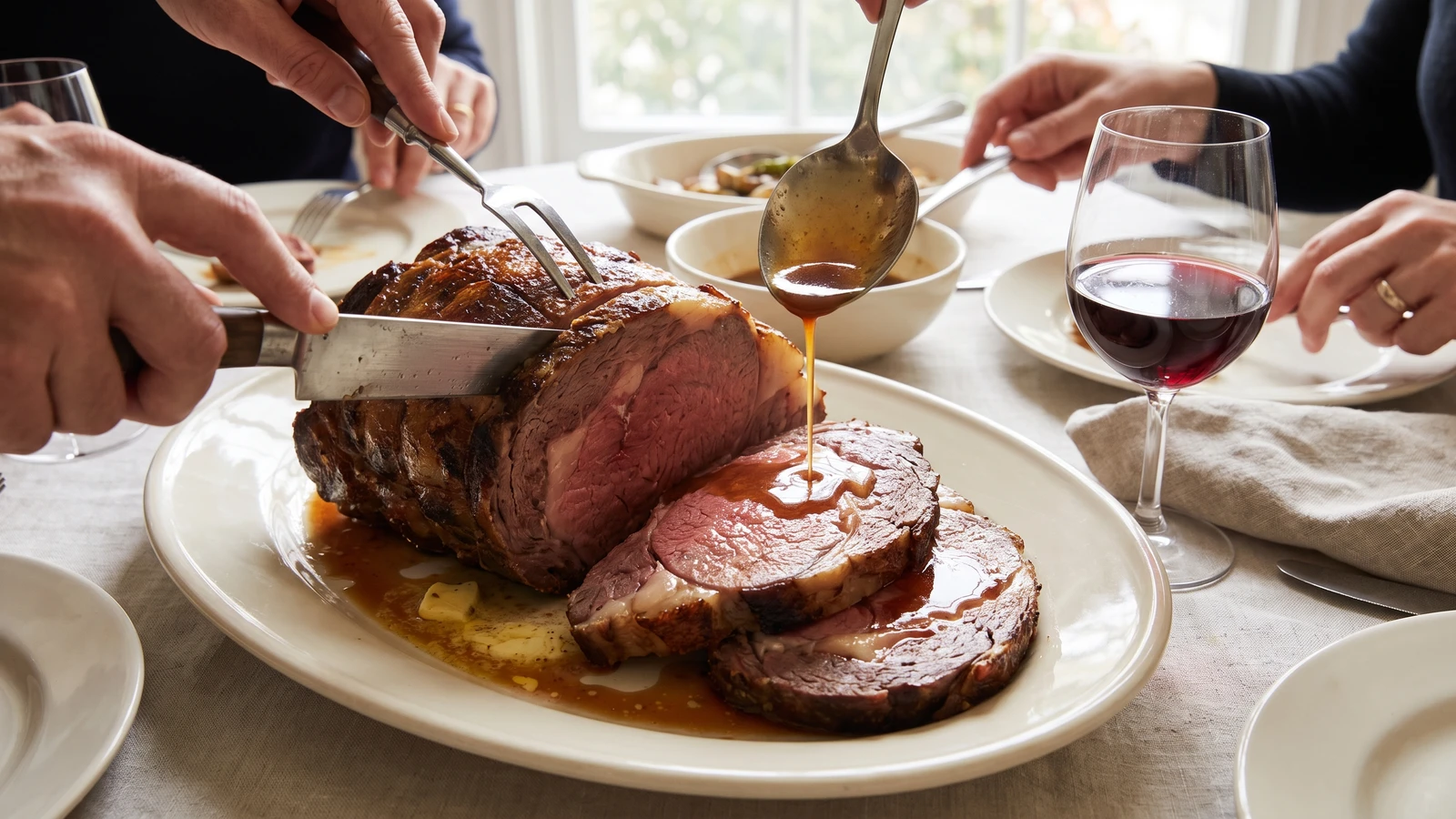
Remove the twine. Run a sharp knife along the curve of the ribs and lift the meat away in one piece; because the chine and feather bones were cleared, the blade should travel cleanly. Cut the meat across the grain into generous slices about 1.25 cm (½ inch) thick, then separate the ribs for anyone who understands that the cook's portion is often the best one. Arrange everything on a warm platter and spoon over only enough jus to gloss the cut surfaces, serving the rest alongside. À table!
1 serving (about 320g)
Culinary guides, cultural storytelling, and the editorial depth that makes cooking meaningful.
Discover Culinary ExplorerChef Juliette
John Dory has the delicacy of sole and the firmness of turbot. A light flouring, a quick butter sauté, and nut-brown beurre noisette show exactly why looks never mattered.

Chef Juliette
Fresh haddock proves its delicacy in the meunière pan: a fine flour crust, moist pearly flakes, and beurre noisette sharpened with lemon and parsley, ready from one skillet in half an hour.

Chef Juliette
Éperlans à l’Anglaise turns small fish into a lesson in disciplined coating: boned smelts under a close, crisp crumb, pan-fried in clarified butter and finished with bright, half-melted maître d’hôtel butter.

Chef Juliette
Tiny smelts, shallot, mushrooms, white wine, gratin sauce, and fine bread raspings meet a fierce oven, where the fish must turn tender in the same breath the buttered crust bronzes.