
Chef Juliette
Châteaubriand, Fillet Steak, Tournedos
One tenderloin heart, three classical portions: roast Châteaubriand for carving, bifteck de filet for one, tournedos two to a plate, all with braised endives and a red-wine pan jus.
A cooking platform built around craft, culture, and the stories behind what we eat.
Created by Chef Juliette
Based on No. 1121, Tournedos Persane, from Le Guide Culinaire (1907) by Auguste Escoffier
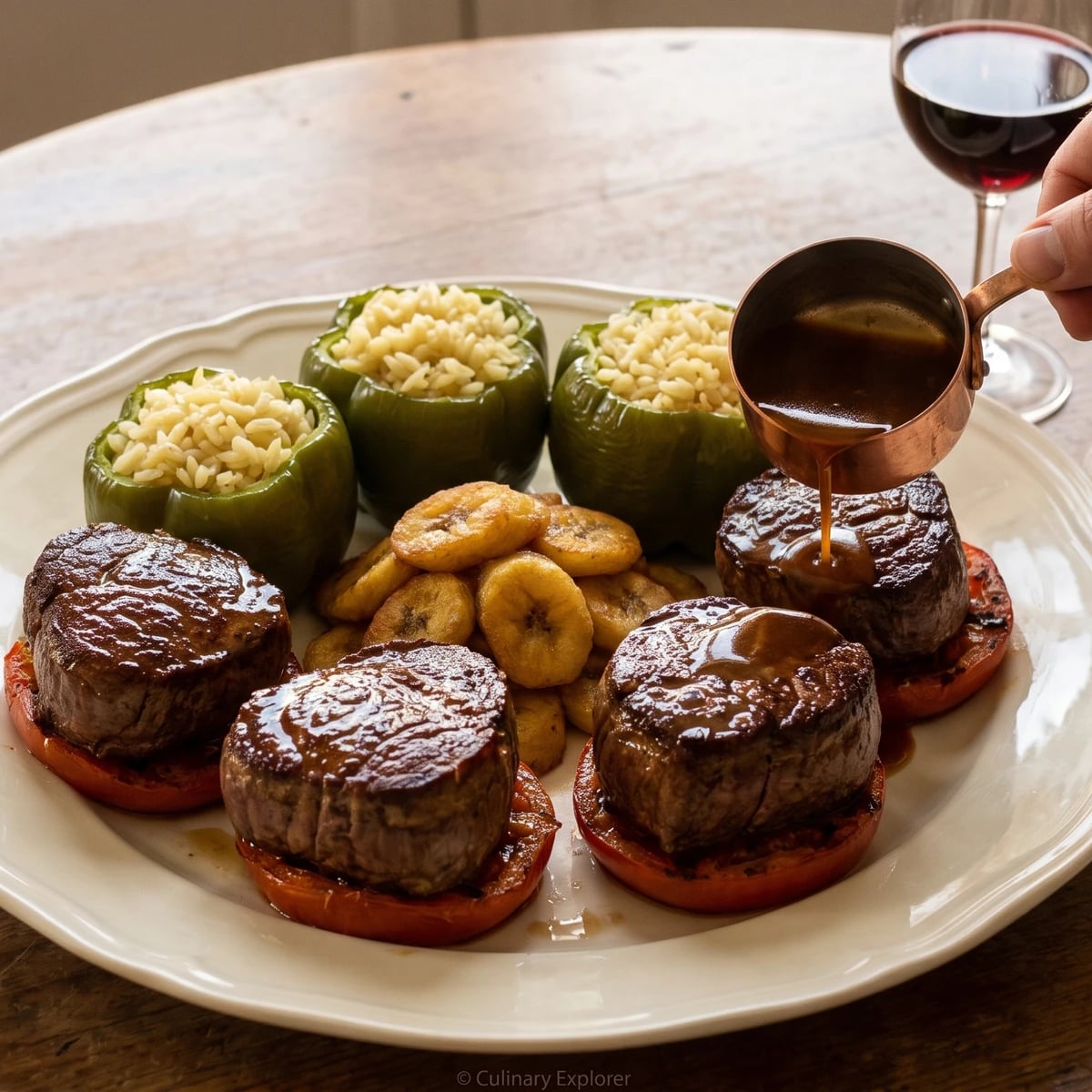
Tournedos seared hard in butter, settled on grilled tomato, capped with rice-stuffed green capsicum, and ringed by fried banana, with glossy Châteaubriand sauce passed separately at the table.
Tournedos Persane (butter-seared beef with rice-stuffed green capsicum and fried banana) teaches orchestration. The one true thing to know is this: the beef waits for nothing. Its tomato pedestal, braised capsicum, fried banana, warm platter, and sauce must all be ready before the tournedos touch the pan.
The original kitchen assumed a saucier at your elbow, stock never off the fire, a salamander for the tomatoes, and enough hands to fry, braise, sear, and plate together. At home, the Châteaubriand sauce remains a finished preparation made ahead, good unsalted stock supplies the braise, and the oven broiler does the salamander's work. Cooking the garnishes in order and holding them briefly replaces the brigade. One cook, one stove, one evening.
The brigade's many holding pans were scaffolding and can go. The butter sear, grilled tomato below, rice-stuffed capsicum above, twelve fried banana slices in the centre, and Châteaubriand sauce passed apart are the dish itself, so every one stays. Before you touch the beef, warm the platter and finish everything else.
Tournedos Persane belongs to the Parisian grand-kitchen repertoire rather than to a Persian regional table or a French farmhouse tradition. On classical menus, à la Persane often signalled an imagined foreign garnish, not a faithful account of Persian cookery, and this combination of green capsicum, rice, and banana reflects that dining-room vocabulary. Its identity remained unusually exact as it moved to private dinner tables: tomato below, stuffed capsicum above, banana at the centre, and Châteaubriand sauce passed separately.
Quantity
4, 5½ to 6 ounces (155 to 170 g) each
cut about 1½ inches (4 cm) thick
Quantity
4, about 14 ounces (400 g) total
stem ends neatly removed and seeds discarded
Quantity
½ cup (120 ml / 95 g)
rinsed
Quantity
2 cups (480 ml / 480 g)
divided
Quantity
8 tablespoons (120 ml / 113 g)
divided
Quantity
2 large, about 1 pound (450 g) total
halved crosswise
Quantity
2 large, about 9 ounces (255 g) peeled
cut into 12 thick diagonal slices
Quantity
1 cup (240 ml / 245 g)
Quantity
2 teaspoons (10 ml / 12 g)
divided
Quantity
1 teaspoon (5 ml / 2 g)
divided
| Ingredient | Quantity |
|---|---|
| center-cut beef tenderloin tournedoscut about 1½ inches (4 cm) thick | 4, 5½ to 6 ounces (155 to 170 g) each |
| very small green capsicumsstem ends neatly removed and seeds discarded | 4, about 14 ounces (400 g) total |
| long-grain white ricerinsed | ½ cup (120 ml / 95 g) |
| unsalted or low-sodium beef stockdivided | 2 cups (480 ml / 480 g) |
| unsalted butterdivided | 8 tablespoons (120 ml / 113 g) |
| firm tomatoeshalved crosswise | 2 large, about 1 pound (450 g) total |
| firm-ripe bananascut into 12 thick diagonal slices | 2 large, about 9 ounces (255 g) peeled |
| prepared Châteaubriand sauce | 1 cup (240 ml / 245 g) |
| fine sea saltdivided | 2 teaspoons (10 ml / 12 g) |
| freshly ground black pepperdivided | 1 teaspoon (5 ml / 2 g) |
Tie each tournedos around its middle with kitchen twine so it keeps a high, round shape. Pat the meat completely dry and leave it uncovered in the cold while you prepare the garnishes. Gently melt 3 tablespoons (45 ml / 43 g) of the butter, skim away the foam, and pour the clear butterfat into a small cup, leaving the milky sediment behind. This clarified butter gives the tournedos the source's butter sear without scorching under the necessary heat. Set out a large round serving platter and a sauceboat so both can be warmed before service.
Put the rinsed rice in a small saucepan with ¾ cup (180 ml / 180 g) of the stock, 1 tablespoon (15 ml / 14 g) of the butter, and ¼ teaspoon (1.25 ml / 1.5 g) of the salt. Bring it to a simmer, cover tightly, and cook over the gentlest heat until the liquid is absorbed and the grains are tender, about 15 minutes. Rest it off the heat for 5 minutes, then fluff it. Divide the warm rice into four portions and mould each gently into a ball that fits its capsicum; press enough to hold, but don't mash the grains into paste.
Fit one rice ball into each capsicum, rounding the exposed rice neatly. Stand the capsicums upright in a snug lidded sauté pan, add 1 cup (240 ml / 240 g) of the stock around them, and dot with 1 tablespoon (15 ml / 14 g) of the butter. Cover and braise at a bare tremble for 20 to 25 minutes, until a knife enters the flesh easily but the capsicums still hold their shape. Lift them carefully to a covered warm plate. Strain the braising liquor and boil it down to ¼ cup (60 ml / 60 g). If a capsicum begins to split, lift it out at once and plate the split toward the centre later; the cooked filling is already safe and the crown will support it.
Set an oven rack about 6 inches (15 cm) below the broiler and heat it well. Arrange the tomato halves cut-side up on a small metal tray, season with ½ teaspoon (2.5 ml / 3 g) of the salt and a little pepper, then dot them with 1 tablespoon (15 ml / 14 g) of the butter. Broil for 5 to 8 minutes, until their edges bronze and the cut surfaces soften without collapsing. Spoon away any loose juice, then arrange the halves cut-side up in a ring on the warmed platter. Turn the oven down to 200°F (95°C) and keep the platter warm only briefly.
Combine the reduced capsicum-braising liquor with the prepared Châteaubriand sauce in a small saucepan. Bring it only to a bare simmer, whisk until smooth and glossy, then taste before adding any salt. If the sauce is thin, simmer it gently until it naps the back of a spoon. If aggressive heat makes it look oily, remove it from the burner and whisk in 1 tablespoon (15 ml / 15 g) of the reserved cool stock. Ça se rattrape. Pour the finished sauce into the warm sauceboat and keep it covered.
Melt 2 tablespoons (30 ml / 28 g) of the butter in a wide skillet over medium-high heat. When it foams, lay in the 12 banana slices without crowding and fry for 45 to 60 seconds per side, until butter-gold at the edges while still holding their shape. Transfer them in a single layer to a small warm tray. If a slice tears, don't fuss with it in the pan; slide it out with a thin spatula and place it beneath the intact slices in the central heap.
Season the dried tournedos with the remaining salt and pepper. Heat a heavy 12-inch (30 cm) skillet until very hot, add the clarified butter, and set in the meat with space between each piece. Sear without moving for 2½ to 3 minutes, until the first face develops a dark Maillard crust, then turn and cook the second face for about 2 minutes. Roll the edges briefly through the butter with tongs. For medium-rare, lift the tournedos at 122 to 125°F (50 to 52°C) and rest them for 4 minutes. If the butter blackens rather than bronzes, lift out the meat, wipe the pan, and restart with fresh butter; burnt milk solids cannot be reasoned with, but the beef can still be saved.
Remove the twine and place one tournedos on each grilled tomato half. Set a braised rice-stuffed capsicum upright on every tournedos, then heap the 12 fried banana slices in the centre of the platter, three for each serving. Carry the platter and the Châteaubriand sauce to the table separately, exactly as the dish requires, and let each guest spoon on the sauce. À table!
1 serving (about 535g)
Culinary guides, cultural storytelling, and the editorial depth that makes cooking meaningful.
Discover Culinary Explorer
Chef Juliette
One tenderloin heart, three classical portions: roast Châteaubriand for carving, bifteck de filet for one, tournedos two to a plate, all with braised endives and a red-wine pan jus.

Chef Juliette
Tournedos Algérienne teaches timing: crisp sweet-potato croquettes and tender oil-stewed tomatoes must be ready before lean fillet meets clarified butter, sears fast, and goes straight to the table.

Chef Juliette
Tournedos crowned over crisp tartlets of wine-braised choucroute and lean ham: a hot, quick grill for the fillet, a dry, buttery foundation below, and Alsace carried through the whole plate.

Chef Juliette
Tender tournedos meet a Provençal ring of golden aubergine and sautéed tomato, each steak crowned with fried onion. The lesson is timing: prepare the garnish, then give lean fillet one hot, quick pan.