
Chef Juliette
John Dory (St. Pierre)
John Dory has the delicacy of sole and the firmness of turbot. A light flouring, a quick butter sauté, and nut-brown beurre noisette show exactly why looks never mattered.
A cooking platform built around craft, culture, and the stories behind what we eat.
Created by Chef Juliette
Based on No. 1106, Tournedos Mascotte, from Le Guide Culinaire (1907) by Auguste Escoffier
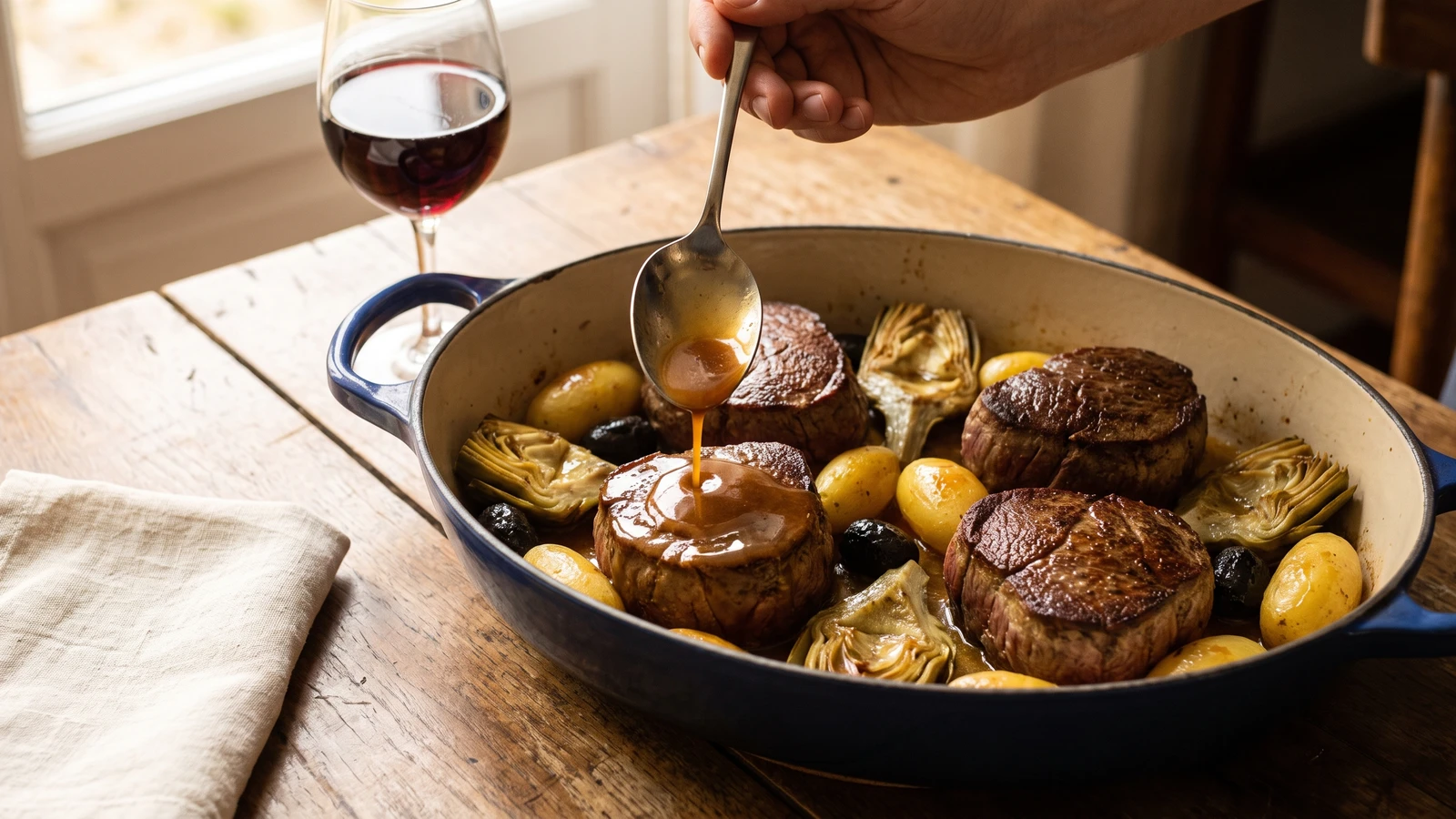
Tournedos Mascotte teaches the pan's clearest lesson: sear the beef in butter, protect the fond, then turn white wine and gravy into the glossy sauce binding artichokes, olive potatoes, and truffle.
Tournedos Mascotte (butter-seared beef medallions with artichokes, olive potatoes, and truffle) teaches the discipline of the fond. The brown film beneath the beef isn't residue; it is the sauce waiting for wine. Sear hot enough to build it, but never so fiercely that the butter and fond turn black.
The original entry assumed a saucier tending brown gravy, a stockpot never off the fire, a garnish cook turning vegetables by the tray, and a fierce front oven doing the salamander's work. At home, four tournedos, one skillet, a shallow cocotte, and a small measure of gelatin-rich gravy accomplish the same intent. Separate holding pans and brigade quantities are scaffolding, so they go. The olive shapes, butter frying, white-wine deglazing, strained reduction, and brief finish in the cocotte are the dish, so they stay. One cook, one stove, one evening.
The finished cocotte should hold four bronze medallions among golden potatoes, nutty artichoke quarters, and black truffle, all caught in a light, gleaming jus. Before you touch the pan, dry the beef thoroughly; once it meets the butter, your one task is to keep the fond deep bronze, never black.
Tournedos Mascotte belongs to the Parisian classical dining-room repertoire, where named garnishes identified complete combinations and told the brigade exactly how a cut of beef should arrive. Mascotte denotes this precise company of butter-fried raw artichoke bottoms, olive-turned potatoes, and similarly shaped truffles, not a separate sauce or regional style. Its white-wine deglazing and brown gravy make the beef's own fond the only sauce required.
Quantity
4 medallions, 24 ounces (680 g) total
each about 1½ inches (4 cm) thick and tied around the circumference
Quantity
4 bottoms, about 2 cups (475 ml / 250 g)
quartered
Quantity
about 8 potatoes, 4 cups (950 ml / 570 g)
peeled and turned into 16 olive shapes
Quantity
1 to 2 small truffles, about ¼ cup (60 ml / 40 g)
divided and turned into olive shapes
Quantity
7 tablespoons (105 ml / 100 g)
divided
Quantity
1½ teaspoons (7.5 ml / 8 g)
divided
Quantity
¾ teaspoon (3.75 ml / 1.5 g)
Quantity
¾ cup (180 ml / 180 g)
Quantity
½ cup (120 ml / 120 g)
| Ingredient | Quantity |
|---|---|
| center-cut beef tenderloin medallionseach about 1½ inches (4 cm) thick and tied around the circumference | 4 medallions, 24 ounces (680 g) total |
| raw artichoke bottomsquartered | 4 bottoms, about 2 cups (475 ml / 250 g) |
| small waxy potatoespeeled and turned into 16 olive shapes | about 8 potatoes, 4 cups (950 ml / 570 g) |
| fresh black truffledivided and turned into olive shapes | 1 to 2 small truffles, about ¼ cup (60 ml / 40 g) |
| unsalted butterdivided | 7 tablespoons (105 ml / 100 g) |
| fine sea saltdivided | 1½ teaspoons (7.5 ml / 8 g) |
| freshly ground black pepper | ¾ teaspoon (3.75 ml / 1.5 g) |
| dry white wine | ¾ cup (180 ml / 180 g) |
| rich, unthickened brown beef or veal gravy | ½ cup (120 ml / 120 g) |
Heat the oven to 400°F (200°C). Tourner the potatoes, trimming them into smooth olive shapes about 1½ inches (4 cm) long, with tapered ends and even middles. A small paring knife replaces the brigade's turning knife perfectly well. Quarter the raw artichoke bottoms just before cooking so they don't linger and darken. Divide the truffle into eight pieces and round each lightly into an olive, keeping every trimming for the cocotte; geometry isn't worth throwing away perfume.
Melt 2 tablespoons (30 ml / 28 g) of the butter in a heavy 12-inch (30 cm) skillet over medium heat. Add the potatoes with ¼ teaspoon (1.25 ml / 1.5 g) of the salt and cook for 8 minutes, turning frequently so their tapered sides color evenly. Add the artichoke quarters and another 2 tablespoons (30 ml / 28 g) of butter, then cook for 10 to 12 minutes more, until both garnishes are tender at the point of a knife and butter-gold outside. If they brown before becoming tender, lower the heat and cover the pan for 2 minutes. Ça se rattrape. Transfer the garnish to the cocotte and cover loosely.
Wipe the skillet only if its butter solids are very dark, then return it to medium-high heat. Pat the tournedos completely dry and season them on both sides with the remaining salt and the pepper. Melt 2 tablespoons (30 ml / 28 g) of butter until it foams, then add the beef with room between the pieces. Fry without disturbing for about 3 minutes per side, spooning the foaming butter over the tops and briefly coloring the edges. For medium-rare after the final oven finish, remove the beef when its center reaches 118 to 122°F (48 to 50°C). If the butter blackens, lift the beef out immediately, wipe the pan, and restart with the reserved tablespoon of butter. Catch it promptly and the fond survives; burnt fond cannot make a good sauce.
Set the tournedos in the cocotte among the potatoes and artichoke quarters, keeping everything in a single generous layer. If the reserved tablespoon (15 ml / 14 g) of butter wasn't needed during searing, melt it briefly in the skillet and roll the truffle olives and trimmings through it for 20 seconds. Add them to the cocotte. If that butter was used to rescue the sear, tuck the truffle straight among the hot garnish; the final heat will warm it without driving away its aroma.
Return the skillet to medium-high heat and immediately pour in the white wine. Scrape the pan firmly with a wooden spoon, dissolving every bronze patch of fond, then reduce the wine until about ¼ cup (60 ml / 60 g) remains. Add all but 2 tablespoons (30 ml / 30 g) of the brown beef or veal gravy and reduce for 2 to 4 minutes, until the sauce is nappant, lightly coating the back of a spoon while still flowing freely. If it tightens too far, whisk in the reserved gravy a spoonful at a time. If it remains thin, give it another minute over lively heat. Taste before adding any more salt.
Strain the sauce through a fine-mesh sieve directly over the tournedos and garnish, pressing only enough to recover the liquid. Set the uncovered cocotte in the oven for 1 to 2 minutes, no longer. This replaces the original front-of-oven finish: its purpose is to marry the sauce, beef, and garnish, not to cook the tournedos again. The beef should finish around 130°F (54°C) for medium-rare. Spoon the glossy sauce over each medallion and bring the cocotte straight to the table. À table!
1 serving (about 375g)
Culinary guides, cultural storytelling, and the editorial depth that makes cooking meaningful.
Discover Culinary ExplorerChef Juliette
John Dory has the delicacy of sole and the firmness of turbot. A light flouring, a quick butter sauté, and nut-brown beurre noisette show exactly why looks never mattered.

Chef Juliette
Fresh haddock proves its delicacy in the meunière pan: a fine flour crust, moist pearly flakes, and beurre noisette sharpened with lemon and parsley, ready from one skillet in half an hour.

Chef Juliette
Éperlans à l’Anglaise turns small fish into a lesson in disciplined coating: boned smelts under a close, crisp crumb, pan-fried in clarified butter and finished with bright, half-melted maître d’hôtel butter.

Chef Juliette
Tiny smelts, shallot, mushrooms, white wine, gratin sauce, and fine bread raspings meet a fierce oven, where the fish must turn tender in the same breath the buttered crust bronzes.