
Chef Juliette
John Dory (St. Pierre)
John Dory has the delicacy of sole and the firmness of turbot. A light flouring, a quick butter sauté, and nut-brown beurre noisette show exactly why looks never mattered.
A cooking platform built around craft, culture, and the stories behind what we eat.
Created by Chef Juliette
Based on No. 1069, Filet de Bœuf Régence, from Le Guide Culinaire (1907) by Auguste Escoffier
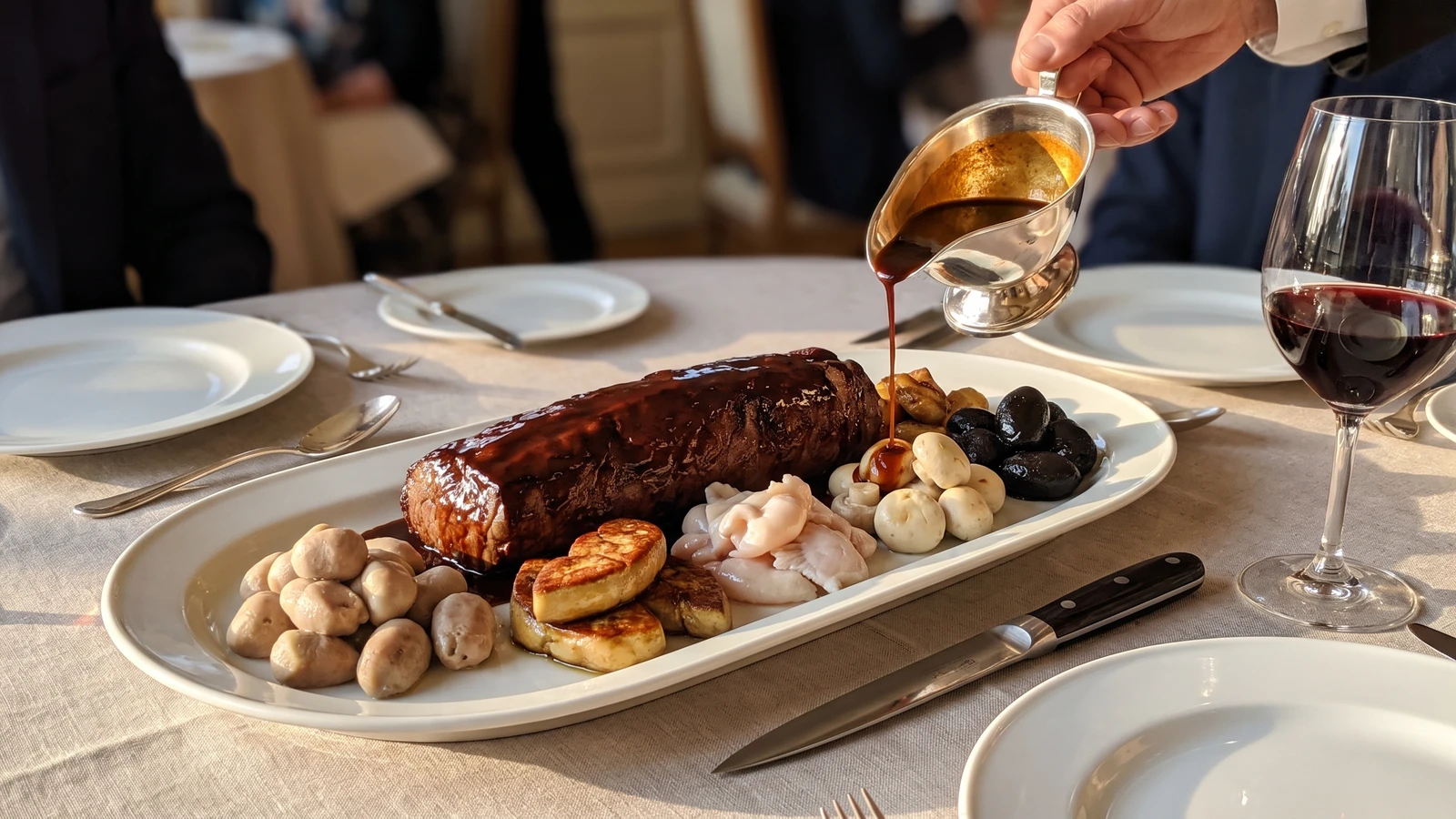
A grand braise scaled for four: Rhine-wine beef fillet glazed to a lacquer, then surrounded by tongue quenelles, foie gras, cocks' combs, white mushrooms, and truffles under a deeply reduced demi-glace.
Filet de Bœuf Régence (beef fillet in the Régence manner) teaches that grandeur is mostly timing. The fillet is tender before it enters the pot, so the one true thing to know before touching a pan is this: every garnish and every sauce component must be ready to finish before the beef is cooked. The reward is a bronzed, glazed fillet surrounded by ivory quenelles, buttery foie gras, white mushroom heads, cocks' combs, and black truffles, with a sauce deep enough to hold them together.
The original assumed a saucier on staff, a stock never off the fire, a salamander, brigade portions, and enough hands to poach quenelles while someone else reduced the sauce. At home, you need prepared demi-glace, a narrow casserole, an instant-read thermometer, and the broiler in place of the salamander. The separate sauce station and its many hands were scaffolding and can go. The Cooked Marinade for Venison (No. 168), the Matignon (No. 227), bacon barding, last-minute garnish, distinct heaps, and concentrated sauce are the dish and must stay. One cook, one stove, one evening.
Pull the beef before it reaches its final temperature, because the glaze and rest will finish it. If the thermometer gets ahead of you, skip the broiler and paint the fillet with boiling glaze instead. Ça se rattrape. The decisive step is taking the fillet from the braise at 48 to 50°C before glazing.
Filet de Bœuf Régence belongs to the Parisian grand-kitchen repertoire, where a named garnish described a complete composition arranged around a central joint. Its foie gras, truffles, cocks' combs, tongue quenelles, and white mushroom heads define the opulent Régence garnish, while Rhine wine supplies the braise; the wine does not make the dish Alsatian. The arrangement itself, rather than any single sauce, is what gives Régence its identity.
Quantity
1 tenderloin, about 2¼ pounds (1 kg)
silverskin removed and tied into an even cylinder
Quantity
2 cups (480 ml / about 480 g) Cooked Marinade for Venison (No. 168)
prepared with dry Rhine wine for its white wine and thoroughly chilled
Quantity
12 thin slices, about 10½ ounces (300 g)
Quantity
1½ cups (360 ml / about 375 g)
unsalted or very low in salt
Quantity
1¼ cups (300 ml / about 300 g)
chilled and already seasoned
Quantity
⅓ cup (80 ml / 60 g)
finely chopped
Quantity
8 collops, about 7 ounces (200 g)
kept cold
Quantity
12, about 6 ounces (170 g)
drained
Quantity
12, about 7 ounces (200 g)
stems removed
Quantity
2 small truffles, about 2 ounces (55 g)
drained if preserved
Quantity
5 tablespoons (75 ml / 70 g)
divided
Quantity
1 tablespoon (15 ml / 15 g)
Quantity
4½ cups (1.08 L / 1.08 kg)
divided between the mushrooms and quenelle poach
Quantity
1½ teaspoons (7.5 ml / 9 g), plus more only after tasting
divided
Quantity
½ teaspoon (2.5 ml / 1 g)
divided
| Ingredient | Quantity |
|---|---|
| center-cut beef tenderloinsilverskin removed and tied into an even cylinder | 1 tenderloin, about 2¼ pounds (1 kg) |
| Cooked Marinade for Venisonprepared with dry Rhine wine for its white wine and thoroughly chilled | 2 cups (480 ml / about 480 g) Cooked Marinade for Venison (No. 168) |
| Matignonprepared and cooled | 1 cup (240 ml / about 225 g) Matignon (No. 227) |
| unsmoked streaky bacon or pork belly | 12 thin slices, about 10½ ounces (300 g) |
| prepared demi-glace, or half-glaze sauceunsalted or very low in salt | 1½ cups (360 ml / about 375 g) |
| prepared ordinary veal forcemeatchilled and already seasoned | 1¼ cups (300 ml / about 300 g) |
| cooked tonguefinely chopped | ⅓ cup (80 ml / 60 g) |
| foie graskept cold | 8 collops, about 7 ounces (200 g) |
| prepared white cooked cocks' combsdrained | 12, about 6 ounces (170 g) |
| white button mushroom headsstems removed | 12, about 7 ounces (200 g) |
| whole black trufflesdrained if preserved | 2 small truffles, about 2 ounces (55 g) |
| unsalted butterdivided | 5 tablespoons (75 ml / 70 g) |
| fresh lemon juice | 1 tablespoon (15 ml / 15 g) |
| waterdivided between the mushrooms and quenelle poach | 4½ cups (1.08 L / 1.08 kg) |
| fine sea saltdivided | 1½ teaspoons (7.5 ml / 9 g), plus more only after tasting |
| ground white pepperdivided | ½ teaspoon (2.5 ml / 1 g) |
Set the tied fillet in a snug nonreactive dish and pour over the chilled Cooked Marinade for Venison (No. 168). Cover and refrigerate for 2 to 3 hours, turning the beef twice so the wine reaches it evenly. Do not leave tenderloin in the marinade overnight; its delicate exterior will soften long before the centre gains anything useful. If it runs an hour long, pat the surface thoroughly dry and continue. The dish is not lost.
While the beef marinates, fold the chopped tongue evenly through the cold ordinary veal forcemeat. With a coffee spoon dipped in cold water, shape 12 neat quenelles and arrange them on a cold tray; cover and refrigerate. Trim the mushroom heads cleanly. Shape the truffles like large olives with a small knife, reserving every trimming for the sauce. Drain the cocks' combs and keep each garnish separate. This order is not fussiness. The garnish must be waiting for the beef, never the reverse.
Heat the oven to 325°F (165°C). Lift the beef from the marinade and reserve every drop of liquid. Pat the fillet lightly, then season it with ½ teaspoon salt and ¼ teaspoon white pepper. Cover the meat evenly with the cooled Matignon (No. 227). Lay the bacon slices in an overlapping rectangle, set the covered fillet across them, and wrap the bacon closely around the meat; secure it with butcher's twine. Set the parcel in a narrow lidded casserole and pour the reserved Cooked Marinade for Venison (No. 168) around it, taking care not to wash away the Matignon.
Cover the casserole and bring the liquid just to a tremble over medium heat, then transfer it to the oven. Braise for 30 to 45 minutes, turning the parcel once, until the centre reaches 118 to 122°F (48 to 50°C) for a medium-rare finish after glazing and resting. Use the thermometer, not the clock; tenderloin has very little connective tissue and a hard simmer only tightens it. If it has already passed 130°F (54°C), remove it immediately and skip the broiler later. Brush it with boiling glaze instead. Ça se rattrape.
Lift the beef to a broiler-safe tray. Snip away the twine, peel off the bacon, and scrape the Matignon (No. 227) into the casserole. Tent the fillet loosely while you work. Pour the braising liquor through a fine sieve into a wide saucepan, pressing firmly on the vegetables to recover their juices, then discard the solids. Let the liquid stand for a minute and spoon away every visible pool of fat. The bacon and aromatic covering have done their work; leaving them on now would prevent the clean glaze the dish requires.
Boil the strained liquor from the Cooked Marinade for Venison (No. 168) until reduced to about ¾ cup (180 ml), skimming as needed. Add the demi-glace and the reserved truffle trimmings, then simmer until the sauce coats the back of a spoon in a glossy, wine-dark layer. Taste before adding salt. Reserve ⅓ cup (80 ml) for glazing, then take the remaining sauce off the heat and whisk in 2 tablespoons of cold butter. If the butter floats instead of disappearing, the pan is too hot; whisk in a spoonful of cold water away from the heat. Ça se rattrape. If the reduction is too strong or salty, loosen it with hot water rather than reducing it further.
Bring 4 cups (960 ml) of the water and ½ teaspoon salt to the barest tremble. Slip in the tongue quenelles and poach for 5 to 7 minutes, without boiling, until they feel lightly springy and reach 160°F (71°C) at the centre. Drain them carefully and keep them plain. If the first quenelle frays, lower the heat and chill the remaining mixture for 10 minutes before continuing. In a second pan, make a cuisson à blanc, a covered white cooking, with the mushroom heads, 1 tablespoon butter, the remaining ½ cup (120 ml) water, the lemon juice, and a pinch of salt. Cook for 5 to 6 minutes, just until tender and still very white. Warm the cocks' combs and truffle olives separately in spoonfuls of sauce so each garnish keeps its shape and identity.
Keep the foie gras cold until the last moment. Heat 2 tablespoons butter in a wide pan until the foam subsides, then add the collops in one uncrowded layer. Toss them gently for 30 to 45 seconds per side, just until their surfaces take a little gold and the centres soften. Season lightly and lift them out at once. If they begin shedding fat before they colour, the pan was not hot enough; remove them, cool the pan, and begin again over brisker heat with the remaining pieces.
Heat the broiler, the home kitchen's honest equivalent of the salamander. Brush the fillet with a thin coat of the reserved reduced sauce and place it close to the heat for 20 to 30 seconds, only until the glaze sets and darkens. Brush and repeat once or twice to build a bronzed lacquer, watching without interruption because the sweetened wine marinade can catch quickly. If the beef reached its final temperature during the braise, do not broil it. Paint it twice with boiling glaze and let each coat set in the open air.
Set the whole glazed fillet on a warm long platter. Arrange the tongue quenelles, foie gras collops, cocks' combs, mushroom heads, and truffle olives around it in distinct heaps, never scattered together. Leave the quenelles plain and spoon only a light veil of sauce over the other garnishes. Pour the remaining sauce into a warm sauceboat and send it separately, exactly as the composition requires. Carve the fillet at the table. À table!
1 serving (about 620g)
Culinary guides, cultural storytelling, and the editorial depth that makes cooking meaningful.
Discover Culinary ExplorerChef Juliette
John Dory has the delicacy of sole and the firmness of turbot. A light flouring, a quick butter sauté, and nut-brown beurre noisette show exactly why looks never mattered.

Chef Juliette
Fresh haddock proves its delicacy in the meunière pan: a fine flour crust, moist pearly flakes, and beurre noisette sharpened with lemon and parsley, ready from one skillet in half an hour.

Chef Juliette
Éperlans à l’Anglaise turns small fish into a lesson in disciplined coating: boned smelts under a close, crisp crumb, pan-fried in clarified butter and finished with bright, half-melted maître d’hôtel butter.

Chef Juliette
Tiny smelts, shallot, mushrooms, white wine, gratin sauce, and fine bread raspings meet a fierce oven, where the fish must turn tender in the same breath the buttered crust bronzes.