Culinary Explorer

A cooking platform built around craft, culture, and the stories behind what we eat.
Discover Culinary Explorer
Filet de Bœuf Lorette

Filet de Bœuf Lorette

Created by Chef Juliette

Based on No. 1058, Filet de Bœuf Lorette, from Le Guide Culinaire (1907) by Auguste Escoffier

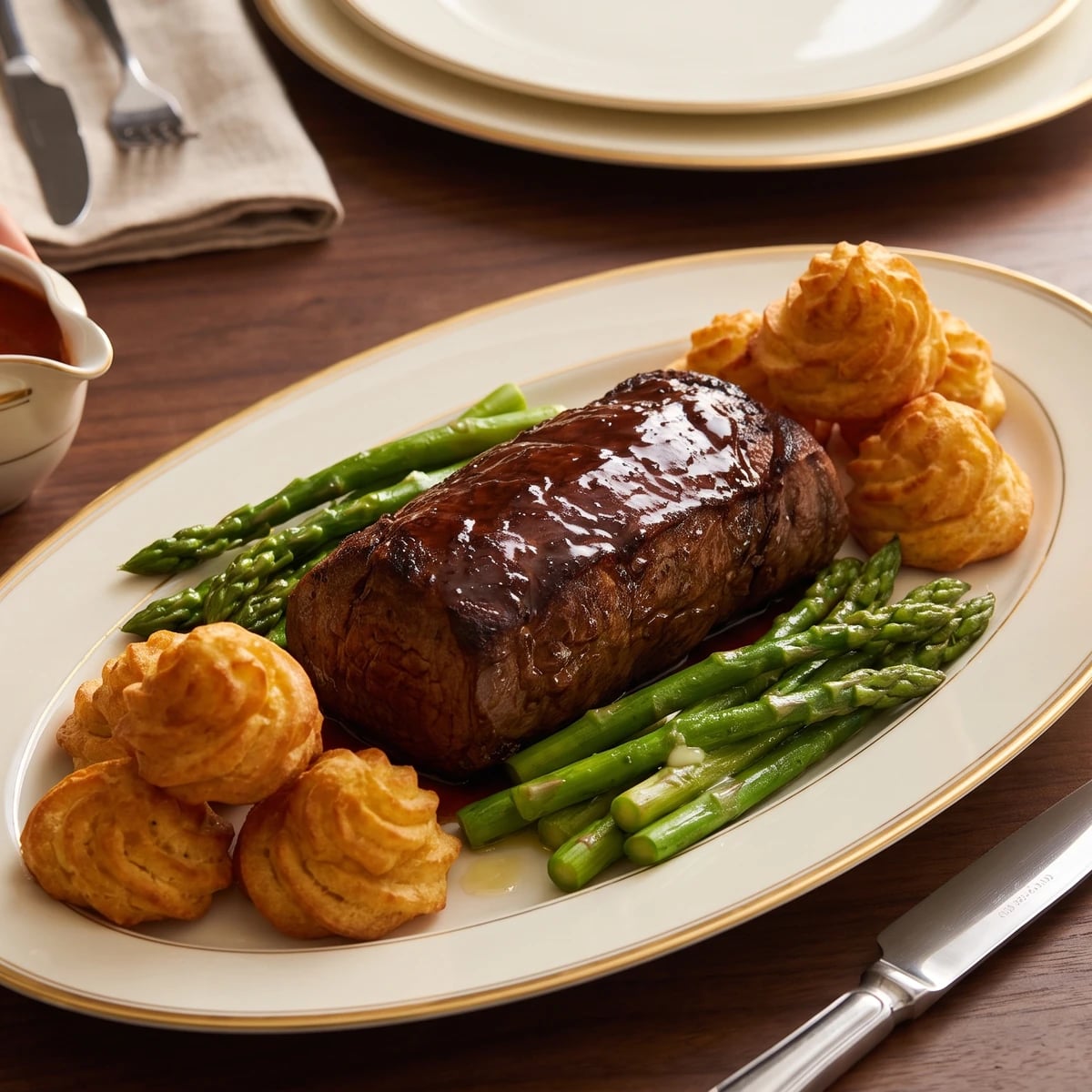
Butter-poëled beef, crisp choux-potato crescents, and asparagus gather around one platter: Filet de Bœuf Lorette teaches the home cook that grand service is really timing, not theatrical fuss.

Main Dishes
French
Dinner Party
Special Occasion
45 min
Active Time
45 min cook1 hr 30 min total
Yield4 servings

Filet de Bœuf Lorette (beef fillet butter-roasted with Lorette potato crescents and asparagus) teaches one thing before you touch a pan: grand service is timing made visible. The fillet must be rested yet hot, the asparagus glossed at the last breath, the Pommes de Terre Lorette (No. 2226) crisp enough to stand in two pyramids, and the sauce warm but still apart. None is difficult alone. They must arrive together.

The book's kitchen assumed a larding needle, a saucier on staff, stock never off the fire, a fry cook waiting beside very hot fat, and a salamander fierce enough to glaze the beef in moments. Your honest equivalents are a narrow boning knife, prepared veal demi-glace, Poëlings (No. 250) scaled to one fillet, a heavy lidded casserole, and the broiler already hot. The brigade staffing is scaffolding and goes. The larding, butter poëling, made-to-order frying, paired pyramids, butter-bound asparagus, last glaze, and sauce served apart are the dish and stay. One cook, one stove, one evening.

Do the quiet work first: shape and chill the potatoes, trim the asparagus, build the tomatéd half-glaze, and warm the platter. Then the final minutes become assembly rather than panic. The one step that decides the whole presentation is the fry: drop the potato crescents only while the rested fillet is waiting to be glazed.

Filet de Bœuf Lorette belongs to the Parisian classical service repertoire, where a named garnish could give a dish its identity as surely as the cut of meat. Lorette here is not a regional claim: the name travels with the cheese-enriched choux-potato crescents of Pommes de Terre Lorette (No. 2226), set in pyramids with asparagus around a whole fillet and a tomatéd half-glaze sent apart. The composition moved from staffed banquet kitchens to the bourgeois celebration table by keeping the arrangement while reducing the number of hands required to serve it.

The technique, the tradition, and the story behind every dish.

Discover Culinary Explorer

Ingredients

center-cut beef fillet roast

Quantity

1 roast, 2 lb (900 g)

trimmed and tied evenly

unsmoked salt-cured fatback

Quantity

2½ oz (70 g)

chilled and cut into 8 slender batons

Poëlings (No. 250)

Quantity

1 batch, scaled in its entry for a 2 lb (900 g) fillet

prepared veal demi-glace

Quantity

1¼ cups (300 ml / 310 g)

divided

double-concentrated tomato purée

Quantity

1½ tablespoons (22 ml / 25 g)

Pommes de Terre Lorette (No. 2226)

Quantity

12 crescents, about 1 lb 2 oz (510 g)

chilled, dredged, and ready to fry

refined peanut or sunflower oil

Quantity

6 cups (1.5 L / about 1.38 kg)

for deep-frying

slender asparagus tips

Quantity

24 tips, from about 1 lb (450 g) asparagus

trimmed to 3 inches (8 cm)

unsalted butter

Quantity

2 tablespoons (30 ml / 28 g)

cubed

fine sea salt

Quantity

1½ teaspoons (7.5 ml / 9 g)

divided

coarse salt

Quantity

2 tablespoons (30 ml / 36 g)

for the asparagus water

freshly ground black pepper

Quantity

¾ teaspoon (3.75 ml / 1.5 g)

Equipment Needed

  • Larding needle or narrow boning knife
  • 3 to 4 quart (3 to 4 L) heavy lidded casserole for Poëlings (No. 250)
  • Instant-read thermometer
  • 4 to 5 quart (4 to 5 L) heavy frying pot
  • Deep-fry thermometer and wire spider
  • 16 inch (40 cm) long serving platter
  • Small warmed sauceboat

Instructions

  1. 1

    Stage the service

    Take the beef from the cold 45 minutes before cooking. Heat the oven to 325°F (160°C), place a rack in the upper third, and have the Poëlings (No. 250) component measured and ready. Set out the chilled Pommes de Terre Lorette (No. 2226), a long warm platter, and a warmed sauceboat. Fill the frying pot no more than halfway with oil, but do not heat it yet. This mise en place is what replaces four separate cooks.

  2. 2

    Lard the fillet

    Pat the fillet completely dry. Push a larding needle lengthwise through the meat and draw in the chilled fatback batons, spacing them evenly; without the needle, make eight narrow tunnels parallel to the grain with a slim boning knife and guide each baton through with a clean skewer. Keep the cuts narrow so the fat stays enclosed. If the fatback softens or smears, chill both meat and fat for 10 minutes, then continue. Season the surface with 1 teaspoon of the fine salt and all the pepper.

  3. 3

    Prepare the half-glaze

    Warm the veal demi-glace over low heat until fluid, then reserve 3 tablespoons (45 ml) plain for glazing the fillet. Whisk the tomato purée into the remainder and simmer gently for 5 to 8 minutes. Tomatéd means the tomato must be distinctly visible in both shade and flavour, not merely whispered into the pot. The half-glaze is ready when it coats the back of a spoon in a glossy film. If it becomes sticky, loosen it with a spoonful of water; if it runs like broth, reduce it a little longer. Hold it barely warm.

  4. 4

    Poële the beef

    Cook the fillet using Poëlings (No. 250), following its butter-rich vegetable bed, covered cooking, and frequent basting at the smaller scale specified in that entry. Begin checking the centre after 20 minutes and uncover near the end so the surface takes a fine bronze colour. Remove the beef at 120 to 122°F (49 to 50°C) for medium-rare or 126 to 129°F (52 to 54°C) for medium; carryover heat will finish it as it rests. If the vegetables threaten to scorch, lower the oven and move the vessel upward, but do not add liquid during the poëling because that turns the method toward a braise. Rest the beef loosely covered for 12 to 15 minutes while you complete the linked preparation's extraction, then strain and degrease its liquor.

  5. 5

    Blanch the asparagus

    While the beef cooks, bring a wide saucepan of water to a lively boil and add the coarse salt. Blanch the asparagus tips for 2 to 3 minutes, until vivid green and tender when pierced but still able to hold their shape. Lift them into cold water to stop the cooking, drain thoroughly, and spread them on a towel. Wet asparagus dilutes the butter and slides into a heap instead of holding one.

  6. 6

    Fry the Lorette potatoes

    As the beef rests, heat the frying oil to 355°F (180°C). Lower half the Pommes de Terre Lorette (No. 2226) into the fat with a spider and fry for about 6 minutes, turning gently, until expanded, crisp, and evenly deep gold. Drain on a rack and hold in a 225°F (110°C) oven while frying the second batch. If the first crescent slumps or splits, lift it out, return the fat to 355°F (180°C), and chill the remaining crescents for 10 minutes. Ça se rattrape. Never crowd the pot or fill it beyond halfway.

  7. 7

    Glaze the fillet

    Heat the broiler fully and place its rack about 6 inches (15 cm) from the element. Remove the strings from the rested fillet. Reduce the reserved plain demi-glace until tacky enough to cling, brush it over the beef, and place the fillet under the broiler for 30 to 45 seconds, just until the coating shines and catches a deeper bronze. If the glaze slides off, it is too thin: boil it for another minute, brush again, and use the broiler only long enough to set it. Stir ¼ cup (60 ml) of the strained poëling liquor into the tomatéd half-glaze and return that sauce to a bare simmer.

  8. 8

    Build the platter

    Melt the butter in a wide pan with 1 tablespoon of the asparagus water. Let it boil into a milky emulsion, add the asparagus tips, and turn them gently until the butter clings and the green shines. If the butter separates into an oily puddle, pull the pan from the heat, add a teaspoon of cold water, and shake until it comes together. Set the whole glazed fillet lengthwise on the warm platter. Build one pyramid of six potato crescents at each end, then arrange the asparagus in four fine butter-bound heaps along the sides. Pour the hot tomatéd half-glaze into the warmed sauceboat and send it separately. À table!

Chef Tips

  • Ask for a uniformly thick center section of beef fillet. A tapered roast forces you to choose between an overdone tail and an underdone middle, and no quantity of sauce repairs the geometry.
  • Use unsmoked salt-cured fatback, not smoked bacon. The larding is here to carry richness through a very lean cut; smoke would announce itself over the asparagus and change the dish.
  • A frozen veal demi-glace made from stock and gelatin is the honest home equivalent to the saucier's simmering pot. If you begin with unsalted veal stock instead, reduce 6 cups (1.5 L / about 1.5 kg) to 1¼ cups (300 ml / about 310 g) before measuring it into the recipe.
  • Fresh asparagus with tight tips gives the cleanest heaps. Good frozen tips can stand in when the market is poor, but blanch them from frozen, dry them carefully, and expect a softer texture.
  • For frying, use a stable refined oil and a thermometer. The potato crescents need heat fierce enough to expand and set their shell, but the pot must remain no more than half full.
  • Pour a supple Médoc or a red Burgundy with freshness rather than heavy oak. The fillet is delicate; the sauce supplies the depth.

Advance Preparation

  • The Pommes de Terre Lorette (No. 2226) can be shaped, dredged, and chilled a day ahead. Frying is the dish, so that part waits until the fillet rests.
  • The tomatéd half-glaze can be prepared up to two days ahead, chilled, and reheated gently. Reserve the plain demi-glace for glazing before adding the tomato.
  • The Poëlings (No. 250) setup can be measured earlier in the day, and the fillet can be larded and tied up to 4 hours ahead. Keep it covered in the cold, then bring it out 45 minutes before cooking.
  • The asparagus can be trimmed and blanched up to 4 hours ahead. Dry and chill it, then bind it with butter only during final assembly.

Frequently Asked Questions

Nutrition Information

1 serving (about 450g)

Calories
1055 calories
Total Fat
72 g
Saturated Fat
27 g
Trans Fat
1 g
Unsaturated Fat
40 g
Cholesterol
235 mg
Sodium
2200 mg
Total Carbohydrates
43 g
Dietary Fiber
5 g
Sugars
4 g
Protein
59 g

Note: Chef personas and recipes are created with AI assistance. Cook with care: follow safe food-handling practices, check doneness with a thermometer when needed, and adapt for allergies and your kitchen.

Where cooking meets culture.

Culinary guides, cultural storytelling, and the editorial depth that makes cooking meaningful.

Discover Culinary Explorer

More from Relevés and Entrées - BEEF

Browse the full collection