
Chef Juliette
John Dory (St. Pierre)
John Dory has the delicacy of sole and the firmness of turbot. A light flouring, a quick butter sauté, and nut-brown beurre noisette show exactly why looks never mattered.
A cooking platform built around craft, culture, and the stories behind what we eat.
Created by Chef Juliette
Based on No. 1013, Filets de Maquereau à la Vénitienne, from Le Guide Culinaire (1907) by Auguste Escoffier
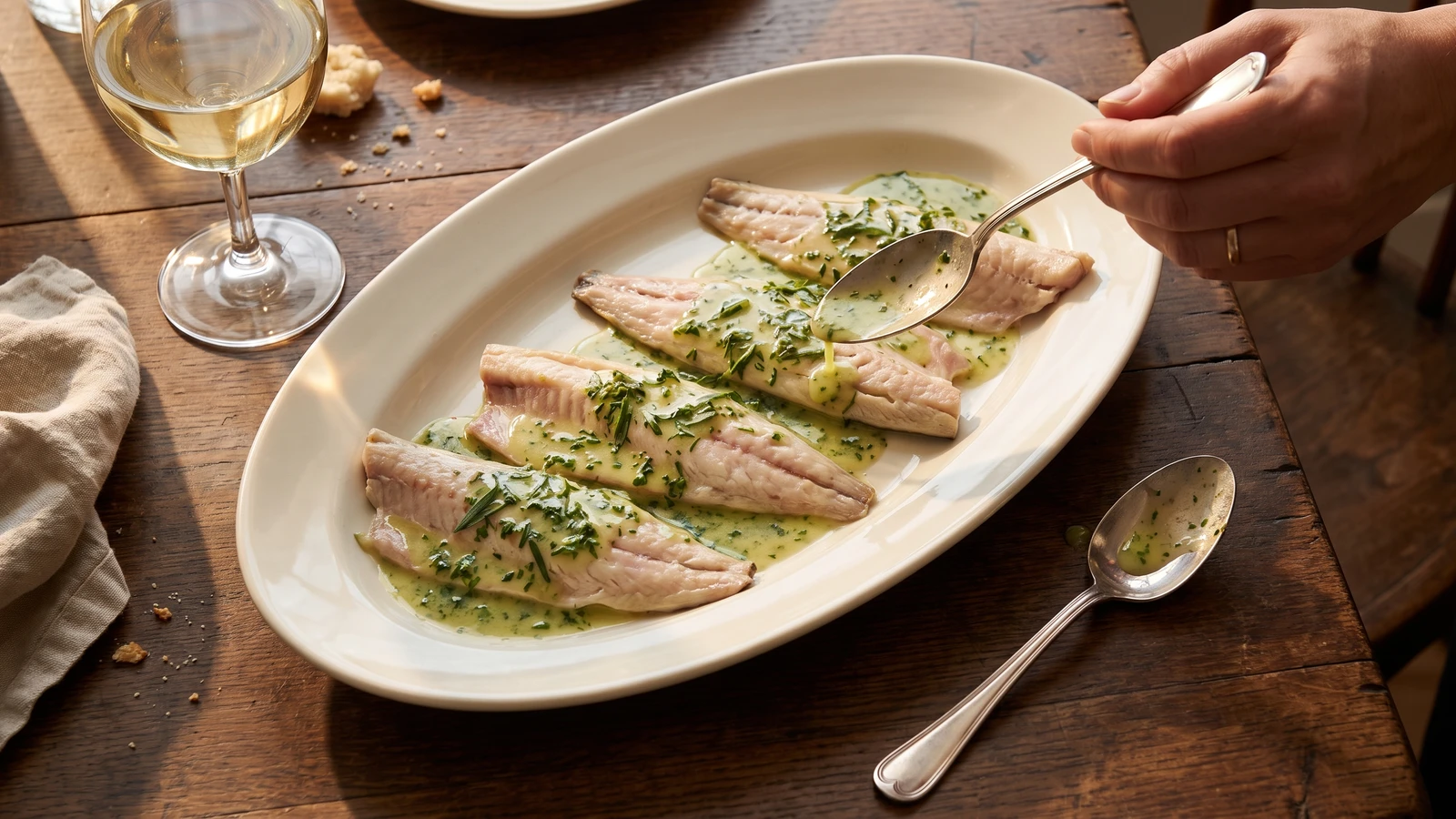
Mackerel takes kindly to gentle poaching: white-wine court-bouillon keeps the flesh succulent, while sauce vénitienne brings buttered body, tarragon, chervil, and green herb brightness to cut the fish’s richness.
Filets de Maquereau à la Vénitienne (mackerel fillets with Venetian sauce) teaches the discipline of poaching an oil-rich fish: the liquid must tremble, never boil. Mackerel is generous but delicate. Court-bouillon keeps its flesh succulent, while the herb-sharp sauce answers that richness with white wine, tarragon, and chervil.
The old entry assumed a saucier on staff, a finished white-wine sauce already in production, and a fish kettle built for brigade portions, much as that kitchen kept stock never off the fire. No salamander is needed here. At home, the referenced sauce remains a separate finished preparation, exactly as the book keeps it, while a wide shallow pan replaces the fish kettle and four portions replace the service tray. That is scaffolding we can remove. The wine court-bouillon, the skinning after poaching, and the final cloak of sauce are the dish, so they stay. One cook, one stove, one evening.
Lift the fillets with two tools if they feel fragile, and peel their skins while the flesh is still warm. If one splits, fit it back together on the long platter and cover it confidently. Ça se rattrape. The one step that matters most is heat control: settle the court-bouillon below a simmer before the mackerel goes in.
Filets de maquereau à la Vénitienne belongs to the Parisian classical fish table, where a geographical menu phrase often named a sauce treatment rather than a proven birthplace. Here Vénitienne means a white-wine sauce sharpened with tarragon vinegar, chervil, and tarragon, then colored with herb juice, a bright counterpoint to mackerel’s oil-rich flesh. As the treatment moved from grand kitchens into cuisine bourgeoise, the fish kettle and saucier disappeared, but the gentle wine poach and green herb finish remained.
Quantity
4 large or 8 small fillets (about 1½ pounds / 680 g total)
pin bones removed
Quantity
2 cups (475 ml / 475 g)
Quantity
2 cups (475 ml / 470 g)
Quantity
1 tablespoon (15 ml / 15 g)
Quantity
1 small (about ¾ cup / 110 g)
thinly sliced
Quantity
1 small (about ½ cup / 70 g)
thinly sliced
Quantity
8
Quantity
2 sprigs
Quantity
1
Quantity
10
Quantity
2 teaspoons (10 ml / 12 g)
| Ingredient | Quantity |
|---|---|
| skin-on mackerel filletspin bones removed | 4 large or 8 small fillets (about 1½ pounds / 680 g total) |
| water | 2 cups (475 ml / 475 g) |
| dry white wine | 2 cups (475 ml / 470 g) |
| white wine vinegar | 1 tablespoon (15 ml / 15 g) |
| yellow onionthinly sliced | 1 small (about ¾ cup / 110 g) |
| carrotthinly sliced | 1 small (about ½ cup / 70 g) |
| parsley stems | 8 |
| thyme | 2 sprigs |
| bay leaf | 1 |
| black peppercorns | 10 |
| fine sea salt | 2 teaspoons (10 ml / 12 g) |
| prepared Venetian Saucekept warm | 1½ cups (360 ml / 375 g) Venetian Sauce (No. 107) |
Combine the water, wine, vinegar, onion, carrot, parsley stems, thyme, bay leaf, peppercorns, and salt in a wide, shallow pan. Bring the liquid just to a simmer, partially cover, and cook gently for 15 minutes, until it smells briskly of wine and aromatics. Strain it into a clean bowl, discard the vegetables and herbs, then return the liquid to the pan. Reserve ¼ cup (60 ml) separately for adjusting the sauce.
Let the strained court-bouillon settle between 175 and 185°F (80 and 85°C), with movement beneath the surface but no breaking bubbles. Arrange the mackerel skin-side down in one layer and lay a parchment cartouche directly on the liquid. Poach for 4 to 6 minutes, until the thickest part reaches 145°F (63°C) and separates into large, moist flakes under gentle pressure. Boiling makes the flesh dry and breaks the fillets; if bubbles begin breaking hard, pull the pan from the heat, remove the parchment, and let it settle for 30 seconds before continuing over lower heat. Ça se rattrape.
Warm a long oval platter with hot water, then dry it thoroughly. Lift each fillet from the court-bouillon with a flexible fish spatula, steadying the top with a wide spoon, and drain it briefly on a clean towel. Set it skin-side up, catch the skin at the narrow end with a paring knife, and peel it back while the fish is still warm. If it resists, slide the knife nearly flat beneath the skin rather than pulling harder. Arrange the skinned fillets neatly on the warm platter. If one splits, fit the pieces together in their original shape; the sauce will cloak the join, and you never apologize at your own table.
Warm the Venetian Sauce (No. 107) in a small heavy saucepan over low heat, stirring gently and never letting it boil. It is ready when it coats the back of a spoon with a glossy, herb-flecked layer. If chilling has tightened it, whisk in the reserved court-bouillon one teaspoon at a time until it flows generously but still holds to the spoon.
Nappez, meaning cloak, the fillets from end to end with the warm Venetian Sauce (No. 107), letting it pool generously around them without drowning their shape. Wipe the rim of the platter, carry it directly to the table, and serve while the mackerel remains succulent and the herbs are bright. À table!
1 serving (about 230g)
Culinary guides, cultural storytelling, and the editorial depth that makes cooking meaningful.
Discover Culinary ExplorerChef Juliette
John Dory has the delicacy of sole and the firmness of turbot. A light flouring, a quick butter sauté, and nut-brown beurre noisette show exactly why looks never mattered.

Chef Juliette
Fresh haddock proves its delicacy in the meunière pan: a fine flour crust, moist pearly flakes, and beurre noisette sharpened with lemon and parsley, ready from one skillet in half an hour.

Chef Juliette
Éperlans à l’Anglaise turns small fish into a lesson in disciplined coating: boned smelts under a close, crisp crumb, pan-fried in clarified butter and finished with bright, half-melted maître d’hôtel butter.

Chef Juliette
Tiny smelts, shallot, mushrooms, white wine, gratin sauce, and fine bread raspings meet a fierce oven, where the fish must turn tender in the same breath the buttered crust bronzes.