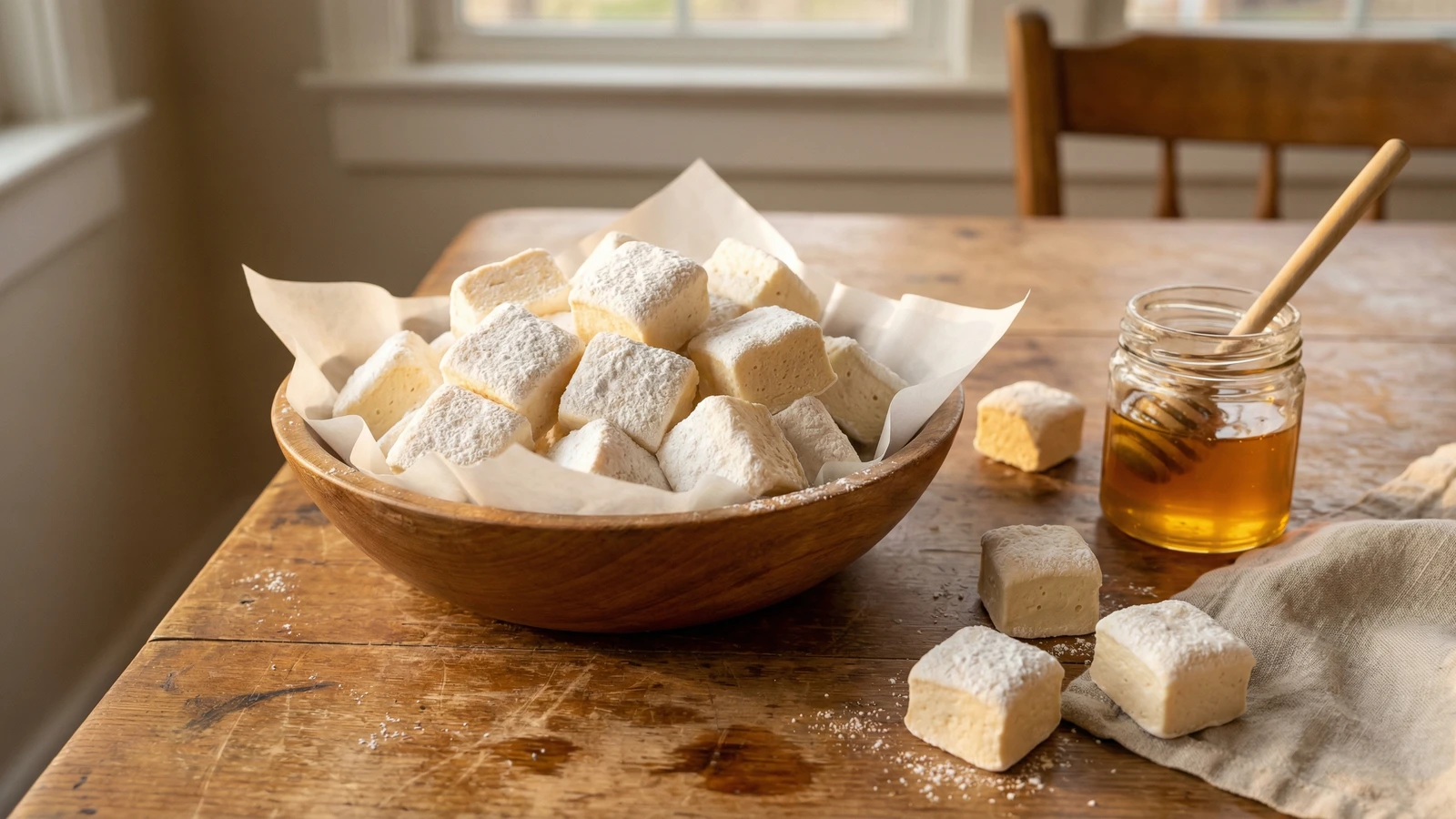
Pillowy squares of honey sweetness, made by hand with local wildflower honey, dusted in powdered sugar, and impossibly soft in a way no plastic bag could ever deliver.
Desserts
American
Holiday
Make Ahead
Christmas
30 min
Active Time
15 min cook•4 hr 45 min total
YieldAbout 64 marshmallows
Start with the honey. Not the plastic bear from the supermarket shelf, but real honey from a beekeeper you can visit, honey that tastes like the flowers the bees found. Wildflower honey carries the flavor of a place and a season. Clover, goldenrod, blackberry blossoms, whatever bloomed that summer. This is the soul of your marshmallow.
Store-bought marshmallows taste like sugar and air. Nothing more. When you make them yourself with good honey, something else happens. The flavor is subtle but real: floral, warm, and alive. The texture is different too. Softer. Cloudlike. They dissolve on the tongue instead of squeaking against your teeth.
The technique asks for a candy thermometer and a stand mixer. Beyond that, there is little standing between you and something genuinely homemade. Hot sugar, bloomed gelatin, and patience as the mixer does its work. Ten minutes of whipping transforms the amber syrup into billowing white clouds. It feels like magic, but it is just chemistry in service of a better ingredient.
Every meal is a meaningful choice, even the small ones. Making marshmallows for hot cocoa or a holiday gift box connects you to the beekeeper, to the flowers, to a slower way of doing things. That connection matters. And the marshmallows taste better for it.
The technique, the tradition, and the story behind every dish.
Pour the cold water into the bowl of a stand mixer fitted with the whisk attachment. Sprinkle the gelatin evenly across the surface. Do not stir. Let it sit undisturbed for ten minutes while you prepare the syrup. The gelatin will absorb the water and become spongy, a process called blooming that ensures smooth, lump-free marshmallows.
2
Prepare the pan
While the gelatin blooms, prepare a 9x9 inch baking pan. Line it with parchment paper, leaving overhang on two sides for easy lifting later. Whisk together the powdered sugar and cornstarch in a small bowl, then dust the parchment generously with this mixture. Set aside extra coating for the top and cut surfaces.
3
Cook the honey syrup
Combine the honey, granulated sugar, remaining water, and salt in a medium saucepan. Attach a candy thermometer to the side. Set over medium-high heat and stir gently until the sugar dissolves. Once dissolved, stop stirring. Let the syrup bubble and climb to 240°F, the soft ball stage. This takes eight to twelve minutes. Watch carefully near the end because honey burns easily.
If you do not have a candy thermometer, drop a small amount of syrup into ice water. At 240°F it will form a soft, pliable ball that flattens when pressed.
4
Stream syrup into gelatin
Remove the syrup from heat. Turn the mixer to low speed and carefully pour the hot syrup down the side of the bowl in a slow, steady stream, avoiding the whisk to prevent spattering. The mixture will bubble and steam. Once all the syrup is added, increase the speed to high.
Hot sugar syrup can cause serious burns. Pour slowly and keep your face and hands clear of the bowl.
5
Whip until transformed
Beat on high speed for ten to twelve minutes. The mixture will begin as a thin, amber liquid. Gradually it will turn opaque, then pale, then pure white. The bowl will cool from hot to barely warm. When finished, the marshmallow should be thick, glossy, and tripled in volume. It will hold soft peaks and fall slowly from the whisk in thick ribbons. Add the vanilla in the last minute of beating.
6
Pour and smooth
Working quickly before the marshmallow sets, scrape it into the prepared pan using a lightly oiled spatula. The mixture is sticky and unforgiving, so move decisively. Smooth the top as best you can, then dust generously with more powdered sugar mixture. Let the marshmallow set at room temperature, uncovered, for at least four hours or overnight.
7
Cut into squares
Lift the slab from the pan using the parchment overhang. Dust a cutting board with more coating mixture. Invert the marshmallow onto the board and peel away the parchment. Cut into roughly one-inch squares using an oiled knife or pizza cutter. Toss each piece in the coating to prevent sticking. The marshmallows will feel pillowy and spring back when pressed.
Chef Tips
•Find your honey at a farmers market. Talk to the beekeeper. Ask what bloomed that year. The conversation is part of the pleasure, and you will learn which honey varieties you prefer.
•Oil your spatula, your knife, and your hands. Marshmallow is tenacious. A little vegetable oil prevents wrestling matches with sticky equipment.
•Humidity is the enemy of homemade marshmallows. Store them in a dry place, and avoid making them on rainy days when they may never fully set.
•For holiday gifting, cut marshmallows into festive shapes using oiled cookie cutters. Dust generously and package in cellophane bags with ribbon.
Advance Preparation
•Marshmallows keep for two to three weeks stored in an airtight container at room temperature, each layer separated by parchment paper.
•The marshmallow slab can set overnight before cutting. This actually makes cutting easier as the exterior firms slightly.
•Do not refrigerate. Cold and humidity cause marshmallows to weep and become sticky.
Frequently Asked Questions
Nutrition Information
1 serving (about 14g)
Calories
35 calories
Total Fat
0 g
Saturated Fat
0 g
Trans Fat
0 g
Unsaturated Fat
0 g
Cholesterol
0 mg
Sodium
9 mg
Total Carbohydrates
9 g
Dietary Fiber
0 g
Sugars
8 g
Protein
0 g
Where cooking meets culture.
Culinary guides, cultural storytelling, and the editorial depth that makes cooking meaningful.