Culinary Explorer

A cooking platform built around craft, culture, and the stories behind what we eat.
Discover Culinary Explorer
Watergruwel (Krentjebrij)

Watergruwel (Krentjebrij)

Created by

The name sounds like punishment, but watergruwel is the old red barley pudding that turns dried fruit, berry juice, and patience into a cold spoonful of Dutch summer.

Desserts
Dutch
Comfort Food
Make Ahead
Budget Friendly
15 min
Active Time
1 hr cook4 hr 15 min total
Yield6 servings

In my grandmother's second notebook, watergruwel sits among the modest dishes with the dangerous names. It looks like something a serious aunt would prescribe for moral improvement: barley, water, dried currants, a little juice. Then it chills, turns deep crimson, and becomes the sort of pudding children remember while pretending they don't.

The name already tells you why this dish needs defending. Gruwel belongs to the old family of gruel, grain cooked soft in liquid, not to the Dutch gruwel that now means horror or abomination, though I admit the misunderstanding has done no favors at the table. In the north they often call it krentjebrij, currant porridge, which is kinder and more accurate, but less funny. But let me tell you a secret: many of the best Dutch dishes begin by sounding poorer than they are.

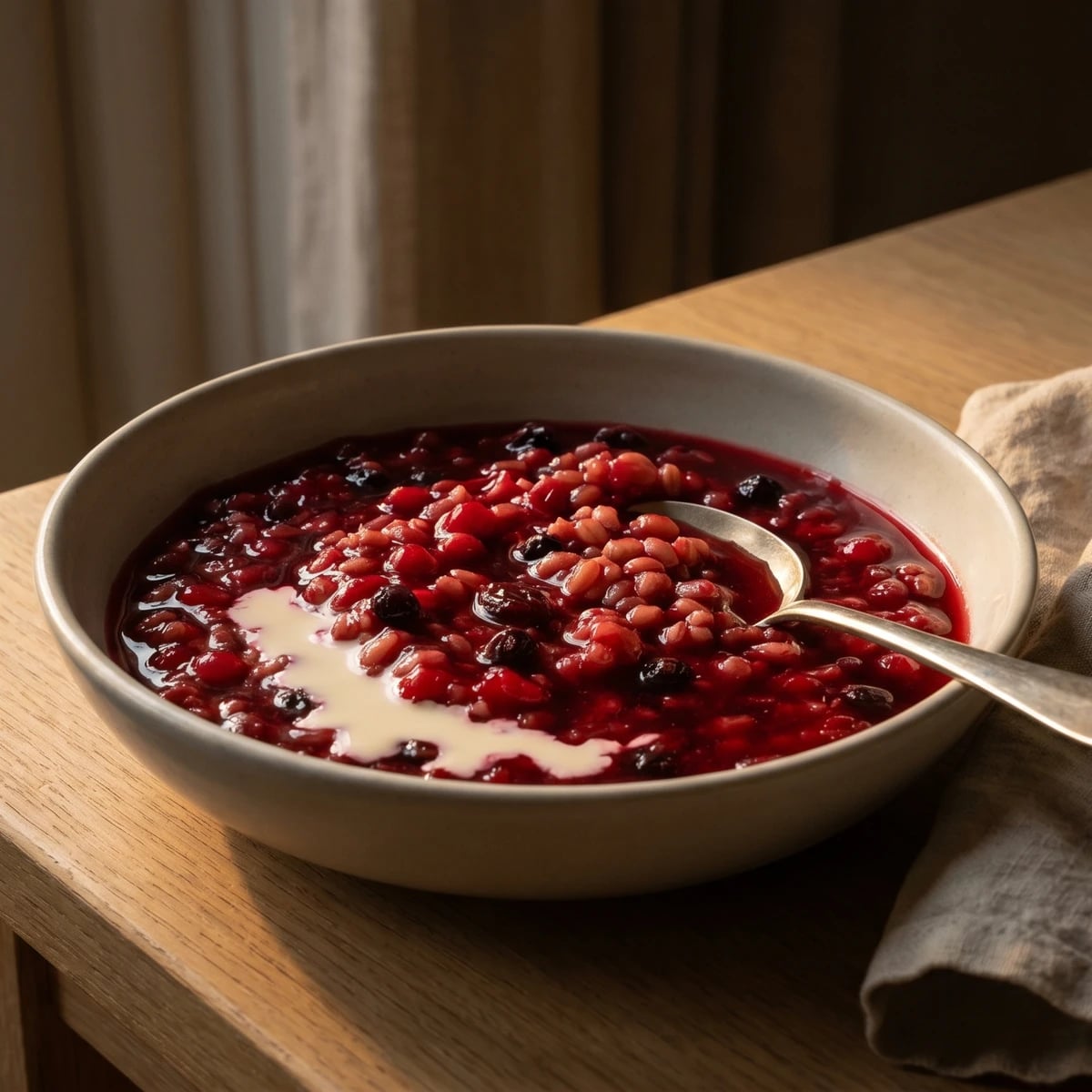
This is frugal food with a bright shirt on. Pearl barley gives the body, dried fruit gives chew and sweetness, red-currant juice gives that sharp Dutch fruit-acid that keeps the pudding from becoming dull. The method asks for almost nothing theatrical. Simmer until the barley is tender, add the berry juices late so their color stays vivid, sweeten only after the fruit has spoken, and chill it properly. Hou het altijd simpel, always keep it simple. A cold bowl, a spoonful of cream, and the old name has argued itself innocent.

Watergruwel is a traditional Dutch grain pudding, especially associated with the northern provinces where it is widely known as krentjebrij, currant porridge. The dish belongs to an older household economy of groats and dried fruit, with pearl barley or hulled grain simmered until soft, then sharpened and colored with berry juice such as red currant, raspberry, or blackberry. Its survival as a chilled summer dessert shows a Dutch pattern repeated across regional cookery: cheap stored ingredients made festive by one seasonal ingredient, in this case the tart red fruit of the garden.

The technique, the tradition, and the story behind every dish.

Discover Culinary Explorer

Ingredients

pearl barley

Quantity

125g

rinsed

water

Quantity

750ml

lemon peel

Quantity

1 strip

cinnamon stick

Quantity

1 small

dried currants

Quantity

75g

raisins

Quantity

75g

pitted prunes

Quantity

50g

chopped

unsweetened red-currant juice

Quantity

500ml

raspberry juice or sieved raspberries

Quantity

150ml juice or 150g raspberries

sugar

Quantity

75g, plus more to taste

lemon juice (optional)

Quantity

1 tablespoon

salt

Quantity

pinch

cream or cold milk (optional)

Quantity

to serve

Equipment Needed

  • Heavy saucepan, 2-liter or larger
  • Wooden spoon
  • Fine sieve if using fresh raspberries

Instructions

  1. 1

    Start the barley

    Put the rinsed pearl barley, water, lemon peel, cinnamon stick, and a pinch of salt into a heavy saucepan. Bring it to a boil, then lower the heat until the pot barely murmurs. Simmer for about 35 minutes, stirring now and then, until the barley has swollen and softened but still keeps a little chew.

    Use pearl barley, not quick barley. The old dish depends on grains that swell slowly and give body to the liquid without turning it into paste.
  2. 2

    Add dried fruit

    Stir in the currants, raisins, and chopped prunes. Simmer for another 15 minutes, until the dried fruit plumps and the barley is fully tender. If the pan looks dry, add a splash of water; the fruit should soften in liquid, not cling to the bottom like a bad idea.

  3. 3

    Pour in juice

    Remove the lemon peel and cinnamon stick. Add the red-currant juice, raspberry juice, and sugar, then bring the pan back only to a gentle simmer. Cook for 8 to 10 minutes, stirring along the bottom, until the pudding turns deep red and the liquid lightly thickens around the grains. Taste now. Red-currant juice can be stern, so add more sugar if needed, or a little lemon juice if your fruit is too sweet.

  4. 4

    Chill completely

    Spoon the watergruwel into a bowl, cover it, and chill for at least 3 hours, preferably overnight. The barley continues to drink, the fruit settles into the juice, and the sharp red flavor becomes rounder. Serve cold in small bowls with a little cream or cold milk poured at the edge.

Chef Tips

  • Red-currant juice matters because it brings acidity as well as color. If you can only find sweet mixed berry juice, reduce the sugar and sharpen the pudding with lemon juice at the end.
  • Watergruwel is better after a night in the refrigerator. Fresh from the pot it tastes like parts; the next day it tastes like one old sensible idea.
  • Serve it cold, not lukewarm. The chilled texture is the point, with the barley firm, the fruit plump, and the cream cutting the bright red acidity.

Advance Preparation

  • Make up to 2 days ahead and keep covered in the refrigerator.
  • If it thickens too much overnight, loosen with a splash of red-currant juice, cold milk, or water before serving.

Frequently Asked Questions

Nutrition Information

1 serving (about 310g)

Calories
285 calories
Total Fat
2 g
Saturated Fat
1 g
Trans Fat
0 g
Unsaturated Fat
1 g
Cholesterol
5 mg
Sodium
70 mg
Total Carbohydrates
67 g
Dietary Fiber
5 g
Sugars
44 g
Protein
4 g

Note: Chef personas and recipes are created with AI assistance. Cook with care: follow safe food-handling practices, check doneness with a thermometer when needed, and adapt for allergies and your kitchen.

Where cooking meets culture.

Culinary guides, cultural storytelling, and the editorial depth that makes cooking meaningful.

Discover Culinary Explorer

More from Toetjes: Vla, Pap & Pudding

Browse the full collection