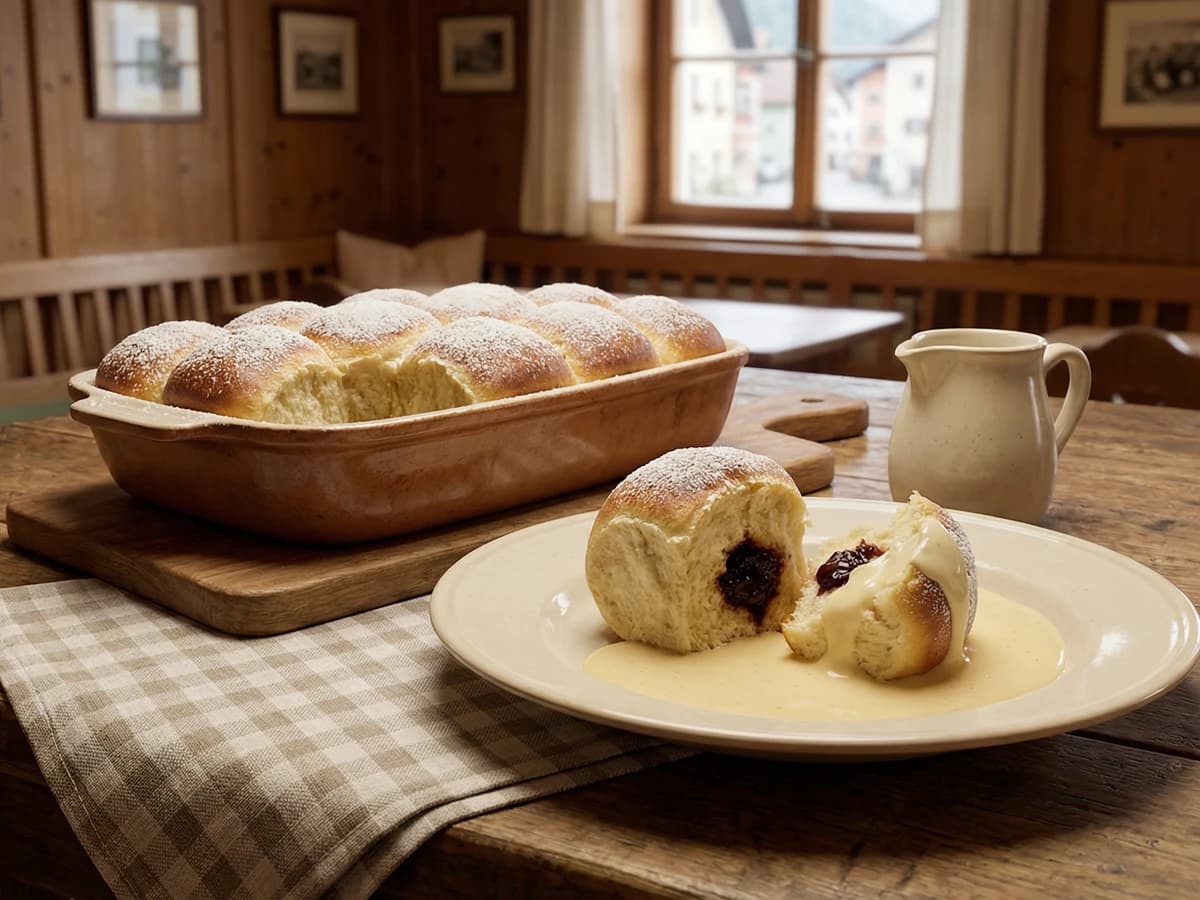
Tender Palatschinken rolled around sweet lemony Topfen filling, nestled into a buttered dish, bathed in vanilla custard, and baked until the tops turn golden and the kitchen smells like a Sunday you never want to end.
Desserts
Austrian
Dinner Party
Make Ahead
40 min
Active Time
50 min cook•1 hr 30 min total
Yield4 servings
In my grandmother Eva's kitchen in Kent, Gretel Beer made Palatschinken the way she made everything: without measuring, without fuss, and with total confidence that the pan knew what to do. She'd pour a thin stream of batter, tilt the pan once, and thirty seconds later a pale golden disc would slide onto the waiting stack. I'd stand on my stool and try to count how many she could make before the batter ran out. She never told me. She just kept going until the bowl was empty.
Überbackene Topfenpalatschinken is what happens when those simple pancakes become something grander. You fill each one with a sweetened Topfen mixture, bright with lemon zest and soft with raisins that have been soaking in rum since you started cooking. Roll them up, tuck them side by side into a buttered baking dish, and pour over a vanilla custard that seeps into every gap and crevice. The oven does the rest. Twenty-five minutes later, the tops are golden, the custard has set into something between a sauce and a pudding, and the Topfen filling inside has gone warm and creamy.
This is a Mehlspeise you can serve as a sweet main course, which is something Austrians do without apology. Gretel always said that Austrians like to eat well, and what they like to eat best is dessert. A dish like this proves her right. It's not a side note at the end of a meal. It is the meal. Serve it on a Sunday with good coffee, a glass of cold water beside it, and the kind of afternoon where nobody is in a hurry to be anywhere else.
The beauty of Überbackene Topfenpalatschinken is that everything can be done ahead. Make the Palatschinken in the morning, fill and roll them, assemble the dish, and refrigerate it. Pour the custard over and bake when your guests arrive. The oven does the performing while you sit down and enjoy the Gemütlichkeit.
Palatschinken arrived in Austrian kitchens from Hungary, the word itself tracing back through the Hungarian palacsinta to the Romanian plăcintă and ultimately the Latin placenta, meaning flat cake. The Topfen-filled and baked version became a hallmark of Viennese Bürgerliche Küche, the solid middle-class cooking tradition where Mehlspeisen were treated as a full course, not a garnish at the end of dinner. In Austrian Gasthäuser, überbackene Topfenpalatschinken still appears on menus listed under Mehlspeisen as a Hauptspeise, a main course, reinforcing the Austrian conviction that a proper meal built around flour, eggs, butter, and Topfen is not a compromise but a destination.
The technique, the tradition, and the story behind every dish.
•Ceramic or earthenware baking dish (approximately 28cm x 20cm)
•Whisk
•Pastry brush for buttering
Instructions
1
Soak the raisins
Put the raisins in a small bowl and pour the rum over them. Let them sit while you make everything else. They need at least thirty minutes, but an hour is better. The raisins should drink up the rum and go plump and dark. If you skip this step, you'll have dry little pebbles sitting in your filling doing nothing for anyone.
You can soak these overnight if you're planning ahead. They only get better with time.
2
Make the Palatschinken batter
Whisk the three eggs in a large bowl until broken up. Add the flour, milk, sparkling water, a pinch of salt, and the melted butter. Whisk until the batter is completely smooth and about the consistency of thin cream. It should coat a spoon and run off in a steady, unbroken stream. The sparkling water is a trick I learned at GAFA: the bubbles make the Palatschinken lighter without changing the flavor. Let the batter rest for fifteen minutes. The flour needs time to absorb the liquid and the gluten needs to relax, or your Palatschinken will be tough and rubbery instead of tender.
3
Fry the Palatschinken
Heat a non-stick pan (about 24cm) over medium heat and brush it with a thin layer of melted butter. Pour in just enough batter to coat the bottom, tilting the pan in a quick circle as you pour. The batter should set almost immediately into a thin, even layer. Cook until the underside is pale gold and the edges start to lift away from the pan, about forty-five seconds. Flip it and cook for another twenty seconds. The second side will always look less pretty. That's fine. It goes inside when you roll them. Stack the finished Palatschinken on a plate. You should get eight from this batter.
The first Palatschinke almost always goes wrong. The pan isn't quite hot enough, the butter isn't quite right. Gretel called it the cook's Palatschinke and ate it standing at the stove. Don't count it against yourself.
4
Make the Topfen filling
In a mixing bowl, beat together the Topfen, egg yolks, caster sugar, Vanillezucker, lemon zest, and sour cream until smooth and creamy. The sour cream loosens the filling just enough that it stays soft after baking instead of going chalky. Fold in the rum-soaked raisins. Taste it. The filling should be sweet but balanced by the lemon zest, with a faint warmth from the rum. If your Topfen is very wet, drain it in a sieve lined with muslin for twenty minutes first. Too much liquid and the filling will seep out of the Palatschinken during baking.
Topfen and quark are the same thing. Do not substitute Greek yogurt. It's too tangy, too thick, and it behaves differently in the oven. If you can't find quark at your regular shop, try a Polish, German, or Eastern European grocery. They'll have it.
5
Fill and roll
Lay a Palatschinke flat with the prettier side facing down. Spread about two tablespoons of the Topfen filling across the lower third, leaving a centimeter border at each edge. Roll it up snugly from the bottom, tucking the filling in as you go. Don't roll it too tight or the filling will squeeze out the ends. Set it aside seam-side down and repeat with the rest. You want them all roughly the same size so they bake evenly.
6
Arrange in the baking dish
Preheat your oven to 180°C (160°C fan). Butter a baking dish generously. The dish should be just large enough that the rolled Palatschinken fit snugly side by side in a single layer, seam-side down. They should be touching but not crushed. This closeness matters: they support each other and the custard pools between them, creating that gorgeous golden surface when it bakes.
A ceramic or earthenware dish about 28cm by 20cm is ideal. Avoid using a dish that's too large. If the Palatschinken are spread out with gaps between them, the custard spreads too thin and won't set properly around them.
7
Make and pour the custard
Whisk together the three eggs, milk, cream, Vanillezucker, sugar, and a pinch of salt until everything is combined and the sugar has dissolved. Don't beat it into a froth. You want it smooth and liquid, not airy. Pour the custard slowly over the Palatschinken, letting it seep into all the gaps and settle around them. The tops of the rolls should still be visible, poking above the custard like a little mountain range. They'll turn golden while the custard sets around them.
8
Bake until golden
Bake in the center of the oven for 25 to 30 minutes. The custard should be set but still have a gentle wobble when you shake the dish. The tops of the Palatschinken will turn a deep, burnished gold. If they're browning too fast, lay a sheet of foil loosely over the top for the last ten minutes. Let the dish rest for five minutes out of the oven before serving. The custard firms up as it cools slightly and the filling relaxes into something silky.
9
Dust and serve
Dust the top generously with powdered sugar. The sugar should land on the golden peaks and settle into the custard like the first snow on the Untersberg. Bring the whole dish to the table. Serve two Palatschinken per person, spooning some of the set custard alongside. This is a dish that belongs in the middle of the table, not portioned in the kitchen. Mahlzeit!
Chef Tips
•The quality of the Topfen makes or breaks this dish. Good quark tastes clean, milky, and slightly tart. If yours tastes sour or acidic, it's past its best. Buy it fresh and use it within a day or two.
•Vanillezucker is not vanilla extract. Austrian baking depends on vanilla sugar for its rounded, warm sweetness. You can buy it in packets at European grocery shops, or make your own by burying two split vanilla pods in a kilogram jar of caster sugar for a week. It changes everything.
•If you want to dress this up for a dinner party, serve it with a small bowl of lightly sweetened Schlagobers (whipped cream) on the side and a warm Marillensauce made by heating good apricot jam with a splash of water and a squeeze of lemon. The fruit cuts through the richness beautifully.
•Don't overbake. The custard should still tremble slightly in the center when you pull it out. Residual heat finishes the job. A dry, stiff custard means you went too far.
Advance Preparation
•Palatschinken can be made a full day ahead. Stack them with a small piece of baking parchment between each one, wrap the stack in cling film, and refrigerate. They peel apart easily when cold.
•The Topfen filling can be made up to a day ahead and refrigerated. Stir it once before using, as it may thicken slightly.
•The entire dish can be assembled, covered, and refrigerated for up to six hours before baking. Pour the custard over and bake straight from the fridge, adding five minutes to the baking time. This makes it an ideal dinner party dish: all the work happens in the morning and the oven does the rest while you enjoy your guests.
Frequently Asked Questions
Nutrition Information
1 serving (about 430g)
Calories
1000 calories
Total Fat
52 g
Saturated Fat
29 g
Trans Fat
0 g
Unsaturated Fat
23 g
Cholesterol
510 mg
Sodium
300 mg
Total Carbohydrates
95 g
Dietary Fiber
2 g
Sugars
54 g
Protein
35 g
Where cooking meets culture.
Culinary guides, cultural storytelling, and the editorial depth that makes cooking meaningful.