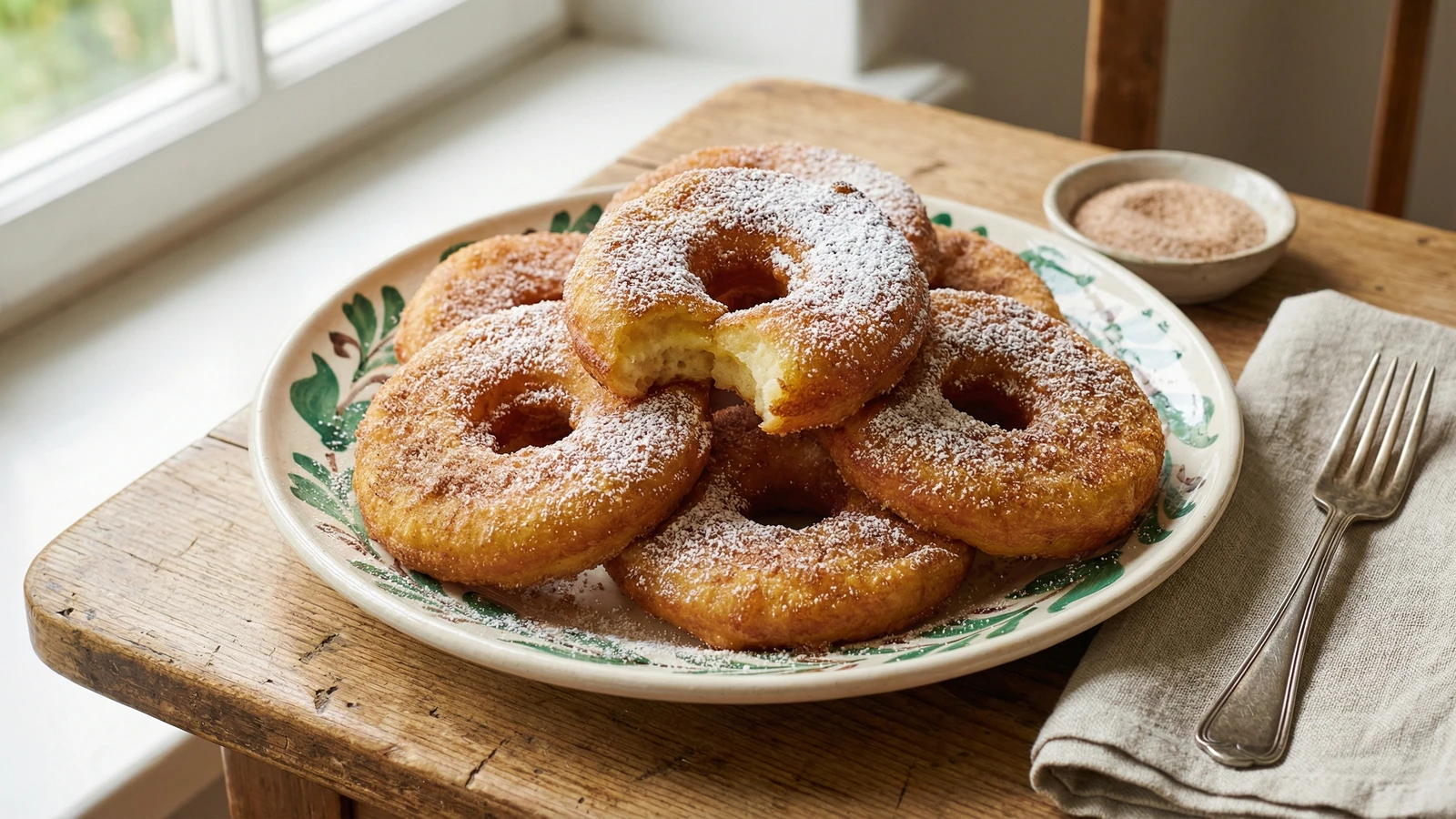
Thick apple rings in a light, eggy batter, fried golden in butter and oil, then buried under cinnamon sugar while they're still hot enough to melt it on contact.
Pastries & Cookies
Austrian
Weeknight
Comfort Food
20 min
Active Time
20 min cook•40 min total
Yield4 servings
In my grandmother Eva's kitchen in Kent, Apfelradeln were the thing Gretel made when the apples came in. Not a grand recipe, not a Konditorei showpiece. Just good apples, a bowl of batter, a hot pan, and a plate of cinnamon sugar waiting at the end. The whole kitchen smelled like browned butter and warm cinnamon, and the two of them would eat the first batch standing at the stove before I got any.
Apfelradeln are apple rings. That's the literal translation: apple wheels. You core the apple, slice it into thick rings, dip each one in a light batter made with egg, milk, and flour, then fry them until the coating puffs up golden and crisp while the apple inside goes soft and sweet. You eat them hot, straight from the pan, rolled in cinnamon sugar or dusted so thick with Staubzucker that the plate looks like a January morning.
This is Mehlspeisen at its most honest. No layers, no tempering, no architectural plating. Just fruit and batter and heat, done properly. The batter needs to be thin enough to coat without smothering. The oil needs to be hot enough that the Radeln sizzle the moment they go in, but not so hot that the outside burns before the apple softens. And the apples need to be firm, tart, and in season. Gretel always said you cook what the season gives you, and Apfelradeln belong to autumn. When the Boskop and Kronprinz Rudolf apples show up at the Grünmarkt in Salzburg, that's when I put these on the menu. Not before.
Apfelradeln belong to a family of battered and fried fruit dishes that runs deep through Austrian and Bohemian home cooking, part of the Mehlspeisen tradition where flour-based preparations formed the center of the meal rather than the dessert course. In rural Austria, dishes like Apfelradeln, Hollerstrauben (fried elderflower), and Marillen im Schlafrock (apricots in nightgowns) were often the main course on fast days and meatless Fridays. The Viennese cookbook tradition records apple fritter recipes from the 18th century onward, but the farmhouse versions are certainly older, tied to the autumn apple harvest across Lower Austria, Styria, and the Salzkammergut.
The technique, the tradition, and the story behind every dish.
firm tart apples (Boskop, Braeburn, or Granny Smith)
Quantity
4 large
plain flour
Quantity
150g
egg
Quantity
1 large
whole milk
Quantity
200ml
granulated sugar
Quantity
1 tablespoon
vanilla sugar (Vanillezucker)
Quantity
1 teaspoon
salt
Quantity
pinch
rum (optional)
Quantity
1 tablespoon
butter
Quantity
for frying
combined half and half with oil
neutral oil (sunflower or rapeseed)
Quantity
for frying
combined half and half with butter
granulated sugar
Quantity
3 tablespoons
mixed with cinnamon for coating
ground cinnamon
Quantity
1 teaspoon
mixed with sugar for coating
powdered sugar (Staubzucker)
Quantity
for dusting
Ingredient
Quantity
firm tart apples (Boskop, Braeburn, or Granny Smith)
4 large
plain flour
150g
egg
1 large
whole milk
200ml
granulated sugar
1 tablespoon
vanilla sugar (Vanillezucker)
1 teaspoon
salt
pinch
rum (optional)
1 tablespoon
buttercombined half and half with oil
for frying
neutral oil (sunflower or rapeseed)combined half and half with butter
for frying
granulated sugarmixed with cinnamon for coating
3 tablespoons
ground cinnamonmixed with sugar for coating
1 teaspoon
powdered sugar (Staubzucker)
for dusting
Equipment Needed
•Large heavy-bottomed frying pan or skillet (28cm)
•Apple corer
•Wide shallow bowl for batter
•Slotted spatula or spider
•Wire cooling rack
Instructions
1
Make the batter
Whisk the flour, egg, milk, sugar, Vanillezucker, salt, and rum together in a wide bowl until you have a smooth, lump-free batter. It should be the consistency of thick cream, thin enough to coat the apple rings without clinging in heavy globs, but substantial enough that it doesn't slide right off. If it's too thick, add a splash more milk. Let the batter rest for fifteen minutes. The flour needs time to hydrate and the gluten needs to relax, which gives you a tender coating instead of a chewy one.
The rum is traditional and does real work here. Alcohol evaporates faster than water in the hot pan, which means a crispier coating. If you're cooking for children or prefer to leave it out, the Radeln will still be good, just slightly less crisp.
2
Prepare the apples
Peel the apples. Core them using an apple corer, pushing straight through the center to remove the seeds and tough core in one piece. If you don't have a corer, cut the apple in half, scoop out the core with a melon baller or a small spoon, then slice into rings. Cut each apple crosswise into rings about one centimeter thick. You want them sturdy enough to hold their shape in the batter and the pan. Too thin and they'll fall apart. Too thick and the apple won't soften before the coating burns.
Choose apples that are firm and tart. A soft, sweet apple will turn to mush in the pan. Boskop is the classic Austrian choice. Braeburn and Granny Smith work well outside Austria. Avoid anything mealy or floury.
3
Mix the cinnamon sugar
Stir together the three tablespoons of sugar and the cinnamon on a wide, flat plate. Spread it out so the hot Radeln can be rolled through it easily. Have this ready before you start frying. Once the first ring comes out of the pan, you won't have time to measure anything.
4
Heat the frying fat
Melt a generous knob of butter with an equal amount of neutral oil in a large, heavy pan over medium heat. You want about half a centimeter of fat in the pan. The butter gives flavor, the oil raises the smoke point so the butter doesn't burn. When the fat shimmers and a drop of batter sizzles immediately on contact, you're ready. If the batter sits in the fat silently, it's not hot enough and your Radeln will soak up oil instead of crisping.
The half-butter, half-oil approach is how Austrian home cooks have always fried Mehlspeisen that aren't Schnitzel. Clarified butter alone works beautifully too, but it's more expensive for the quantity you need here.
5
Dip and fry the apple rings
Using a fork or your fingers, dip each apple ring into the batter, let the excess drip off for a moment, then lay it gently into the hot fat. Don't crowd the pan. Three or four rings at a time is plenty. Fry for about two minutes per side, until the batter turns a deep, even gold and the edges look dry and crisp. The apple inside should be soft when you press the ring gently with a spatula. Flip once. If you're flipping more than once, you're fussing and the coating will suffer for it.
Watch the heat. If the first batch browns too fast, turn the flame down slightly for the next. The sweet batter catches quickly, and there's a narrow window between golden and burnt. Adjust after each batch if needed.
6
Coat and serve immediately
Lift the finished Radeln out with a slotted spatula and let them drain on kitchen paper for just a few seconds. While they're still hot, roll them through the cinnamon sugar on the plate, pressing gently so the sugar sticks to the warm surface. Pile them on a serving plate. Dust with a final snowfall of Staubzucker if you want to be generous, and you should. Serve them the moment the last ring comes out of the pan. Apfelradeln wait for nobody. They're at their best when the coating is still crackling and the apple inside is warm enough to release its juice when you bite through. Mahlzeit!
Chef Tips
•Let the batter rest. I know it's tempting to start dipping immediately, but fifteen minutes of resting makes a real difference. The batter relaxes and coats more evenly, and the finished Radeln come out lighter and crisper.
•Season is everything with this dish. Make Apfelradeln in autumn when the apples are firm and tart and just picked. A supermarket apple in March that's been in cold storage since October will give you a sad, watery result. If it's not apple season, make Palatschinken instead and come back to these in September.
•If you're making these for a crowd, keep the finished Radeln warm on a wire rack in an oven set to 80°C while you fry the rest. Don't stack them or the coating goes soft. Spread them in a single layer.
•Gretel always said the cinnamon sugar coating is not optional. You can dust with plain Staubzucker if you like, but the cinnamon is what makes Apfelradeln taste like autumn instead of just fried batter.
Advance Preparation
•The batter can be made up to two hours ahead and refrigerated. Give it a quick whisk before using, as it may thicken slightly. Add a splash of milk if needed.
•Apfelradeln cannot be made ahead. They must be fried, coated, and eaten immediately. Reheated fried batter is a sad thing and I won't pretend otherwise.
Frequently Asked Questions
Nutrition Information
1 serving (about 240g)
Calories
425 calories
Total Fat
13 g
Saturated Fat
4 g
Trans Fat
0 g
Unsaturated Fat
9 g
Cholesterol
60 mg
Sodium
95 mg
Total Carbohydrates
71 g
Dietary Fiber
5 g
Sugars
35 g
Protein
7 g
Where cooking meets culture.
Culinary guides, cultural storytelling, and the editorial depth that makes cooking meaningful.