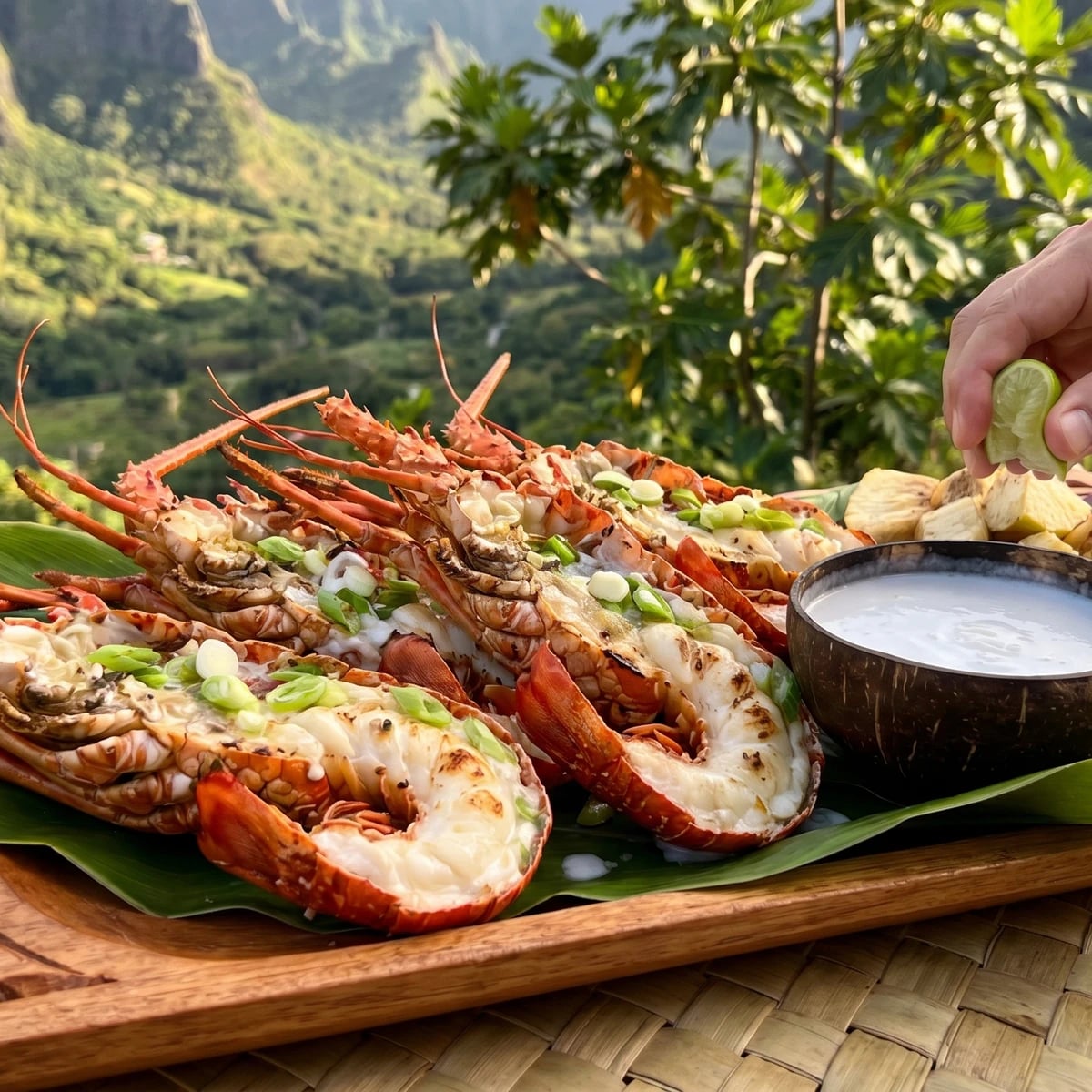
Reef spiny lobster from the Marquesas, split in the shell and kissed by the grill, then dressed with fresh miti haari, coconut cream, lime, and green onion, bright against the rough Pacific.
Main Dishes
Polynesian
Special Occasion
Celebration
Outdoor Dining
30 min
Active Time
10 min cook•40 min total
Yield4 servings
The canoe keeps going after my home waters. It keeps going east, past Tahiti, out to Henua ʻEnana, the Marquesas, where the islands rise sharp from the open Pacific and the valleys run deep and green to black-rock bays. This uà nunu pataka Haaènana, Marquesan grilled spiny lobster, belongs to that place. Not Tahiti. Not a nameless ocean plate. The Marquesas have their own hand.
I didn't learn this one at my family board. I learned to approach it the way a younger cousin should, quiet first, listening. Uà is the spiny lobster, the reef animal with no big claws to hide behind, and miti haari is the coconut cream sauce, fresh-squeezed and bright with lime and green onion. Split the shell, give it fire, then dress it simply. The lobster should still taste like the rough sea it came from.
Across the Triangle, the cousins keep that same law: start with what the ocean gave, handle it clean, don't bury it. Tahiti has ʻia ota, the Cooks have ika mata, Sāmoa has oka, Tonga has ʻota ʻika, and back home Hawaiʻi has poke. Same fish, different bowl. Here in the Marquesas, the hand goes to the grill and the coconut cream, and the breadfruit, mei or ʻuru, waits alongside because Henua ʻEnana leans hard on breadfruit where other islands lean on taro.
So cook this open-handed. For the deep parts of the Festival des Marquises, the umu kai, and the food knowledge tied to specific valleys and families, go sit with Marquesan elders. They should tell their own story. I can help you bring the plate into a contemporary kitchen, warm and unfussy, but the island keeps the root of it.
The Marquesas, Henua ʻEnana, were settled by East Polynesian voyagers in the first millennium CE, and their high volcanic valleys became one of the great breadfruit heartlands of the Pacific. Unlike Tahiti's lagoon-fringed image, the Marquesas face the open ocean directly, so foods like grilled uà, spiny lobster, sit in a rugged sea-and-valley foodway with mei or ʻuru, breadfruit, at the center. The French name Langouste Grillée à la Marquisienne marks the colonial language layer, but the dish is Marquesan in place and hand, with miti haari carrying the wider French Polynesian coconut-and-lime table without turning it Tahitian.
The technique, the tradition, and the story behind every dish.
spiny lobster tails (uà), or 2 whole small spiny lobsters
Quantity
4 tails or about 2 pounds total
split lengthwise
coconut oil or neutral oil
Quantity
1 tablespoon
sea salt
Quantity
1 teaspoon
plus more to taste
fresh coconut cream
Quantity
1 cup
squeezed from 1 grated mature coconut with 1/2 cup warm water, or thick canned coconut cream
fresh lime juice
Quantity
2 tablespoons
plus lime wedges for serving
green onions
Quantity
3
thinly sliced
fresh chile (optional)
Quantity
1 small
seeded and finely sliced
banana leaves or ti leaves
Quantity
as needed
for lining the platter
roasted mei or ʻuru (breadfruit) (optional)
Quantity
for serving
Ingredient
Quantity
spiny lobster tails (uà), or 2 whole small spiny lobsterssplit lengthwise
4 tails or about 2 pounds total
coconut oil or neutral oil
1 tablespoon
sea saltplus more to taste
1 teaspoon
fresh coconut creamsqueezed from 1 grated mature coconut with 1/2 cup warm water, or thick canned coconut cream
1 cup
fresh lime juiceplus lime wedges for serving
2 tablespoons
green onionsthinly sliced
3
fresh chile (optional)seeded and finely sliced
1 small
banana leaves or ti leavesfor lining the platter
as needed
roasted mei or ʻuru (breadfruit) (optional)
for serving
Equipment Needed
•Outdoor grill or heavy cast-iron grill pan
•Kitchen shears for splitting shells
•Coconut scraper or box grater with clean cloth for squeezing cream
•Long tongs and a small basting brush
Instructions
1
Respect the catch
Check your local seasons, size limits, and rules before you buy or catch spiny lobster. Henua ʻEnana, the Marquesas, takes from a rough open Pacific, not a gentle lagoon, and the sea gives nothing casual. Choose lobster that smells clean and briny, with firm flesh and bright shell. If you have live lobster and you're not comfortable splitting it, ask the fishmonger to do it cleanly.
2
Squeeze the cream
For the miti haari, the coconut cream sauce, squeeze grated mature coconut with the warm water through a clean cloth, twisting hard until the thick white cream runs out. Stir in the lime juice, green onion, chile if using, and a pinch of salt. Taste it. It should be rich first, then sharp, then green at the end.
A good thick can of coconut cream will feed the table on a weeknight. Fresh is better here because the sauce is the whole soul of the dish, so squeeze it if you can.
3
Split and clean
If the lobster is not already split, cut it lengthwise through the shell with kitchen shears, then finish through the head or tail with a heavy knife. Remove the dark vein and any grit, rinse only if needed, and pat the flesh very dry. Leave the meat sitting in its shell, because the shell protects it from the fire.
4
Season lightly
Brush the flesh with coconut oil and season with sea salt. No need bury the sweetness. This is uà nunu pataka Haaènana, Marquesan grilled spiny lobster, and the fire, shell, coconut, and lime are enough.
5
Grill shell side
Heat the grill to medium-high and oil the grate. Set the lobster shell side down, cover, and cook 4 to 6 minutes, until the shell turns red-orange and the edges of the flesh turn opaque while the center still looks glossy.
6
Turn and finish
Turn the lobster flesh side down for 1 to 2 minutes, just long enough to mark it and firm the surface. Pull it when the flesh is pearly, opaque, and still juicy, about 140F at the thickest part if you're using a thermometer. Overcook it and it goes tough. No blame the lobster. You rushed the fire.
7
Dress and share
Lay the split lobster on banana or ti leaf and spoon the miti haari over the flesh while it is still glossy from the grill. Scatter a little more green onion, set lime wedges on the side, and serve with roasted mei or ʻuru, breadfruit, if you have it. Henua ʻEnana is breadfruit heartland, so let that starch sit beside the sea.
Chef Tips
•Buy spiny lobster from somebody who can tell you where and when it was taken. Leave egg-bearing or undersized lobster alone, and follow local rules. The sea is not a pantry you raid.
•Fresh coconut cream makes the miti haari fuller and sweeter. If you use canned, choose thick coconut cream with no sugar, stir it smooth, and add the lime close to serving.
•The grill should be hot enough to color the shell but not so fierce it dries the flesh before the center turns pearly. Shell side down first is the kindness.
•Serve it with roasted mei or ʻuru, breadfruit. If you set Marquesan kaʻaku beside it, name it as Marquesan kaʻaku, not Tahitian poʻe. Cousins, yes. Same dish, no.
•This is special-occasion food, but it doesn't need to be precious. A wooden platter, leaf under the lobster, coconut sauce in a coconut shell, and enough for one more person. That's the table.
Advance Preparation
•Squeeze the coconut cream the morning of and keep it cold. Add lime, green onion, and salt close to serving so the sauce stays clean and bright.
•The lobster can be split and kept covered in the fridge for up to 2 hours before grilling. If using live lobster, split it just before cooking.
•Roast or boil the mei or ʻuru ahead, then warm it gently near the grill while the lobster cooks.
Frequently Asked Questions
Nutrition Information
1 serving (about 205g)
Calories
345 calories
Total Fat
27 g
Saturated Fat
22 g
Trans Fat
0 g
Unsaturated Fat
4 g
Cholesterol
85 mg
Sodium
870 mg
Total Carbohydrates
3 g
Dietary Fiber
1 g
Sugars
1 g
Protein
23 g
Where cooking meets culture.
Culinary guides, cultural storytelling, and the editorial depth that makes cooking meaningful.