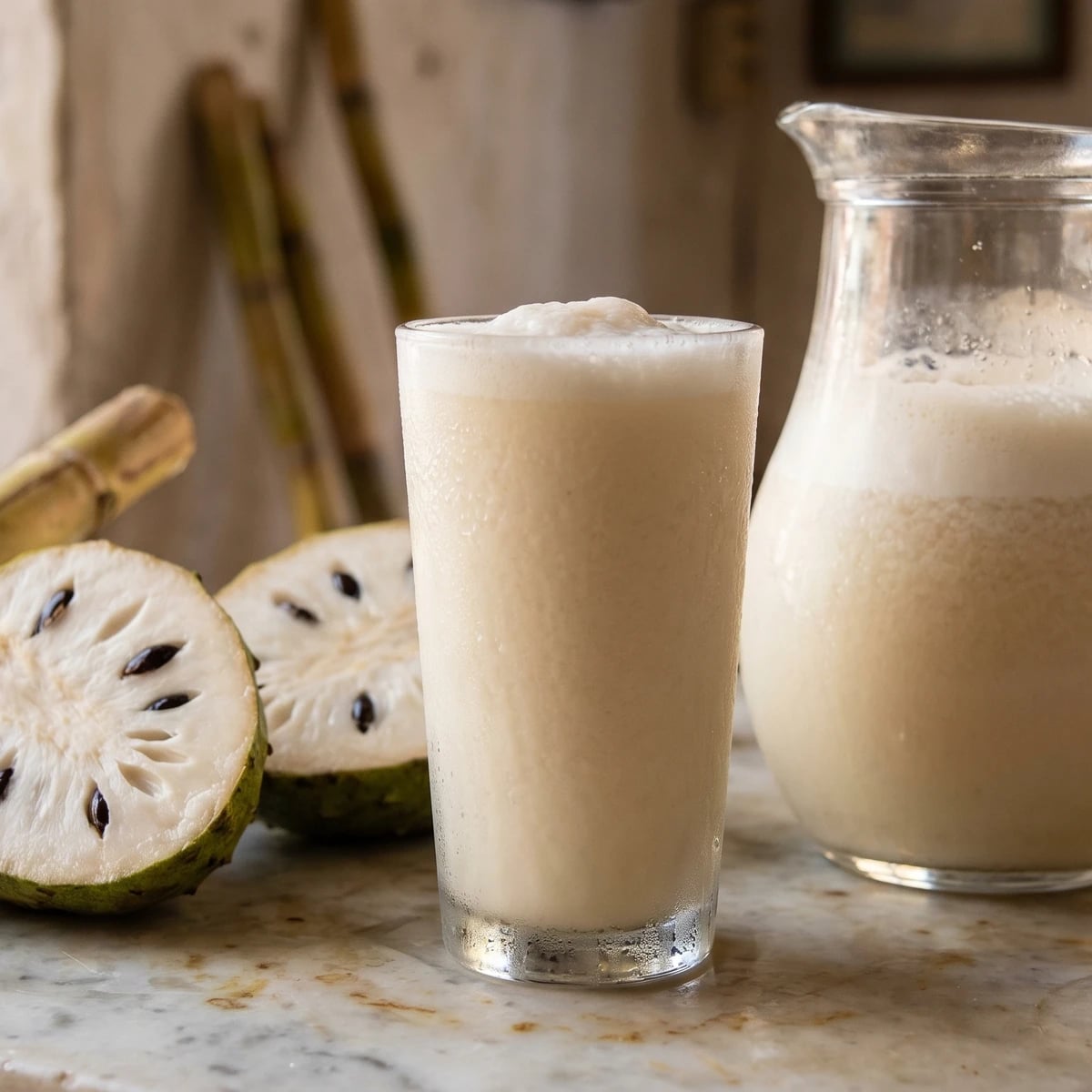
Veracruz's jarocho cooler from the cantinas of Boca del Río: ripe soursop blended with aguardiente de caña, sweetened condensed milk, and evaporated milk into a creamy, tropical pour served ice cold in a frosted glass.
Beverages
Mexican
Celebration
Outdoor Dining
Picnic
20 min
Active Time
0 min cook•2 hr 20 min total
YieldAbout 6 cups (4 to 6 servings)
This is from Veracruz. Not the port city alone, the Sotavento, the low coastal stretch south of the harbor where the rivers run into the gulf and the cane fields reach the horizon. The torito belongs to Boca del Río, to the jarocho cantinas that pour it cold from the middle of the morning on. This drink has a place, and the place is the coast.
A torito is built on three things: a cane spirit, sweet milk, and fruit. The fruit changes (peanut, guava, passion fruit, coconut, guanábana), but the spine never does. Aguardiente de caña. Not rum. Not 'Mexican rum.' Raw cane liquor, the same spirit that has come off the sugar mills working this coast for four hundred years. People see the condensed milk and call the torito a cream cocktail. They are wrong. The milk and the soursop are the body. The cane is the spine. Take it out and you have flavored milk, not a torito. Así se hace y punto.
Guanábana is a tropical fruit with white custardy pulp, tart and floral, studded with glossy black seeds you pull out by hand. Those seeds are not safe to eat, so count them out and keep them far from the blender. Fresh guanábana ripens fast and bruises if you look at it wrong, so most cooks, in Veracruz too, work with frozen pulp, and there is no shame in it. I learned this torito at a stand in Boca del Río from a woman who had been pouring them into frosted glasses since before I was born. She kept her aguardiente under the counter and her cans of condensed milk stacked like bricks. She told me the cold is half the drink. She was right. Recetas probadas y garantizadas.
Sugarcane arrived in the Veracruz lowlands with the Spanish in the 16th century, and the plantations around Córdoba and the Sotavento basin were worked largely by enslaved Africans, whose descendants make up one of Mexico's principal Afro-Mexican populations. Aguardiente de caña, the raw cane spirit distilled from that industry, became the backbone of jarocho drinking culture, and the torito, named for the 'little bull' kick of the liquor, took shape as a Boca del Río specialty in the 20th century. Mexico did not formally recognize Afro-Mexican peoples in its federal constitution until 2019, and the 2020 national census was the first to count them, a recognition that arrived four centuries after their labor and their foodways had already shaped the coast.
The technique, the tradition, and the story behind every dish.
fresh guanábana (soursop) pulpseeds removed, or thawed frozen pulp
2 cups
aguardiente de caña (cane liquor)
1 cup
sweetened condensed milk (leche condensada)
1 can (14 ounces)
evaporated milk (leche evaporada)
1 can (12 ounces)
Mexican vanilla extract (optional)
1 teaspoon
ice (optional)
for serving
Equipment Needed
•High-powered blender
•Fine-mesh strainer (optional, for a silkier pour)
•Glass pitcher or jarra
•Tall glasses, chilled in the freezer until frosted
Instructions
1
Open and deseed the guanábana
If you are using fresh guanábana, it has to be ripe. It should give under gentle pressure like a soft avocado and smell sweet and floral at the stem. Cut it open, scoop the white pulp into a bowl, and pull out every glossy black seed with your fingers. The seeds are not safe to eat, so keep them well away from the blender. If fresh ripe fruit is not in the market, thaw frozen guanábana pulp and use that. It is what most cooks reach for, in Veracruz too. Measure out 2 cups.
Count the seeds as you pull them. Guanábana seeds are toxic, and one whole one cracked open in the blender can ruin the batch. Pulp only, never seeds.
2
Blend the base
Into the blender goes the 2 cups of guanábana pulp, the aguardiente de caña, the sweetened condensed milk, the evaporated milk, and the vanilla if you are using it. Blend on high for 30 to 45 seconds, until the mixture is smooth and a pale froth rises on top. It should be thick enough to coat the back of a spoon but still pour easily. That creamy body is what a torito is known for.
A whisk works if you mash the pulp completely smooth first, and the cantineros in Boca del Río will do it either way. The blender is faster and gives you that frothy cap.
3
Taste and hold the line on the cane
Taste it. It should be sweet and tropical, tart from the soursop, with the warmth of the cane spirit sitting underneath. The aguardiente is the spine of this drink. If you cannot feel the cane, add a little more. If it is too sharp for your table, stir in another spoonful of condensed milk, but do not drown the liquor. A torito without its cane is just flavored milk. No me vengas con atajos.
4
Chill until very cold
Pour the torito into a pitcher and refrigerate for at least 2 hours, until it is properly cold all the way through. Cold is not optional here. A warm torito is a sad thing. While it chills, put your serving glasses in the freezer so they frost over. If you are in a hurry, you can blend the base with a couple cups of ice and serve it right away, but it will come out lighter and more watered down. The Boca del Río stands keep theirs cold in coolers, not diluted with ice.
5
Serve in a frosted glass
Stir the torito, since it settles as it sits, and pour it into the tall frosted glasses straight from the refrigerator. Spoon a little of the froth on top if you like. Drink it cold and unhurried, in the shade, the way they do on the coast. Saber cocinar es saber vivir, and on a hot jarocho afternoon, saber beber too.
Chef Tips
•Fresh guanábana is the prize, but it ripens fast and bruises easily, so most cooks reach for frozen pulp and so should you when fresh is not in the market. Look in the freezer case of a Latin grocery, brands like La Fe and Goya are reliable. Skip the canned soursop in heavy syrup. It tastes like candy, not fruit.
•Aguardiente de caña is the spine of this drink and it is worth hunting for. Outside Mexico it is hard to find, and the closest stand-in is an unaged cane spirit, a cachaça or a rhum agricole blanc. A substitution is a compromise, not an upgrade. Do not reach for spiced rum or a dark aged rum. That makes a different drink with a different name.
•This base is the whole jarocho lineup. Swap the guanábana for peanut, guava, passion fruit, or coconut and you have the toritos they pour all along the Sotavento. Cada estado, su propia cocina, and the torito belongs to Veracruz.
Advance Preparation
•Make the torito up to 2 days ahead and keep it covered in the refrigerator. The chill deepens and the flavors settle. Stir or shake before pouring, since the milk and fruit separate a little as it sits.
•For a semi-frozen version the way some Boca del Río stands serve it, freeze the blended base in a shallow container and scrape it into a slush, or freeze it in cubes and blend again just before serving.
Frequently Asked Questions
Nutrition Information
1 serving (about 240g)
Calories
425 calories
Total Fat
10 g
Saturated Fat
6 g
Trans Fat
0 g
Unsaturated Fat
4 g
Cholesterol
40 mg
Sodium
160 mg
Total Carbohydrates
55 g
Dietary Fiber
3 g
Sugars
52 g
Protein
10 g
Where cooking meets culture.
Culinary guides, cultural storytelling, and the editorial depth that makes cooking meaningful.