
Chef Lupita
Agua de Alfalfa
Ciudad de México's highland market agua fresca, fresh alfalfa blended with pineapple and lime until bright green, strained clean, and poured cold from the vitrolero.
A cooking platform built around craft, culture, and the stories behind what we eat.
Created by
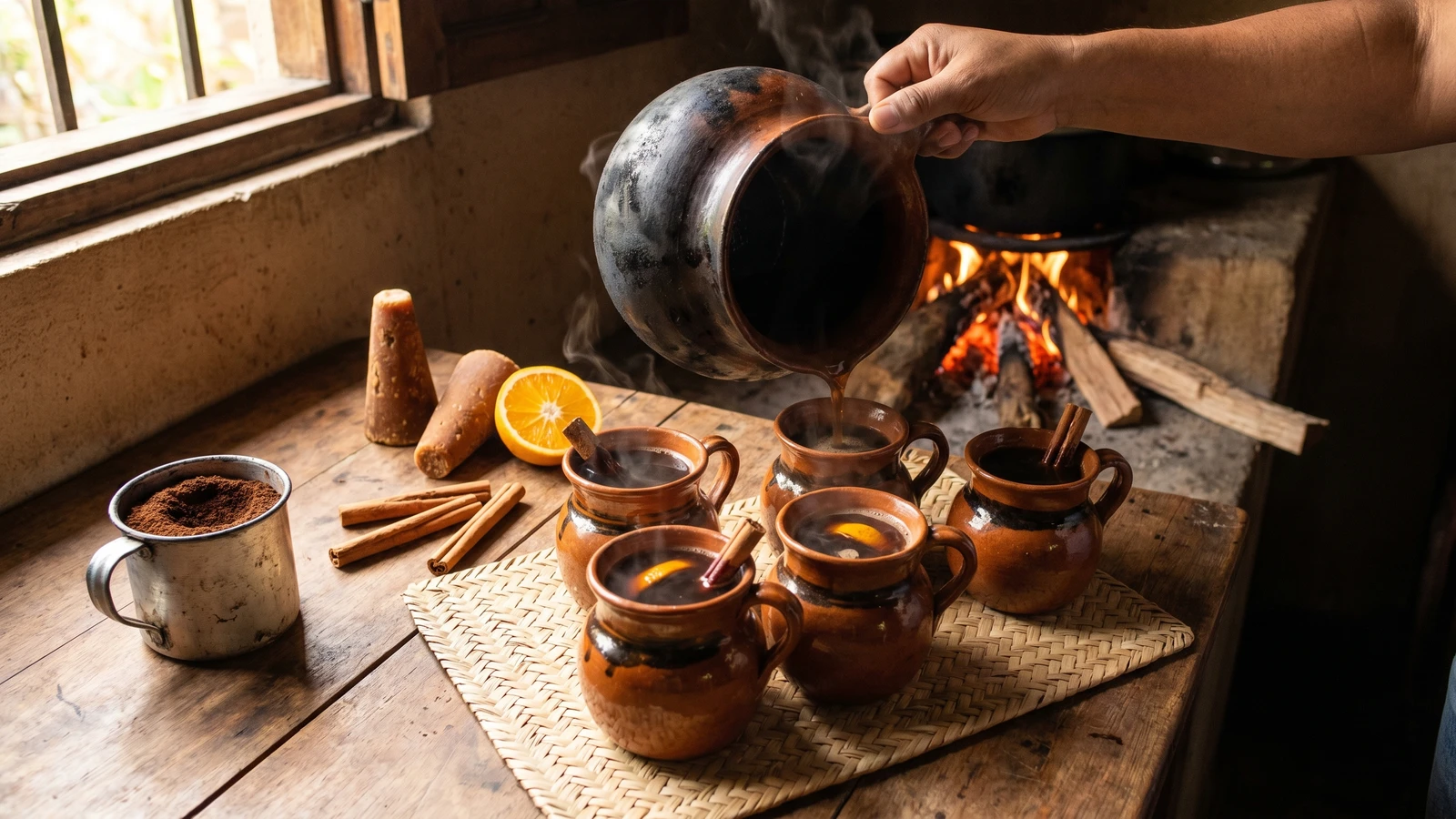
Veracruz's afromestiza morning coffee, brewed the way the Sotavento has always brewed it: highland coffee steeped in a clay olla with piloncillo, canela de Ceilán, and a wide strip of orange peel. Sweet, spiced, slowly earthy.
This is Veracruz. Not the postcard port with the marimbas, the other Veracruz, the Sotavento, the low green country south of the river where the afro-jarocho communities have lived for four hundred years. Above them, in the highlands around Coatepec and Córdoba, the coffee grows. Below, in the kitchens of the Sotavento, it gets brewed in a clay olla the way it has been brewed since the days of the haciendas. Café de olla is a coffee of two geographies: the mountain that grows the bean and the coast that brews it.
You need four things and the right ceramic. Coffee, medium-dark, ground coarse like you would for a French press. Piloncillo, the cone of unrefined cane sugar, not white sugar and not the 'raw sugar' from a health food store. Canela de Ceilán, true Ceylon cinnamon, the soft flaky bark that crumbles between your fingers, not the hard red cassia stick most people think is cinnamon. And the peel of one orange, no white pith. The olla has to be clay. Barro. The clay is not decoration. It rounds the coffee, takes the edge off the acid, and gives it that earthy back-note a metal pot will never give you.
I learned this version in a kitchen outside Tlacotalpan, from a woman whose family had grown and picked coffee for three generations. She put the orange peel in. My mother, from Jalisco, made café de olla without it, just piloncillo and canela. The orange is the Sotavento. It cuts the sweetness and lifts the whole pot. The afromestiza cooks of this coast have been making coffee like this since their ancestors were brought through the port of Veracruz, and the country only got around to writing them into its Constitution a few years ago. The coffee did not wait for the paperwork.
One rule you cannot break: do not boil the coffee. You simmer the water with the piloncillo, the canela, and the orange until the sugar melts and the kitchen smells like a panadería. Then you barely simmer the grounds, pull it off the heat, and let it rest. Boil it hard and you cook out the aroma and drag bitterness from the grounds. Treat it gently and you get sweet, spiced, slow, earthy coffee in a clay cup. Así se hace y punto.
Coffee reached Veracruz in the late 18th century and took root in the highland zones around Córdoba and Coatepec, where much of it was planted and picked by Afro-mestizo and indigenous hands. The Sotavento lowlands below those coffee slopes are the heartland of Mexico's afro-jarocho culture, descended from Africans brought through the port of Veracruz beginning in the 16th century; nearby Yanga, established around 1618 after Gaspar Yanga led a maroon rebellion, is recognized as the first free Black township in the Americas. Mexico did not write its Afro-Mexican peoples into the federal Constitution until a 2019 reform to Article 2, and the 2020 census was the first to count them, more than two million people whose foodways, this clay-pot coffee among them, had anchored community life for four centuries.
Quantity
8 cups
Quantity
1 (about 4 ounces / 100 g)
broken into pieces
Quantity
1 stick (about 5 inches)
plus small pieces reserved for serving
Quantity
wide peel of 1 orange
white pith removed
Quantity
2
Quantity
1/2 cup
Veracruz coffee if you can get it
| Ingredient | Quantity |
|---|---|
| water | 8 cups |
| piloncillo conebroken into pieces | 1 (about 4 ounces / 100 g) |
| canela de Ceilán (Ceylon cinnamon)plus small pieces reserved for serving | 1 stick (about 5 inches) |
| orange peelwhite pith removed | wide peel of 1 orange |
| whole cloves (optional) | 2 |
| coarsely ground coffee, medium-dark roastVeracruz coffee if you can get it | 1/2 cup |
If your olla is new, cure it first. Into the clay olla, pour the water and add the piloncillo, the canela de Ceilán, the orange peel, and the cloves if you are using them. Set it over medium heat. The clay heats slowly, that is its nature, so give it time and do not crank the flame to rush it.
Bring the water to a gentle simmer and stir with a wooden spoon until the piloncillo dissolves completely. Hold it at a low simmer for 8 to 10 minutes. The water turns the color of amber and the kitchen smells like a panadería at dawn: sweet cane, warm canela, the orange sitting behind both. Do not move on until the piloncillo is fully melted and the spices have given up their oils. This base is the whole personality of the coffee.
Stir in the ground coffee. Let it return to the barest simmer, where the surface only trembles, and hold it there for 2 to 3 minutes. This is the only simmering the coffee gets. Do not let it reach a hard rolling boil. A hard boil scorches the grounds and pulls out a bitterness you cannot take back. A bare simmer in the clay draws the coffee out sweet and round.
Turn off the heat. Cover the olla and let it stand for 4 to 5 minutes. The grounds sink, the brew settles, and the flavor deepens. This rest is where café de olla finishes itself. No me vengas con atajos. This is the step people skip and then wonder why their coffee tastes thin and sharp.
Strain the coffee through a fine-mesh sieve or a piece of manta de cielo into clay jarritos. Drop a small piece of canela into each cup if you like. Serve it hot, in the barro, the way the Sotavento has served it for generations. Saber cocinar es saber vivir.
1 serving (about 240g)
Culinary guides, cultural storytelling, and the editorial depth that makes cooking meaningful.
Discover Culinary ExplorerChef Lupita
Ciudad de México's highland market agua fresca, fresh alfalfa blended with pineapple and lime until bright green, strained clean, and poured cold from the vitrolero.

Chef Lupita
Aguascalientes' Lenten agua fresca, jewel-red from cooked beet and full of apple, banana, orange, lettuce, and ground peanuts, served cold when Holy Week meets the Feria de San Marcos.

Chef Lupita
Sonora and Sinaloa's creamy malted barley water, built on toasted cebada perla, Mexican canela, vanilla from Papantla, and evaporated milk. Pink-beige, rich, and served cold over heavy ice in a heavy glass tumbler. Liquid cookie comfort the northwest way.

Chef Lupita
Yucatán's everyday tonic of boiled chaya leaves blended with lima agria, sugar, and ice. The bright green jarra that sits on every Peninsula table from Mérida to Valladolid.