Culinary Explorer

A cooking platform built around craft, culture, and the stories behind what we eat.
Discover Culinary Explorer
Tinos Anginares me Koukia (Αγκινάρες με Κουκιά)

Tinos Anginares me Koukia (Αγκινάρες με Κουκιά)

Created by

Tinos artichokes and fresh broad beans share one short season, then disappear. Cook them gently with olive oil, lemon, and dill, and you've got a nistisimo island supper for bread.

Main Dishes
Greek
Easter
Budget Friendly
Weeknight
40 min
Active Time
45 min cook1 hr 25 min total
Yield4 servings as a main, 6 as part of a fasting table

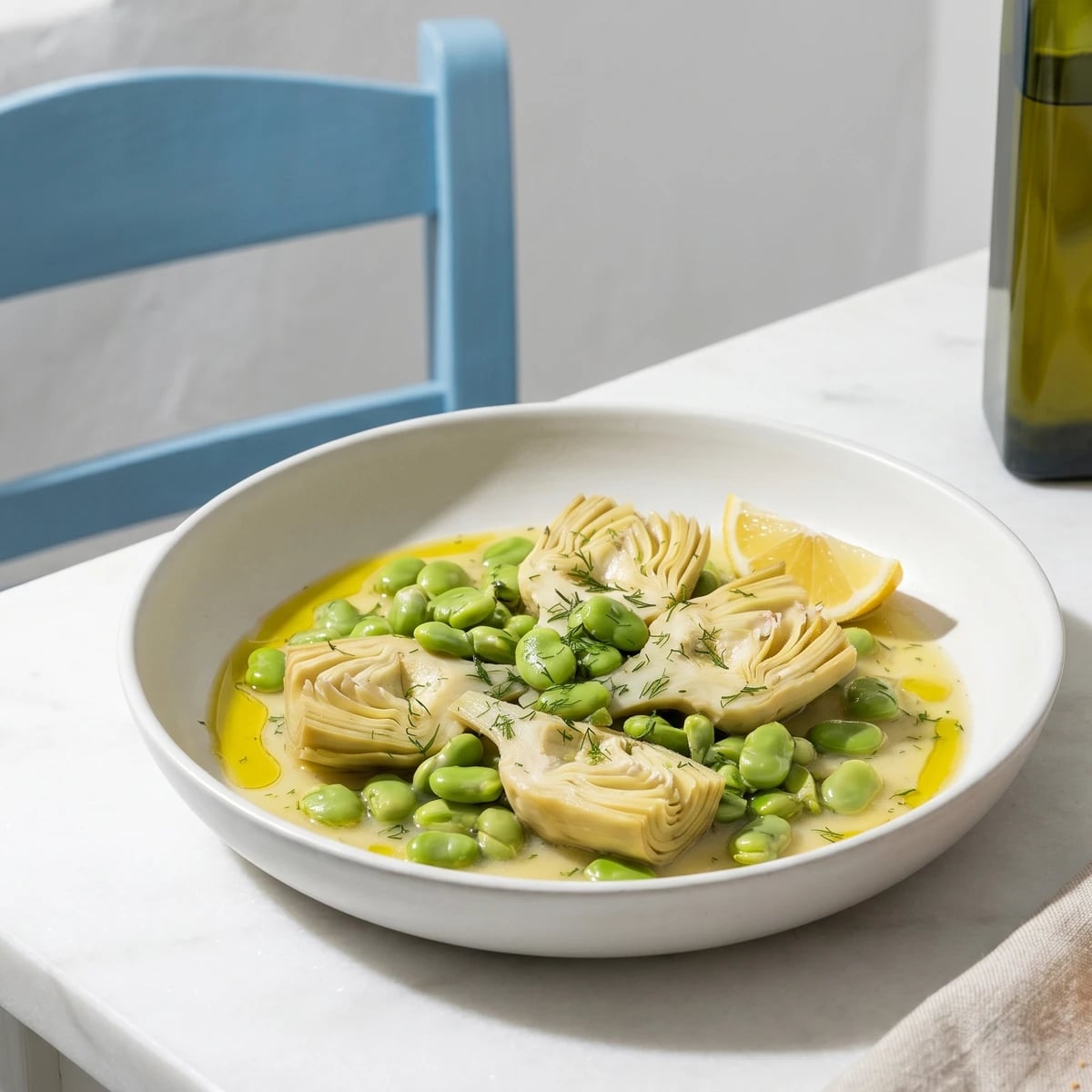
Tinos anginares me koukia are a Cycladic spring pot: fresh artichoke hearts, young broad beans, olive oil, lemon, and dill, cooked until the sauce turns pale and glossy. This is not a little vegetable side pretending to be supper. On the islands, when the fields give these two at the same time, they go into one pot and feed the table with bread.

The one thing that decides it is the artichoke prep. Trim them bravely, rub every cut surface with lemon, and keep the hearts in lemon water until they meet the oil. Artichokes brown almost before you finish the knife work; the lemon keeps their flavor clean and their color alive, so the beans stay sweet beside them instead of tasting muddy.

Use fresh broad beans if the pods are young and heavy. If the beans are large, slip off the pale skins after a quick blanch, no drama. I write this one as I cook it in spring in Thessaloniki after the laiki, with the dill still wet in its paper. The region is the dish's surname, and here the surname is Tinos.

In the Cyclades, especially on Tinos, artichokes are a field crop as much as a market vegetable; the village of Komi still marks the harvest with an annual artichoke festival. Koukia are broad beans, Vicia faba, a pulse known around the Aegean long before tomatoes and potatoes arrived from the Americas. The oil-and-lemon stew is nistisimo, tied to late Lent and the days around Easter when artichokes and young beans meet for only a few weeks.

The technique, the tradition, and the story behind every dish.

Discover Culinary Explorer

Ingredients

fresh artichokes

Quantity

8 medium

trimmed to hearts, stems peeled, quartered

fresh broad beans (koukia)

Quantity

600g shelled

from about 1.8kg pods, peeled if large

lemons

Quantity

4 medium

divided for soaking, rubbing, and 75ml cooking juice

extra virgin Koroneiki olive oil

Quantity

120ml

divided

yellow onion

Quantity

1 large, about 180g

finely chopped

spring onions

Quantity

4

thinly sliced

all-purpose flour

Quantity

15g

hot water

Quantity

350ml

fresh dill

Quantity

15g

chopped, divided

fine sea salt

Quantity

8g

plus more to taste

freshly ground black pepper

Quantity

1/2 teaspoon

Equipment Needed

  • wide heavy pot with lid, 28cm
  • large bowl for lemon water, at least 3L
  • small spoon or melon baller for removing the choke
  • small whisk for the lemon-flour sauce

Instructions

  1. 1

    Prepare the beans

    Shell the broad beans. If they are small, tender, and bright green, leave the skins on. If they are large or gray-green, blanch them in boiling water for 60 seconds, cool them under cold water, and slip off the pale skins. Old skins bring bitterness to a gentle pot.

  2. 2

    Trim the artichokes

    Fill a large bowl with 2 liters cold water and the juice of 1 lemon. Work on one artichoke at a time: pull away the dark outer leaves until you reach the pale tender ones, cut off the top third, trim the stem to about 4cm, peel the stem, and scrape out any hairy choke. Quarter the heart, rub every cut surface with a lemon half, and drop it into the lemon water. Trim boldly. Tough leaves do not soften into kindness.

    The lemon water is not decoration. Artichokes darken fast once cut, and the acid keeps their flavor clean beside the sweet beans.
  3. 3

    Soften the onions

    Warm 90ml of the olive oil in a wide heavy pot over medium heat. Add the yellow onion, spring onions, and salt. Cook for 8 to 10 minutes, stirring often, until the onions are soft and sweet but not browned.

  4. 4

    Stew the vegetables

    Drain the artichokes and add them to the pot with the broad beans. Add 350ml hot water, 45ml lemon juice, the black pepper, and half the dill. The liquid should come about halfway up the vegetables, not drown them. Bring to a gentle simmer, cover, and cook for 30 to 35 minutes, shaking the pot once or twice, until the artichoke stems are tender when pierced.

  5. 5

    Bind with lemon

    Whisk the flour with the remaining 30ml lemon juice and 120ml hot liquid from the pot until smooth. Pour it around the vegetables, not directly onto one spot, and add the remaining dill. Simmer uncovered for 5 to 8 minutes, shaking the pot gently, until the sauce turns glossy and lightly thick. Taste for salt and lemon.

  6. 6

    Rest and serve

    Take the pot off the heat and drizzle over the remaining 30ml olive oil. Cover and let it rest for 15 minutes before serving. Anginares me koukia are best warm, not boiling hot, with bread for the lemony oil at the bottom of the plate.

Chef Tips

  • Buy artichokes that feel heavy, with tight leaves and stems that look freshly cut. Broad bean pods should be firm and full. If the market doesn't have both at the same time, the calendar is telling you the truth.
  • Young broad beans can keep their skins. Older beans need the quick blanch and peel, or their skins turn chewy and a little bitter in the lemon sauce.
  • Frozen artichoke hearts and frozen broad beans can make an honest Tuesday pot when spring has passed. They will not taste like the Tinos field version, but they will still give you dinner. Do not thaw them into a puddle first.
  • This is nistisimo, so it belongs naturally on a Lenten or Holy Week table. Serve it with country bread, olives, and sliced radishes. After Easter, a piece of feta beside it is allowed, but the pot itself needs none.
  • Broad beans are not safe for people with G6PD deficiency, also called favism. For that table, choose another spring ladero dish rather than trying to make this one behave.

Advance Preparation

  • Shell the broad beans up to 1 day ahead and keep them covered in the refrigerator. Peel large beans after blanching, then chill them.
  • Trim artichokes no more than 2 hours ahead and keep them submerged in lemon water in the refrigerator.
  • The finished dish can be cooked 1 day ahead. Warm it gently and finish with a fresh thread of olive oil and a little dill.

Frequently Asked Questions

Nutrition Information

1 serving (about 360g)

Calories
465 calories
Total Fat
29 g
Saturated Fat
4 g
Trans Fat
0 g
Unsaturated Fat
23 g
Cholesterol
0 mg
Sodium
910 mg
Total Carbohydrates
47 g
Dietary Fiber
19 g
Sugars
7 g
Protein
15 g

Note: Chef personas and recipes are created with AI assistance. Cook with care: follow safe food-handling practices, check doneness with a thermometer when needed, and adapt for allergies and your kitchen.

Where cooking meets culture.

Culinary guides, cultural storytelling, and the editorial depth that makes cooking meaningful.

Discover Culinary Explorer

More from Ladera: Greek Olive-Oil Vegetable Mains

Browse the full collection