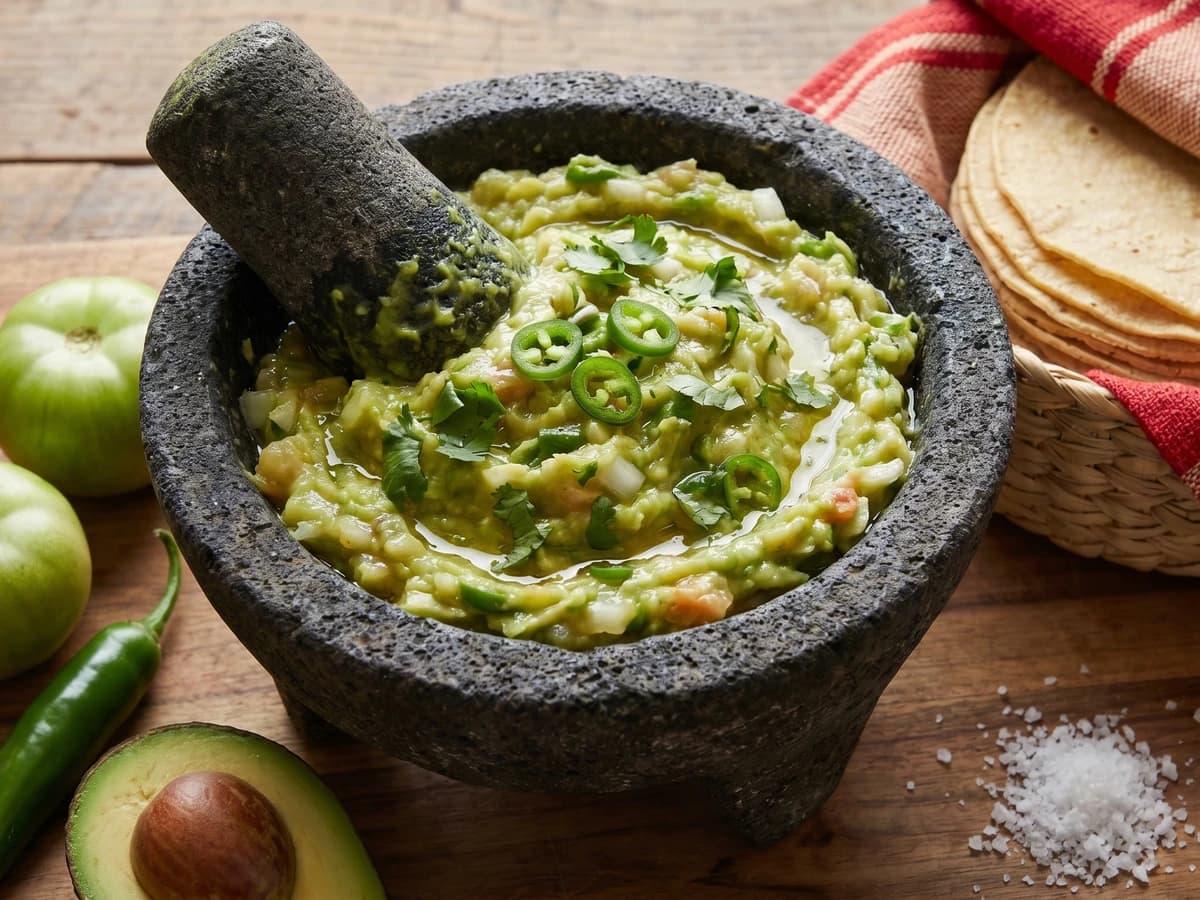
Chiapas's highland tamal kneads fresh chipilín into lard-rich masa, wraps it in hoja de plátano, and serves it with tomato salsa sharpened by chile de Simojovel.
Appetizers & Snacks
Mexican
Holiday
Make Ahead
Christmas
1 hr
Active Time
1 hr 30 min cook•2 hr 30 min total
Yield18 tamales
Chiapas, the Meseta Comiteca Tojolabal around Comitán, is where this tamal lives. Fresh masa, chipilín leaves, manteca de cerdo, queso doble crema de Chiapas, and hoja de plátano. That is the map. That is the recipe.
Chipilín is not a generic Mexican green. It is a highland Chiapas herb, tender and earthy, with the taste of green beans, cool soil, and the milpa after rain. In the mercado of Comitán, a woman once slapped my hand when I reached for the thick stems. Leaves and tender tips only, she told me. She was right. Pregúntale a las señoras del mercado.
The banana leaf is not decoration. It gives the masa a humid, waxy green aroma and keeps the tamal tender while it cooks. Corn husks belong to many great tamales, but not this one. Cada estado, su propia cocina. For posadas, these packets can be made ahead, stacked in the tamalera, and carried to a table full of people without fuss. That is why the women of Chiapas perfected them: because good food also has to work.
My mother was from Jalisco, so chipilín was not her daily herb. In her notebook, beside a recipe copied from a Chiapaneca neighbor, she wrote: more leaf than you think. She was right about that too. Saber cocinar es saber vivir.
The Mexico-Guatemala border was formalized by the 1882 Herrera-Mariscal Treaty, but chipilín tamales are older than that line, part of a Maya southern cooking zone shared by Chiapas and Guatemala. Chipilín (Crotalaria longirostrata) is a native Mesoamerican legume whose tender leaves are cooked into masa, beans, and broths; the banana leaf wrap marks the humid south and changes the tamal's moisture and aroma. In Comitán and the Chiapanecan highlands, tamales de chipilín became practical posadas food because they can be assembled ahead, carried wrapped, and reheated without losing their shape.
The technique, the tradition, and the story behind every dish.
rinsed, softened over flame, and cut into 18 squares about 10 inches wide
banana leaf scraps
Quantity
as needed
for lining the steamer
ripe Roma tomatoes or jitomate saladet
Quantity
1 pound
white onion
Quantity
1/4 medium
garlic cloves
Quantity
2
unpeeled
dried chile de Simojovel
Quantity
3
stemmed
pork lard (manteca de cerdo), for salsa
Quantity
1 tablespoon
fine sea salt, for salsa
Quantity
1/2 teaspoon, plus more to taste
Ingredient
Quantity
fresh nixtamalized masa para tamalcoarse grind if possible
2 pounds
pork lard (manteca de cerdo)at room temperature
1 cup
warm chicken broth or pork broth
1 1/4 to 1 1/2 cups
baking powder
1 teaspoon
fine sea salt
1 tablespoon, plus more to taste
fresh chipilín leaves and tender tipswashed and dried
3 packed cups
queso doble crema de Chiapascut into 18 small pieces
8 ounces
banana leavesrinsed, softened over flame, and cut into 18 squares about 10 inches wide
2 large
banana leaf scrapsfor lining the steamer
as needed
ripe Roma tomatoes or jitomate saladet
1 pound
white onion
1/4 medium
garlic clovesunpeeled
2
dried chile de Simojovelstemmed
3
pork lard (manteca de cerdo), for salsa
1 tablespoon
fine sea salt, for salsa
1/2 teaspoon, plus more to taste
Equipment Needed
•Tamalera or deep steamer pot with a rack
•Gas flame or dry comal for softening banana leaves
•Large mixing bowl or stand mixer with paddle
•Comal for roasting tomatoes and chiles
•Blender
•Small clay cazuela or heavy skillet for frying salsa
Instructions
1
Prepare the leaves
Rinse the hoja de plátano and wipe it dry. Pass each leaf over a gas flame or hot comal until it turns glossy, deep green, and flexible. Cut into 18 squares about 10 inches wide and save the scraps for the steamer. Do not use corn husks here. A corn husk gives you another tamal, not a Chiapas tamal de chipilín.
2
Clean the chipilín
Pick the chipilín leaves and tender tips from the stems. The thick stems stay out. Rinse well and dry completely in a clean towel. Chipilín is not generic green. It has its own field smell, like tender beans and cool soil. If you bruise it into a wet pile, the masa will taste muddy.
3
Beat the masa
In a large bowl or stand mixer, beat the manteca de cerdo with the salt until it looks lighter and soft. Add the fresh masa and baking powder. Beat while adding the warm broth little by little. The masa should be spreadable but not loose, like thick clay that holds the mark of your fingers. Drop a small piece into a glass of water. If it floats, the masa has enough air. If it sinks, keep beating. No me vengas con atajos.
4
Fold in chipilín
Fold the chipilín into the masa with your hands until the leaves are evenly scattered through it. Do not chop the leaves into paste. You want green flecks through every bite, not green dough. Taste a tiny bit of the raw masa for salt. It should taste slightly more seasoned than you think, because steaming will soften the salt.
5
Fill the tamales
Lay one banana leaf square glossy side up. Spoon about 1/3 cup masa into the center and spread it into a thick oval. Put one piece of queso doble crema de Chiapas in the middle. Fold the sides of the leaf over the masa, then fold the top and bottom into a tight packet. The leaf should hold the masa close without squeezing it flat.
If the banana leaf splits, it was not softened enough. Pass the next piece over the flame again until it bends without cracking.
6
Steam the tamales
Set a rack inside a tamalera or deep steamer and add water below the rack. Line the rack with banana leaf scraps. Arrange the tamales seam side down, snug but not crushed. Cover with more banana leaf scraps, then the lid. Steam over medium heat for 70 to 80 minutes, checking the water level once or twice. The tamales are done when the masa pulls cleanly from the leaf and the chipilín has settled into the masa instead of sitting raw on top.
7
Roast the salsa
While the tamales cook, roast the tomatoes, onion, and unpeeled garlic on a dry comal until the tomato skins blister and the garlic softens. Toast the chile de Simojovel for a few seconds per side, just until fragrant. Do not blacken it. This chile is small and serious, and burned chile turns bitter faster than you can apologize.
8
Blend and fry salsa
Peel the garlic. Blend the roasted tomatoes, onion, garlic, toasted chile de Simojovel, and salt until mostly smooth. Melt 1 tablespoon manteca de cerdo in a small cazuela or skillet and fry the salsa for 8 to 10 minutes, stirring often, until it thickens and darkens slightly. The salsa belongs on the tamal, not inside the masa. The tamal itself is about chipilín.
9
Rest and serve
Turn off the heat and let the tamales rest in the covered pot for 10 minutes. Open the banana leaves at the table and spoon the tomato and chile de Simojovel salsa over the green-flecked masa. Serve warm, still in the leaf, on barro de Amatenango del Valle if you have it. Recetas probadas y garantizadas.
Chef Tips
•Use fresh chipilín sold for cooking. Do not forage random Crotalaria plants. Some relatives of chipilín are not food. If the vendor cannot tell you it is chipilín for tamales, keep walking.
•If you cannot find fresh chipilín, frozen chipilín from a Central American or southern Mexican market is the next best thing. Spinach is not a substitute. A spinach tamal may be edible, but it is not tamal de chipilín.
•Fresh masa from a molino or tortillería gives the best result. Masa harina para tamal will work in an emergency, but it loses the deep nixtamal smell. A substitution is a compromise, not an upgrade.
•The salsa uses chile de Simojovel because this is Chiapas. If you cannot find it, use chile de árbol and understand what you are missing: the sharper, smoky fruit of a Chiapas chile. Do not reach for chile amashito here. That belongs to Tabasco salsas.
•La manteca es el sabor. Vegetable oil gives you heavy masa with no character. The lard traps air, carries the chipilín flavor, and helps the tamal pull cleanly from the banana leaf.
Advance Preparation
•Pick and wash the chipilín one day ahead. Dry it well, wrap it in a clean towel, and refrigerate it in a loose bag.
•The banana leaves can be rinsed, softened, cut, and refrigerated one day ahead. Keep them wrapped so they do not dry out.
•The assembled uncooked tamales can be refrigerated overnight. Steam them straight from the refrigerator and add 10 minutes to the cooking time.
•Cooked tamales keep refrigerated for 4 days. Reheat them in a steamer so the banana leaf softens again and the masa stays tender.
Frequently Asked Questions
Nutrition Information
1 serving (about 120g)
Calories
250 calories
Total Fat
16 g
Saturated Fat
7 g
Trans Fat
0 g
Unsaturated Fat
9 g
Cholesterol
22 mg
Sodium
630 mg
Total Carbohydrates
22 g
Dietary Fiber
3 g
Sugars
2 g
Protein
5 g
Where cooking meets culture.
Culinary guides, cultural storytelling, and the editorial depth that makes cooking meaningful.