
Chef Lupita
Aporreadillo Michoacano con Huevo
Michoacán's Tierra Caliente almuerzo, where salted beef is softened, pounded, fried in lard, folded with egg and chile perón salsa, then served beside morisqueta like a proper working table.
A cooking platform built around craft, culture, and the stories behind what we eat.
Created by
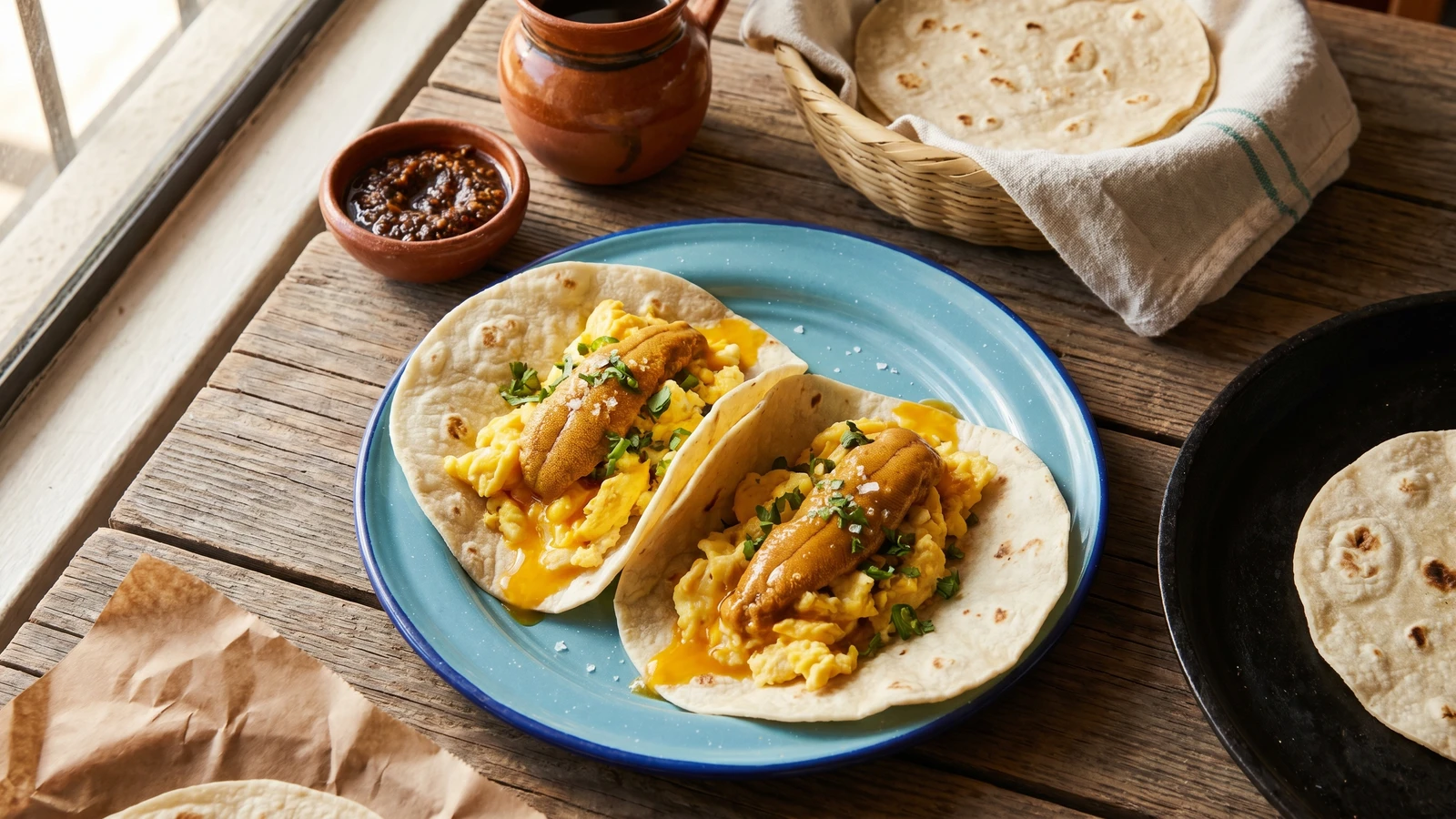
Ensenada's surf-country breakfast taco: soft-scrambled eggs folded off the heat with raw sea urchin from the Baja Pacific, dressed with serrano and cilantro, wrapped in a warm flour tortilla.
This is from Baja California. Specifically from Ensenada and the fishing coves north of it, where the erizo divers come up at dawn with crates of sea urchin still cold from the Pacific and the cooks at the dock palapas crack eggs into a pan before the boats are even unloaded. This is not a Mexico City dish. This is not a Yucatan dish. This is the breakfast of a state with one foot in the desert and the other in the ocean.
The erizo is the recipe. Ensenada's sea urchin is among the most prized in the world, exported to Japan in volumes that should embarrass us, because the locals know what they are sitting on. It is sweet, briny, with a clean iodine finish that disappears into eggs and leaves behind a richness that no cream can match. The flour tortilla is also not a mistake. In the noroeste, flour belongs. The wheat tradition runs from Sonora down through Baja, and a corn tortilla here would be wrong. Defend the flour tortilla without apology.
The technique is the easiest part of the dish if you respect two rules. The eggs go low and slow until they are barely set. The erizo never sees direct heat. You fold it in off the burner so the residual warmth softens the tongues without cooking them. Cook them and you have ruined an ingredient that came up from the ocean that morning. La cocina no es decoracion, es trabajo, but here the work is patience, not labor.
My mother never made this. She was from Jalisco and she was suspicious of seafood for breakfast. I learned this dish in 2009 from a woman named Doña Carmen who ran a four-table comedor near the Mercado Negro in Ensenada. She used a non-stick pan, a silicone spatula, and the same low flame the whole time. She told me, in the tone of someone who had said it a thousand times: 'el erizo no se cocina, se calienta.' The urchin is not cooked, it is warmed. I wrote it down. Recetas probadas y garantizadas.
Sea urchin harvesting on the Baja California Pacific coast is a relatively recent industry, scaling up in the 1970s when Japanese buyers began contracting with Ensenada divers for export of red and purple urchin roe to the Tokyo uni market. Mexico is now among the top global suppliers of sea urchin, and the vast majority is sourced from the cold-water beds between Ensenada and Isla de Cedros. The flour tortilla, ubiquitous in Baja California breakfasts, reflects the wheat-growing tradition the Spanish established across northern Mexico in the 17th and 18th centuries, a regional inheritance that distinguishes noroeste cooking from the corn-based central and southern states.
Quantity
8 pieces
from Ensenada or the Baja Pacific, chilled until the moment of plating
Quantity
8
room temperature, whisked just before cooking
Quantity
2 tablespoons
Quantity
1/2 teaspoon, plus more to taste
Quantity
2 tablespoons
Quantity
1 tablespoon
Quantity
1
stemmed and finely minced
Quantity
3 tablespoons
leaves and tender stems, finely chopped
Quantity
2 tablespoons
finely diced
Quantity
8
warmed on a comal until lightly speckled
Quantity
2
halved
Quantity
for serving
Quantity
for finishing
| Ingredient | Quantity |
|---|---|
| fresh sea urchin tongues (erizo)from Ensenada or the Baja Pacific, chilled until the moment of plating | 8 pieces |
| large eggsroom temperature, whisked just before cooking | 8 |
| crema fresca | 2 tablespoons |
| sea salt | 1/2 teaspoon, plus more to taste |
| unsalted butter | 2 tablespoons |
| mild olive oil | 1 tablespoon |
| fresh chile serranostemmed and finely minced | 1 |
| fresh cilantroleaves and tender stems, finely chopped | 3 tablespoons |
| white onionfinely diced | 2 tablespoons |
| flour tortillas, 6-inchwarmed on a comal until lightly speckled | 8 |
| limones mexicanos (optional)halved | 2 |
| salsa macha de cacahuate (optional) | for serving |
| flaky sea salt from Guerrero Negro (optional) | for finishing |
Pull the sea urchin from the refrigerator and look at it. The tongues should be intact, bright orange to gold, with a clean ocean smell. No dull color, no metallic odor, no broken shapes. If your erizo is anything less than perfect, this is not the day to make this dish. Cook what the market is selling well today. Set the tongues on a chilled plate and return them to the refrigerator until the eggs are almost ready.
Mince the serrano fine. Chop the cilantro. Dice the onion small. Combine all three in a small clay bowl. This is the dressing that goes on the taco at the table. The serrano in Ensenada cooks goes raw. Roasting it changes the dish into something else.
Heat a comal over medium. Warm each flour tortilla for about 20 seconds per side, until soft and lightly speckled. Stack them in a cloth-lined basket and cover. Flour tortillas dry out fast. Keep them wrapped until the eggs hit the pan.
Crack the eggs into a bowl. Add the crema fresca and the half teaspoon of salt. Whisk until completely uniform, no streaks of white. The crema does what cream does for soft scrambles: it slows the protein and keeps the curd loose. Without it, the eggs tighten too fast and you lose the place where the erizo lives.
Set a non-stick skillet over low heat. Add the butter and olive oil. When the butter has just melted, pour in the eggs. Wait. Do not stir for the first 30 seconds. Then begin to drag a silicone spatula slowly across the bottom, lifting the cooked curd into the wet center. Keep the heat low. The eggs should take five to six full minutes to come together. They are done when they are barely set, glossy, the curd loose enough to spoon. No me vengas con atajos. High heat scrambles the eggs in 90 seconds and ruins them.
Off the heat, slide six of the eight tongues into the eggs. Fold them through with two or three slow turns of the spatula. The residual warmth gentles the erizo, never cooks it. The texture should stay creamy, almost melting into the curd, the color streaking gold through the soft yellow. Reserve the last two tongues whole for the top of the tacos.
Lay two warm flour tortillas on each plate. Spoon the egg-and-erizo mixture down the center of each one. Tear a piece of the reserved whole erizo and lay it on top of the egg, where the diner will see it first. Scatter the serrano-cilantro-onion mixture across the top. Finish with a few flakes of sea salt from Guerrero Negro.
Set the plates down with lime halves on the side and a small bowl of salsa macha for the cook who wants it. A squeeze of lime over the erizo at the last second pulls the ocean forward. Eat them with your hands, fold the tortilla loose, do not roll them tight. Asi se hace y punto.
1 serving (about 215g)
Culinary guides, cultural storytelling, and the editorial depth that makes cooking meaningful.
Discover Culinary ExplorerChef Lupita
Michoacán's Tierra Caliente almuerzo, where salted beef is softened, pounded, fried in lard, folded with egg and chile perón salsa, then served beside morisqueta like a proper working table.

Chef Lupita
Guerrero's Costa Grande aporreado is salted cecina pounded soft, scrambled with egg, and finished in a red guajillo and chile de árbol salsa loud with garlic and cilantro.

Chef Lupita
Los Altos de Chiapas turns two-night fermented white corn into a tart-sweet atole, cooked with canela and piloncillo, then poured hot into jícaras for desayuno.

Chef Lupita
Oaxaca's Mixteca region ferments nixtamalized masa for days until it turns tart and alive, then simmers it with piloncillo and canela into a thick, warm atole served at first light in clay.