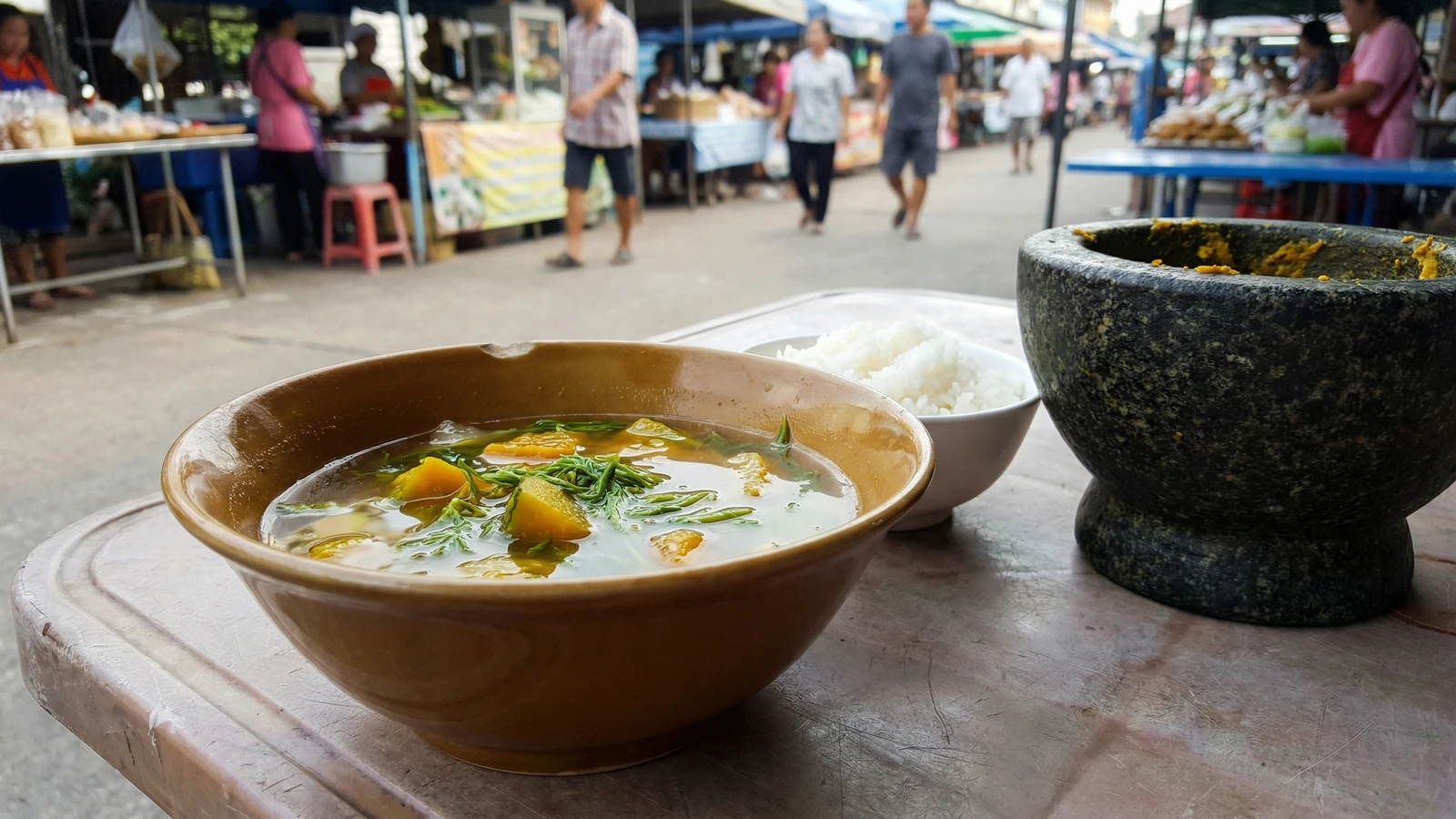
A kapi-pounded paste dissolved into broth, golden with fresh turmeric, loaded with pumpkin and bitter Southern greens that most of the world has never tasted. The kreung tam governs even a bowl of vegetables.
Soups & Stews
Thai
Weeknight
Comfort Food
20 min
Active Time
15 min cook•35 min total
Yield4 servings
Kapi. Shrimp paste. That funky, fermented block of concentrated sea flavor that makes non-Thai cooks wrinkle their noses and Southern Thai grandmothers smile. This is where the soup starts. Not in the pot. In the mortar.
Ajarn always said the kreung tam is the foundation of every Thai dish. People hear that and think he's talking about green curry, massaman, the heavy hitters. He's not. He means everything. Including a bowl of vegetables in broth that a grandmother in Nakhon Si Thammarat puts on the table for a Tuesday dinner. The paste here is simple: kapi, shallots, garlic, white peppercorns, dried shrimp, fresh turmeric root, a few dried chilies. Pound it. That golden, pungent paste hits the water and transforms it from nothing into something worth eating. Without the kreung tam, you have boiled vegetables. With it, you have sup pak tai.
Southern Thai food is the most intense regional cuisine in the country. Spicier, saltier, more pungent, less sweet. Where Central Thai balances all four pillars with careful diplomacy, the South turns up the volume on salt (kapi and nam pla working together), sour (tamarind, not lime, in cooked dishes), and heat (dried chilies ground into the paste), while keeping sweet way in the background. This soup is that philosophy in its simplest form. Cha-om (acacia leaf) brings a bitter, herbal punch that defines Southern home cooking. Most foreigners have never tasted it. It's pungent, slightly sulfurous, and completely unforgettable. Water mimosa (phak krachet) adds a faint grassiness and a texture that holds up in hot broth. Pumpkin rounds out the bowl with natural sweetness, the only sweetness the dish needs. No palm sugar. The South doesn't lean on sweet.
I learned this from a market vendor in Nakhon Si Thammarat during a trip with Ajarn. She had turmeric stains on her hands that looked permanent. Her kreung tam took ninety seconds in the mortar. Her soup took ten minutes after that. She fed us for forty baht and it was better than anything I've eaten in a hotel dining room. That's Southern Thai home cooking. Simple technique. Correct principles. No performance. Fai Thai, baby.
Southern Thai cuisine occupies the Malay Peninsula between the Gulf of Thailand and the Andaman Sea, where abundant coastal seafood fuels a fermentation culture centered on kapi (shrimp paste) and budu (fermented fish sauce unique to the deep south near the Malaysian border). Simple vegetable soups built on kapi-based pastes are the everyday counterpart to the south's famously fiery curries, cooked by families from Nakhon Si Thammarat to Songkhla using whatever greens are in season. Cha-om (Acacia pennata), a defining herb of Southern and Central Thai home cooking, is largely absent from Isan and Northern Thai kitchens, making its presence a regional marker of the peninsula table.
The technique, the tradition, and the story behind every dish.
tough lower stems trimmed, cut into 2-inch lengths
cha-om tips (acacia leaf)
Quantity
1 cup
picked from woody stems
fish sauce (nam pla)
Quantity
2 tablespoons
tamarind paste (makham piak)
Quantity
1 tablespoon
dissolved in 3 tablespoons warm water
Ingredient
Quantity
dried shrimp (goong haeng)
2 tablespoons
white peppercorns (prik thai)
1 teaspoon
shallots (hom daeng)roughly sliced
5
garlic
4 cloves
dried red chilies (prik haeng)soaked in warm water 10 minutes, seeded
3
fresh turmeric root (kamin)sliced
1-inch piece
shrimp paste (kapi)
1 tablespoon
water
4 cups
pumpkin (fak thong)cut into bite-sized wedges, skin on
200g
water mimosa (phak krachet)tough lower stems trimmed, cut into 2-inch lengths
100g
cha-om tips (acacia leaf)picked from woody stems
1 cup
fish sauce (nam pla)
2 tablespoons
tamarind paste (makham piak)dissolved in 3 tablespoons warm water
1 tablespoon
Equipment Needed
•Heavy granite mortar and pestle (krok hin)
•Medium stockpot or saucepan
Instructions
1
Pound the kreung tam
Start with the dried shrimp and white peppercorns in your granite mortar (krok hin). Pound them first because they're the hardest. Crack the peppercorns until they're fragrant, then grind the dried shrimp into coarse fibers. They don't need to be powder. You want them broken enough to release their salt and umami into the broth. Add the garlic, shallots, soaked dried chilies, and fresh turmeric. Pound into a rough paste. The turmeric will stain everything it touches, your mortar, your fingers, your cutting board, golden. That's how you know it's working. Finally add the kapi and pound it in until the paste is uniform. The smell should be intense: briny, peppery, earthy from the turmeric. If it doesn't hit you from across the kitchen, keep pounding.
Fresh turmeric root (kamin), not dried powder. The special instructions say it and Ajarn would say it louder. Fresh turmeric has a resinous, gingery bite that dried powder can't match. Peel it with a spoon to save your fingers from the worst of the staining.
2
Build the broth
Bring the water to a rolling boil in a medium pot. Scoop the kreung tam from the mortar and drop it into the boiling water. Stir to dissolve. The water will turn golden within seconds, turmeric doing its work. Let the broth simmer for 2 to 3 minutes so the paste fully opens up. The aroma should shift from raw shrimp paste funk to something rounder, deeper, with the peppercorns coming through. That's the kreung tam integrating. That's the foundation set.
3
Cook the pumpkin
Add the pumpkin wedges to the broth. They go in first because they need the most time. Simmer for 8 to 10 minutes until the pumpkin is tender but still holds its shape. You should be able to pierce it with a fork without it collapsing. The pumpkin will release its natural sweetness into the broth. That's the only sugar this soup needs. Don't rush this step. Undercooked pumpkin is chalky and ruins the texture of the bowl.
Leave the skin on the pumpkin. Thai cooks don't peel it. The skin holds the wedge together in the broth and adds a slight firmness at the edge. Cut your wedges small enough to eat in two bites.
4
Season the broth
Add the fish sauce and tamarind water. Stir once. Taste. The broth should be savory first, with a gentle sour undertone from the tamarind and a background warmth from the chili and pepper. Not sweet. If you're used to Central Thai food, this will feel different. Southern Thai soups lean into salt and sour, keeping sweetness at arm's length. Adjust the fish sauce if it needs more depth. Adjust the tamarind if it needs more edge. Principles, not recipes.
5
Add the greens
Add the water mimosa and cha-om tips to the broth. Stir them in gently and cook for no more than 1 to 2 minutes. These greens wilt fast and that's all they need. The cha-om will release its signature pungent, slightly bitter aroma the moment it hits the hot broth. If you've never smelled cha-om before, don't panic. It's sulfurous and strong. That's correct. That's the herb doing its job. The water mimosa should stay bright green with a slight crunch. If the greens have gone army-green and limp, you've gone too far. Ladle into bowls immediately. Serve with steamed jasmine rice on the side.
Cha-om smells like nothing else in the Thai herb arsenal. Some people compare it to overripe durian or garlic crossed with asparagus. Be honest with yourself: the first time, it's confrontational. By the third time, you'll crave it. That's how Southern Thai flavors work. They don't ask permission.
Chef Tips
•This soup uses kapi (shrimp paste) in the kreung tam, not as a standalone seasoning dropped into the pot. Pounding the kapi into the paste with the aromatics mellows its raw edge and integrates it with the peppercorns and turmeric. If you just dissolve raw kapi into water, you get a briny, one-note broth. Pounding it into a paste gives you depth. That's the difference between knowing an ingredient and understanding the system.
•Cha-om (Acacia pennata) is the herb that separates Southern Thai home cooking from the tourist version of Thai food. It's pungent, bitter, and polarizing. Describe it honestly to anyone eating it for the first time. If you can't find cha-om fresh, check frozen bags at Southeast Asian grocers. Dried cha-om doesn't work. The flavor dies completely.
•Water mimosa (phak krachet) looks like a delicate fern and grows near water in the south. If you can't source it, substitute morning glory (phak bung) cut into short lengths. The flavor is different but the texture role in the soup is similar. Don't substitute spinach. Spinach melts. You need a green that holds its structure in hot broth.
•The South uses tamarind (makham) for sour in cooked dishes more often than lime. Lime goes into dishes at the table or in raw preparations like som tam. Tamarind's sourness is rounder, darker, and it survives heat without turning bitter. This is one of the regional differences that matters. Northern Thai, Central Thai, Isan, Southern Thai: each region has its own sour source and it shapes everything.
Advance Preparation
•The kreung tam can be pounded up to a day ahead and stored in an airtight container in the refrigerator. The flavors actually deepen slightly overnight as the kapi and turmeric continue to meld.
•Pumpkin can be cut into wedges and stored in water in the refrigerator for several hours before cooking.
•Do not add the cha-om and water mimosa until you are ready to serve. They wilt within minutes and lose their color and texture. The greens go in last, always.
Frequently Asked Questions
Nutrition Information
1 serving (about 340g)
Calories
70 calories
Total Fat
1 g
Saturated Fat
0 g
Trans Fat
0 g
Unsaturated Fat
1 g
Cholesterol
15 mg
Sodium
1190 mg
Total Carbohydrates
12 g
Dietary Fiber
2 g
Sugars
5 g
Protein
5 g
Where cooking meets culture.
Culinary guides, cultural storytelling, and the editorial depth that makes cooking meaningful.