
Chef Freja
Danablu Mad med Rå Æggeblomme
Danish blue cheese layered on dark rye with a raw egg yolk nestled on top, red onion rings, and chives. The last piece at a Danish lunch, and the one that stays with you longest.
A cooking platform built around craft, culture, and the stories behind what we eat.
Created by Chef Freja
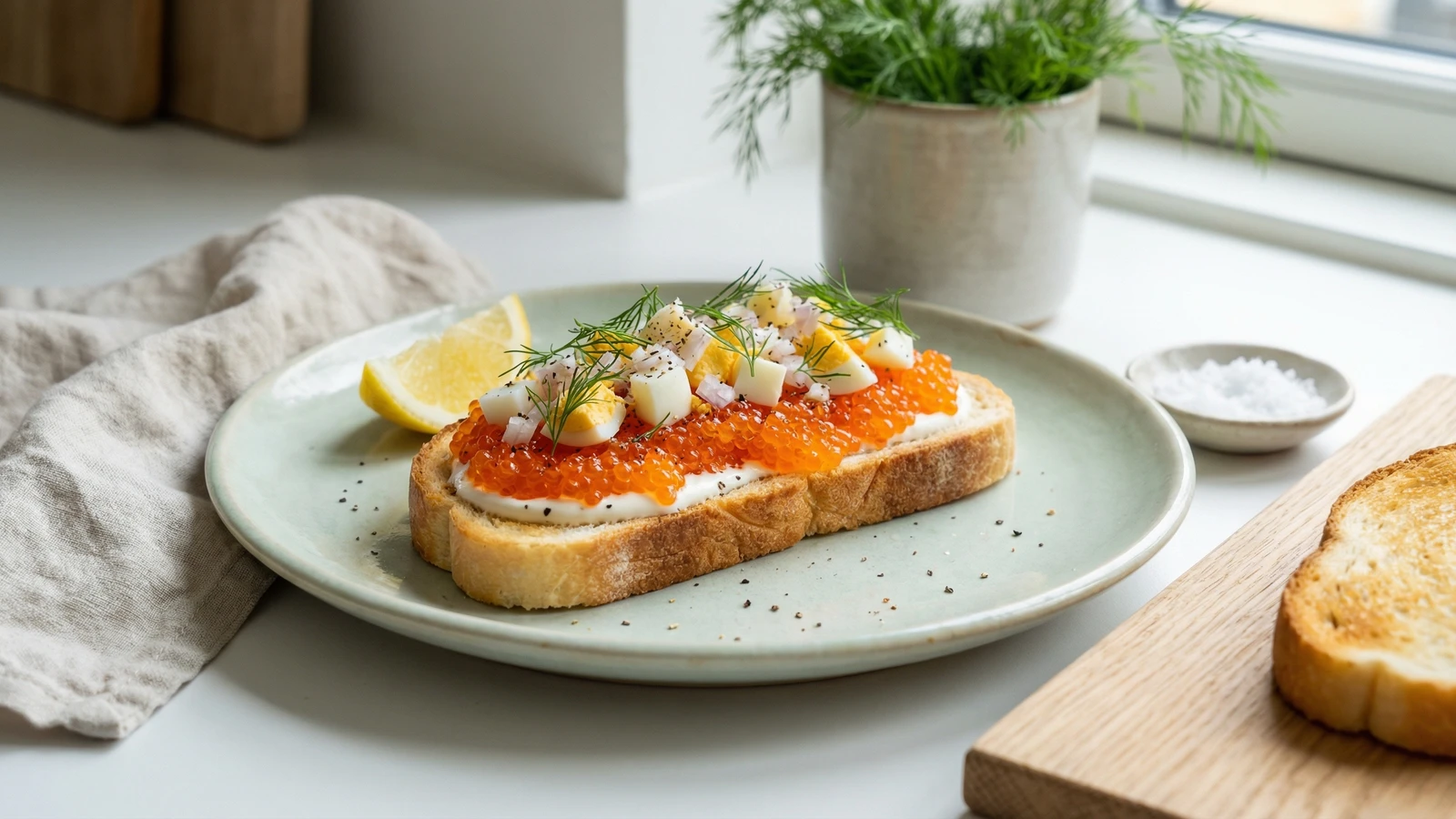
Danish lumpfish roe piled onto warm toasted franskbrod with chopped egg, dill, and a squeeze of lemon. The first luxury of the Danish spring, the dish that arrives when the roe does.
There is a week in late February when the fishmongers in Copenhagen put up handwritten signs. Stenbiderrogn. Just the word, nothing else. It means the season has turned. The lumpfish have come into the shallows to spawn, and for six or eight short weeks the roe is cheap enough to eat generously and fresh enough to taste of the sea it came from. This is the first luxury of the Danish year, and it belongs to spring and to the Easter table.
The dish itself could not be simpler. You toast good white bread, you butter it while it is warm, you pile the glossy orange beads on top, and you finish with chopped egg, dill, and lemon. That is the whole grammar. But the simplicity is exactly why every element has to be right. There is nowhere for a mistake to hide. Cheap bread goes soggy. Cold bread dulls the roe. Over-boiled eggs turn chalky and fight the softness of everything else. I will walk you through each step so that when you sit down to eat, every part of the piece is doing its job.
What matters most is the contrast. Warm bread, cold roe. Rich butter, bright lemon. Soft egg, the tiny pop of each individual bead against your teeth. When you get this right, the whole piece comes alive in the mouth at once, and you understand why Danes wait for this season the way other people wait for strawberries. The joy of waiting is part of the dish. The roe arrives when it arrives, and the season decides.
The stenbider, literally the stone biter, is a homely, round-bellied fish that clings to rocks along the Danish coast with a suction disc on its belly, and for most of the year nobody gives it much thought. But in late winter the females come close to shore to spawn, and their bright orange roe has been harvested by Danish coastal fishermen since at least the 19th century. For generations stenbiderrogn was a Jutland and Bornholm specialty, traded locally and rarely seen in Copenhagen. It became a nationwide spring tradition only in the mid-20th century, when improved transport brought the roe to the city fishmongers, and it was quickly adopted as an Easter delicacy. The season is short and the roe does not freeze well, which is why Danes still treat its arrival as a small annual event.
Quantity
200g
Quantity
4 thick slices
Quantity
40g
for the bread
Quantity
2 large
Quantity
2 tablespoons
Quantity
1 small
very finely chopped
Quantity
small bunch
fronds picked
Quantity
1
cut into wedges
Quantity
to taste
Quantity
freshly ground, to taste
| Ingredient | Quantity |
|---|---|
| fresh stenbiderrogn (lumpfish roe) | 200g |
| good white bread (franskbrod) | 4 thick slices |
| cold unsalted butterfor the bread | 40g |
| eggs | 2 large |
| creme fraiche | 2 tablespoons |
| shallotvery finely chopped | 1 small |
| fresh dillfronds picked | small bunch |
| unwaxed lemoncut into wedges | 1 |
| flaky sea salt | to taste |
| black pepper | freshly ground, to taste |
Tip the stenbiderrogn gently into a fine sieve and rinse it under cold running water for about thirty seconds. Let it drain completely. The rinse pulls away any loose brine and cloudy liquid, which is what makes the roe taste muddled on the bread. What you want is the clean, briny snap of each tiny bead on its own.
Lower the eggs gently into a small pot of simmering water and cook for exactly nine minutes. You want the yolks set but still golden at the center, not chalky and grey. Nine minutes gives you that. Lift the eggs into a bowl of cold water to stop the cooking, then peel them once they are cool enough to handle.
Chop the peeled eggs into small, even dice. Not mashed, not sliced, diced. The small cubes sit cleanly alongside the roe and give you both textures in one bite. Finely chop the shallot until it is almost a mince. Pick the dill fronds from their stems and keep them loose and feathery. Everything stays separate until the moment of assembly.
Toast the slices of franskbrod until they are golden and crisp on the outside but still soft at the centre. A toaster works, but a dry pan over medium heat gives you more control and a better colour. The contrast between warm bread and cold roe is half the pleasure of this dish, so you want the bread genuinely hot when it meets the topping.
Butter each slice generously while it is still warm, right to the edges. The butter melts slightly and soaks into the surface, and that thin layer of fat is what keeps the bread from going soggy when the roe lands on it. Spread a small spoonful of creme fraiche over the butter, just a thin swipe, not a pillow. Then pile the lumpfish roe on top in a generous, glossy mound. Do not flatten it. Let it sit high.
Scatter the diced egg around and partly over the roe so the white and yellow catch against the dark orange beads. Add a small pinch of the finely chopped shallot, not too much, just enough to give a gentle sharpness. Top with several fronds of fresh dill and a grind of black pepper. Serve immediately with a lemon wedge on the side. A squeeze of lemon just before the first bite is the moment the dish wakes up. You'll know when it's right. Tak for mad.
1 serving (about 130g)
Culinary guides, cultural storytelling, and the editorial depth that makes cooking meaningful.
Discover Culinary ExplorerChef Freja
Danish blue cheese layered on dark rye with a raw egg yolk nestled on top, red onion rings, and chives. The last piece at a Danish lunch, and the one that stays with you longest.

Chef Freja
Thick-sliced Danbo on properly buttered rugbrod with sweet pepper rings and a crown of garden cress. The cheese smorrebrod that lives in every Danish lunchbox, from the first day of school to the last day at the office.

Chef Freja
Copenhagen's most storied smorrebrod: leverpostej, cold salt beef, trembling aspic, onion rings, and fresh cress on dark rugbrod. Invented at Oskar Davidsen's in the 1880s for a hungry veterinarian and still one of the great pieces of the Danish lunch table.

Chef Freja
Pungent Esrom from North Zealand on dark rye with paper-thin radish and fresh chives. The cheese course that closes a proper Danish smorrebrod spread, one of the quietest, most satisfying bites in the whole tradition.