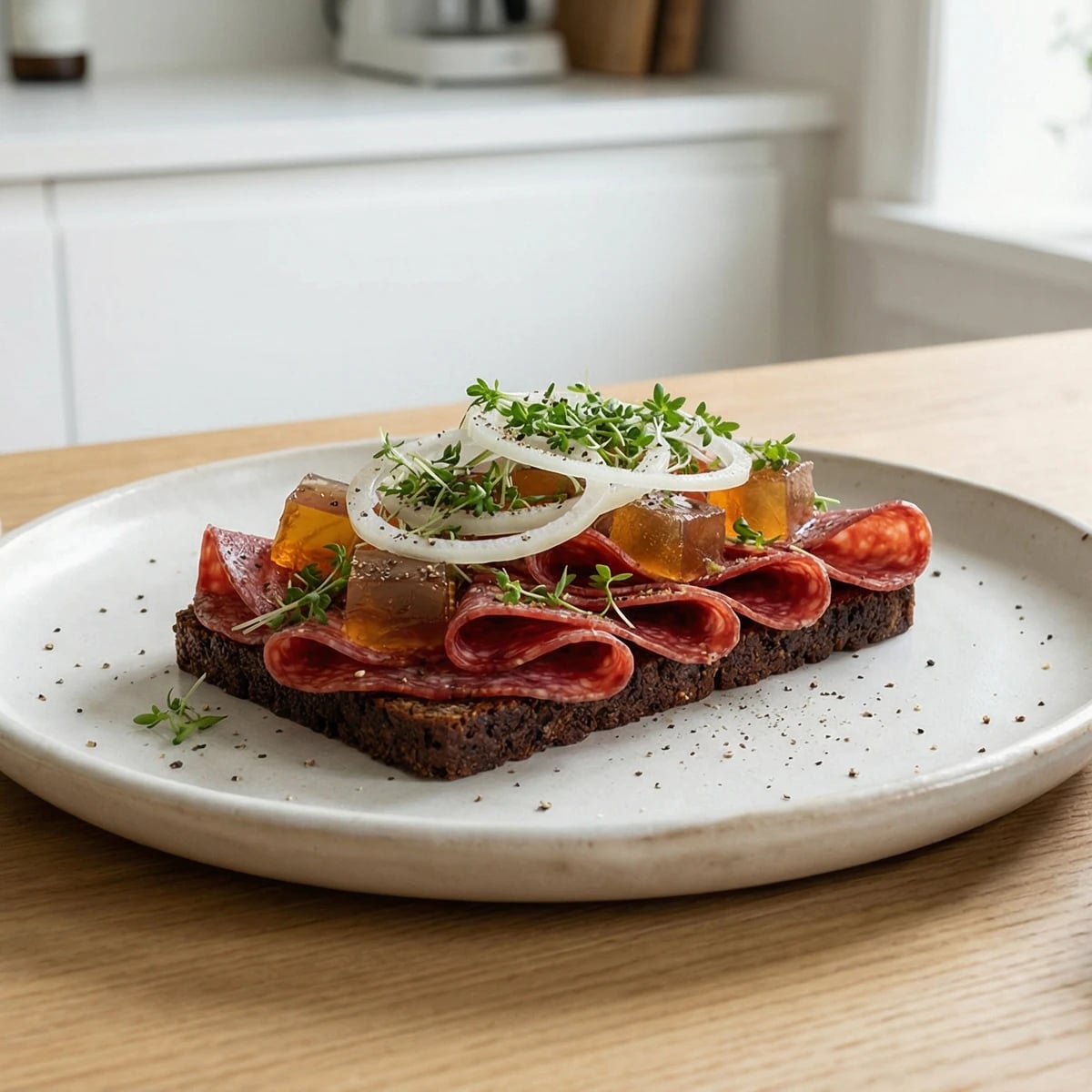
Thin-sliced Danish cured salami on dark rugbrod with trembling cubes of meat aspic, paper-thin onion rings, and garden cress. The weekday piece of smorrebrod that tastes like home.
Sandwiches & Wraps
Danish
Weeknight
Quick Meal
10 min
Active Time
0 min cook•10 min total
Yield4 pieces
Every Danish kitchen has a spegepolse in the fridge. Not the fancy kind wrapped in paper at the delicatessen, the workaday kind, dark red and firm and ready whenever the moment calls for it. Spegepolsemad is the piece of smorrebrod you make on a Tuesday evening when the day has already been long enough. It is also what goes into the madpakke, the Danish lunchbox, from the first day of school to the last day of working life. This is food that asks nothing of you and gives back more than it should.
The structure is simple and every element has a job. Rugbrod carries everything. Butter seals the bread. Spegepolse brings the cured, slightly smoky weight of the pork. Raw onion cuts through that weight with a clean sharp edge. And the sky, the trembling meat aspic, is the quiet detail most people outside Denmark have never met. It softens against the salami, catches the light, and turns a sandwich into smorrebrod.
There's nothing to cook here. What matters is how thin you slice the onion, how cold you keep the aspic, and how generously you scatter the cress. I'll walk you through each one so the layers read exactly right. This is smorrebrod at its most everyday, and everyday in Denmark means something closer to ceremony than most people realize.
Spegepolse belongs to the old Danish tradition of air-drying and curing pork through the long winter months, a preservation method that stretches back centuries in the farmhouses of Jutland and Fyn. The word itself breaks down to spege, meaning cured or salted, and polse, sausage. The use of sky, clarified meat aspic set from bone stock, was originally a butcher's economy, a way to use every drop of the cooking liquid from boiled salted meats, and it found its way onto smorrebrod as a garnish with its own quiet purpose. Garden cress became the standard topping in the twentieth century, when kitchen windowsills across Denmark grew small trays of karse year-round for exactly this kind of use.
The technique, the tradition, and the story behind every dish.
Spread each slice of rugbrod with a thin, even layer of softened butter, going right to the crusts. This is not optional and it is not flavor for its own sake. The butter is a seal. It keeps the bread from drinking the moisture out of the salami and the aspic, and it gives the fat of the cured pork something to lean against.
Take the butter out of the fridge half an hour before you start. Cold butter tears the rye. Soft butter lays down in a smooth layer and does what it needs to do.
2
Slice the onion
Peel the onion and slice it as thinly as you can, ideally on a mandoline. You want rings so thin you can see the knife through them. Thick onion overwhelms the salami and makes every bite taste like onion and nothing else. Separate the rings with your fingers and set them aside.
3
Arrange the salami
Lay four or five slices of spegepolse across each piece of rugbrod in a loose, overlapping fan. Don't flatten them. You want a little lift, a little air between the slices, so the cured pork reads as layers and not as one thick blanket. The slices should cover the bread but let a border of dark rye show around the edge. That border is part of the picture.
4
Spoon the sky
Scatter the cubes of meat aspic across the salami, concentrating them slightly toward the centre. Sky is the quiet detail that turns this from a sandwich into smorrebrod. It's savoury, it trembles, it catches the light, and as it sits on the warm tongue of the salami it begins to soften. If you've never used it before, trust me. This is the step that carries the dish.
Keep the aspic cold until the last moment. Cubes straight from the fridge hold their shape and glisten. Warm aspic slumps and loses its shine.
5
Crown with onion and cress
Lay a small heap of the raw onion rings on top of the salami, two or three rings per piece, no more. Snip a generous tuft of garden cress over each one with scissors. The cress should fall in a soft green scatter, not a neat bundle. Finish with a twist of freshly ground black pepper. You'll know when it's right when the layers read clearly from the side: dark rye, red-fleshed salami, pale aspic, white onion, bright green cress.
6
Serve at once
Eat with a knife and fork, never picked up. Smorrebrod has a grammar, and the grammar says the layers stay where you put them until the moment you cut a piece off. A cold beer alongside, or a small glass of aquavit if the day calls for it. Tak for mad.
Chef Tips
•Buy the best spegepolse you can find. A Danish deli or a good European butcher will have the real thing. If you can only find generic salami, choose one that is firm, dry, and not too strongly flavored with garlic or fennel. Italian salami is a different animal and will pull the dish in the wrong direction.
•Sky, meat aspic, is the step most people want to skip. Don't. You can buy it in jars at a Danish deli, or make it from a good beef or veal stock set with gelatine. Reduce a clear stock until it tastes concentrated, season it carefully, set it with just enough gelatine to hold a soft wobble, and chop it into small cubes when cold.
•Grow cress on your windowsill. A tray of karse takes a week from seed to snip and costs almost nothing. Once you have it, you'll use it on everything, and it is the right finish for this dish in a way that parsley or chives are not.
Advance Preparation
•The sky can be made two or three days ahead and kept covered in the fridge. Chop it into cubes just before you assemble the smorrebrod so the edges stay clean.
•Spegepolsemad is assembled and eaten immediately. It does not keep once the layers are built. The aspic softens, the cress wilts, and the rye begins to darken under the butter. Prepare your elements in advance and build the pieces at the last minute.
Frequently Asked Questions
Nutrition Information
1 serving (about 100g)
Calories
285 calories
Total Fat
16 g
Saturated Fat
7 g
Trans Fat
0 g
Unsaturated Fat
8 g
Cholesterol
45 mg
Sodium
750 mg
Total Carbohydrates
22 g
Dietary Fiber
4 g
Sugars
2 g
Protein
13 g
Where cooking meets culture.
Culinary guides, cultural storytelling, and the editorial depth that makes cooking meaningful.