
Chef Thomas
A Proper Ploughman's Board
A board of good cheddar, thick ham, proper pickle, hard-boiled eggs, and crusty bread. Not cooking so much as assembling with conviction, and one of the finest lunches the English kitchen has ever produced.
A cooking platform built around craft, culture, and the stories behind what we eat.
Created by Chef Thomas
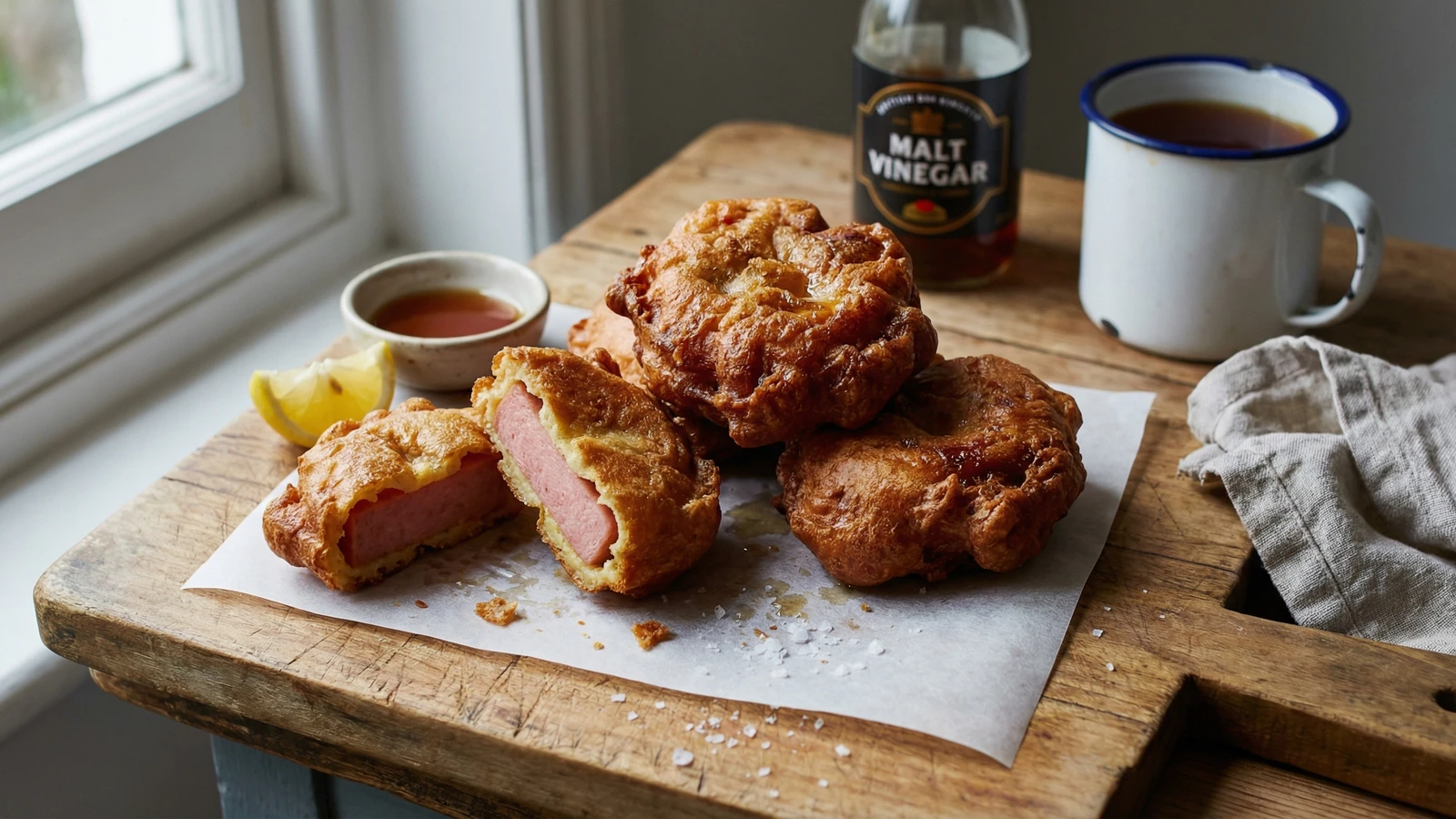
Slices of Spam in cold beer batter, fried to a deep golden crunch, the kind of food that has no business being as good as it is, served with vinegar and eaten while still too hot to hold.
The smell of hot oil and batter is a particular kind of time travel. It takes you back to chip shops with tiled walls and fluorescent lights, to Friday evenings when the queue went out the door, to vinegar-soaked paper parcels eaten on the walk home. Spam fritters were there, behind the glass, golden and anonymous alongside the fish and the sausages. Nobody ordered them to be clever. They ordered them because they were good.
Spam is a tin of cooked pork and salt. That's all it is. It arrived during the war when fresh meat was rationed and fish was hard to come by, and chip shops did what chip shops have always done: they battered it and fried it and put it on the counter for sixpence. The clever part is the batter. A cold beer batter, mixed quickly and left alone, that puffs and crisps in hot oil into something properly shattering. The Spam inside goes soft and salty and savoury, a contrast to the crunch that catches you off guard if you haven't had one in years.
I won't pretend this is health food. I won't apologise for it either. There are evenings, dark ones, rainy ones, the kind where the windows are fogged and you can't be bothered with ambition, when what you want is something fried and salty and eaten standing up in the kitchen with your fingers. A recipe is a conversation, not a contract, and sometimes the conversation is short and to the point. We're only making dinner.
Quantity
1 tin (340g)
cut into 8 slices, about 1cm thick
Quantity
150g, plus extra for dusting
Quantity
1 teaspoon
Quantity
pinch
Quantity
pinch
Quantity
200ml
Quantity
for deep frying
Quantity
to serve
Quantity
to serve
| Ingredient | Quantity |
|---|---|
| Spamcut into 8 slices, about 1cm thick | 1 tin (340g) |
| plain flour | 150g, plus extra for dusting |
| baking powder | 1 teaspoon |
| fine sea salt | pinch |
| white pepper | pinch |
| cold beer | 200ml |
| vegetable or sunflower oil | for deep frying |
| malt vinegar (optional) | to serve |
| lemon wedges (optional) | to serve |
Open the tin and turn the Spam out onto a board. Cut it into eight slices, roughly a centimetre thick. Pat each slice dry with kitchen paper. This matters. Any moisture on the surface will stop the batter from gripping. Dust each slice lightly in plain flour, shake off the excess, and set them aside on a plate.
Sift the flour, baking powder, salt, and white pepper into a bowl. Make a well in the centre and pour in the cold beer. Whisk from the middle outwards, pulling the flour in gradually. You want a batter the thickness of double cream: it should coat the back of a spoon and fall off in a slow, lazy ribbon. If it's too thick, add a splash more beer. Too thin, a tablespoon of flour. Don't overwork it. A few small lumps are fine and better than a batter that's been beaten into submission.
Pour the oil into a deep, heavy-bottomed saucepan to a depth of about six centimetres. Heat it over a medium-high flame. To test, drop a small blob of batter into the oil. If it sinks, sizzles, and rises to the surface within a few seconds, turning golden, you're there. If it sits on the bottom doing nothing, the oil isn't ready. If it browns instantly, the oil is too hot. Turn it down and wait a minute.
Take a flour-dusted slice of Spam, dip it into the batter, let the excess drip off for a second, and lower it gently into the oil. Don't drop it. Fry two or three at a time, no more, because crowding the pan drops the temperature and you end up with something greasy rather than crisp. Turn them once with a slotted spoon when the underside is a deep, honest gold. The whole thing takes three to four minutes per batch. When they're done, the batter should be puffed and crunchy and the colour of a good conker.
Lift the fritters out with a slotted spoon and set them on a wire rack over a tray, not on kitchen paper, which traps steam and softens the bottom. Sprinkle with a little fine salt while they're still hot. Serve with malt vinegar and a wedge of lemon on the side. Chips, if you're making a proper evening of it. Mushy peas if you want the full chip-shop treatment. They wait for nobody, so eat them standing at the counter if you have to.
1 serving (about 175g)
Culinary guides, cultural storytelling, and the editorial depth that makes cooking meaningful.
Discover Culinary ExplorerChef Thomas
A board of good cheddar, thick ham, proper pickle, hard-boiled eggs, and crusty bread. Not cooking so much as assembling with conviction, and one of the finest lunches the English kitchen has ever produced.

Chef Thomas
Puff pastry twisted with anchovy and Parmesan, baked until golden and shattering and salty, the kind of thing you put out with drinks that disappears before anyone sits down.

Chef Thomas
Fresh oysters wrapped in crisp streaky bacon and grilled until the salt of the sea meets the smoke of the cure, served on hot buttered toast the way the Victorians intended, only simpler and at home.

Chef Thomas
Boiled eggs wrapped in a dark, spiced coat of sausage meat and crumbled black pudding, fried to a deep gold. The kind of thing you eat standing up in the kitchen, still warm, with mustard on your thumb.