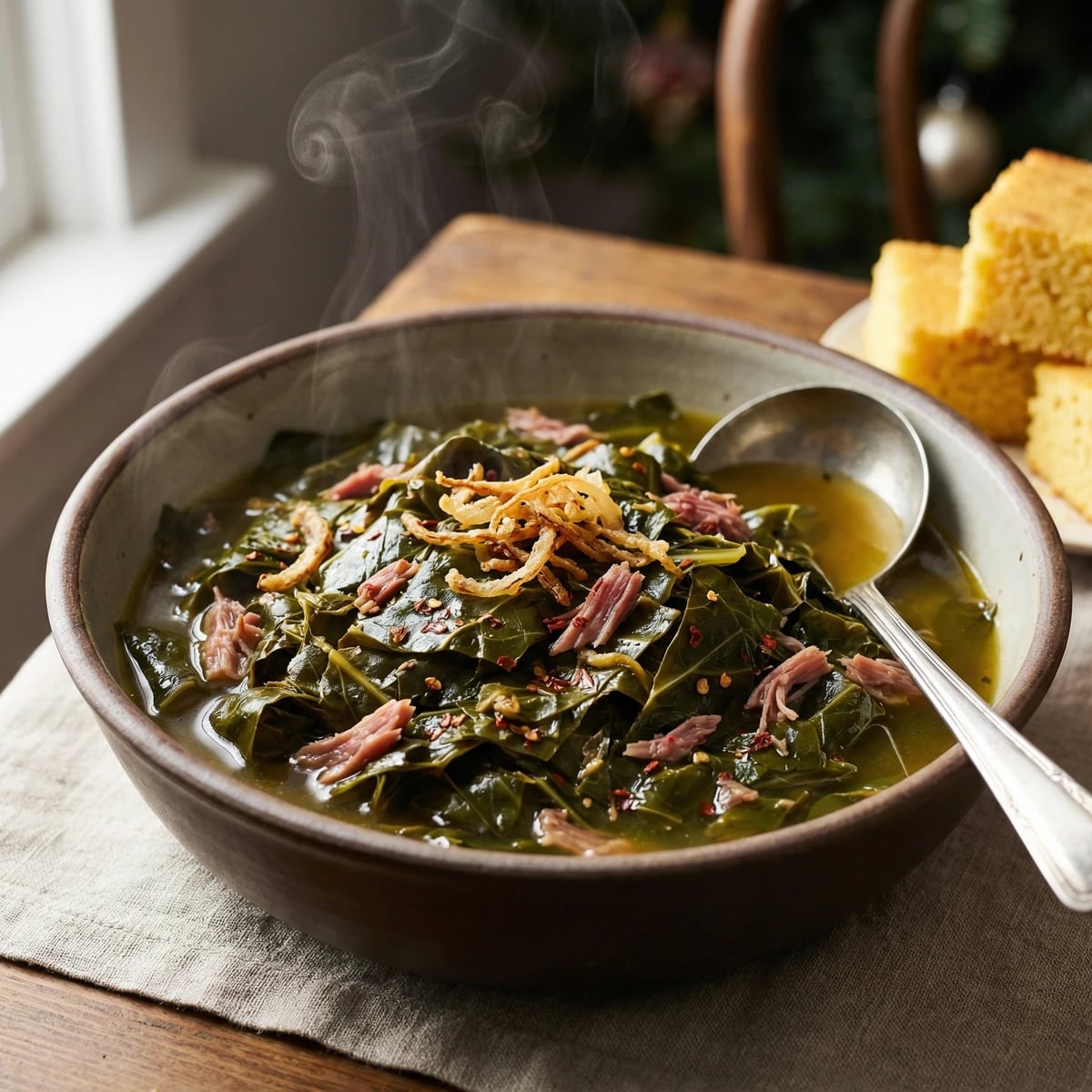
Silky, deeply flavored collard greens slow-simmered with smoky ham hock until tender, bathed in rich pot likker that begs for cornbread. A New Year's tradition that promises prosperity with every bite.
Side Dishes
Southern
New Year's
30 min
Active Time
3 hr cook•3 hr 30 min total
Yield10-12 servings
Collard greens carry the weight of history in every leaf. African cooks brought their traditions to Southern kitchens, transforming tough greens into something extraordinary through patience and smoke. This is food that fed families through hard times and celebrated with them in good ones. On New Year's Day, the green leaves represent folded money, a promise of prosperity for the year ahead.
The secret to proper collards lives in two places: the quality of your smoked pork and the time you give them. A good ham hock, heavy with meat and fat, will perfume your kitchen for hours while it renders into the cooking liquid. That liquid, called pot likker, becomes nearly as valuable as the greens themselves. Don't you dare pour it down the drain.
I've eaten collards in church basements and white-tablecloth restaurants across the South. The best versions share one quality: they respect the time the dish requires. Two hours minimum, three is better. The greens should yield completely to your fork, silky and saturated with smoke. Rush this and you'll taste the difference.
The technique, the tradition, and the story behind every dish.
•Large Dutch oven or heavy-bottomed pot (at least 8-quart capacity)
•Long wooden spoon for stirring
•Sharp chef's knife for stripping and chopping greens
Instructions
1
Clean the greens
Fill your sink with cold water. Submerge the collard leaves and swish them vigorously. Grit hides in every fold and crevice. Lift the greens out, drain the water, and repeat until no sand settles at the bottom. This takes three washes minimum, sometimes four. Don't skip this step or you'll be grinding dirt between your teeth at dinner.
Pre-washed bagged collards save time but still deserve a rinse. Farmers market greens need the full treatment.
2
Strip and chop the leaves
Fold each leaf in half lengthwise along the stem. Run your knife along the stem to remove it entirely. Stack several leaves together, roll them into a tight cylinder, and slice crosswise into one-inch ribbons. The stems are too fibrous for this dish. Discard them or save for stock.
3
Build the braising liquid
Place the ham hock in a large Dutch oven or heavy-bottomed pot. Add the onion, garlic, stock, vinegar, brown sugar, red pepper flakes, smoked paprika, bay leaves, salt, and black pepper. Bring to a boil over high heat, then reduce to a gentle simmer. Cover and cook for one hour. The ham hock needs this head start to begin releasing its smoky fat into the liquid.
The liquid should barely bubble. Aggressive boiling toughens the meat and reduces the liquid too quickly.
4
Add the greens in batches
Add the collards to the pot in handfuls, pressing each addition down with a wooden spoon until it wilts enough to make room for more. This takes patience. Three pounds of raw greens look impossible to fit, but they cook down dramatically. Once all greens are in and submerged, cover the pot.
5
Simmer low and slow
Cook at a bare simmer for 2 to 2 1/2 hours, stirring occasionally. The greens should become completely tender, almost silky, with no chew remaining. The pot likker will darken and concentrate, carrying the smoke from the ham hock into every bite. Taste at the two-hour mark. If the greens still have any resistance, keep going.
If the liquid level drops below the greens, add hot water or stock. They should stay mostly submerged throughout cooking.
6
Finish the ham hock
Remove the ham hock to a cutting board. When cool enough to handle, pull the meat from the bone in rough shreds, discarding the skin, fat, and bone. Return the meat to the pot and stir to distribute. Some cooks leave the hock whole for presentation. I prefer the meat scattered throughout so every serving gets its share.
7
Season and serve
Remove the bay leaves. Taste the pot likker and adjust with more salt, pepper, or vinegar as needed. The greens should taste smoky, slightly sweet, and have a gentle vinegar brightness that cuts through the richness. Transfer to a deep serving bowl, making sure to include plenty of pot likker. Serve with hot sauce and extra vinegar on the table.
Chef Tips
•Seek out a meaty ham hock from a butcher who smokes their own. The pale, shrink-wrapped specimens at chain groceries lack the depth you want. A good ham hock should smell aggressively smoky before it even hits the pot.
•For a lighter version, substitute two smoked turkey legs for the ham hock. You'll lose some richness but gain cleaner pork-free flavor. Many Southern families make this swap regularly.
•The pot likker is liquid gold. Serve it in small cups alongside the greens, or save it for cooking rice, braising beans, or making gravy. It freezes beautifully for months.
•Collards pair with black-eyed peas and cornbread for the traditional Southern New Year's meal. The greens represent money, the peas represent coins, and the cornbread represents gold. Serve all three and you've covered your bases for prosperity.
•A splash of hot pepper vinegar at the table transforms each bite. Make your own by stuffing a jar with fresh cayenne peppers and covering with white vinegar. It keeps indefinitely.
Advance Preparation
•Collard greens improve dramatically when made a day ahead. The flavors deepen and meld overnight. Store in the pot likker, refrigerated, for up to 4 days. Reheat gently over medium-low heat.
•Greens can be washed, stripped, and chopped up to 2 days ahead. Store in plastic bags lined with paper towels in the refrigerator.
•For large gatherings, double the recipe and use your biggest stockpot. The cooking time remains the same. These greens hold beautifully on a buffet for hours if you keep the pot likker level up.
•The ham hock can simmer in the braising liquid several hours ahead. Let it cool in the liquid, then refrigerate. Skim the solidified fat before adding greens and resuming cooking.
Frequently Asked Questions
Nutrition Information
1 serving (about 375g)
Calories
125 calories
Total Fat
5 g
Saturated Fat
2 g
Trans Fat
0 g
Unsaturated Fat
3 g
Cholesterol
18 mg
Sodium
1030 mg
Total Carbohydrates
13 g
Dietary Fiber
5 g
Sugars
4 g
Protein
14 g
Where cooking meets culture.
Culinary guides, cultural storytelling, and the editorial depth that makes cooking meaningful.