
Chef Lupita
Aguascalientes Beef Tongue Pozole (Pozole de Lengua)
Aguascalientes' Bajio pozole de lengua, built with cacahuazintle hominy, tender beef tongue, chile ancho and guajillo, with xoconostle brightness and table garnishes.
A cooking platform built around craft, culture, and the stories behind what we eat.
Created by
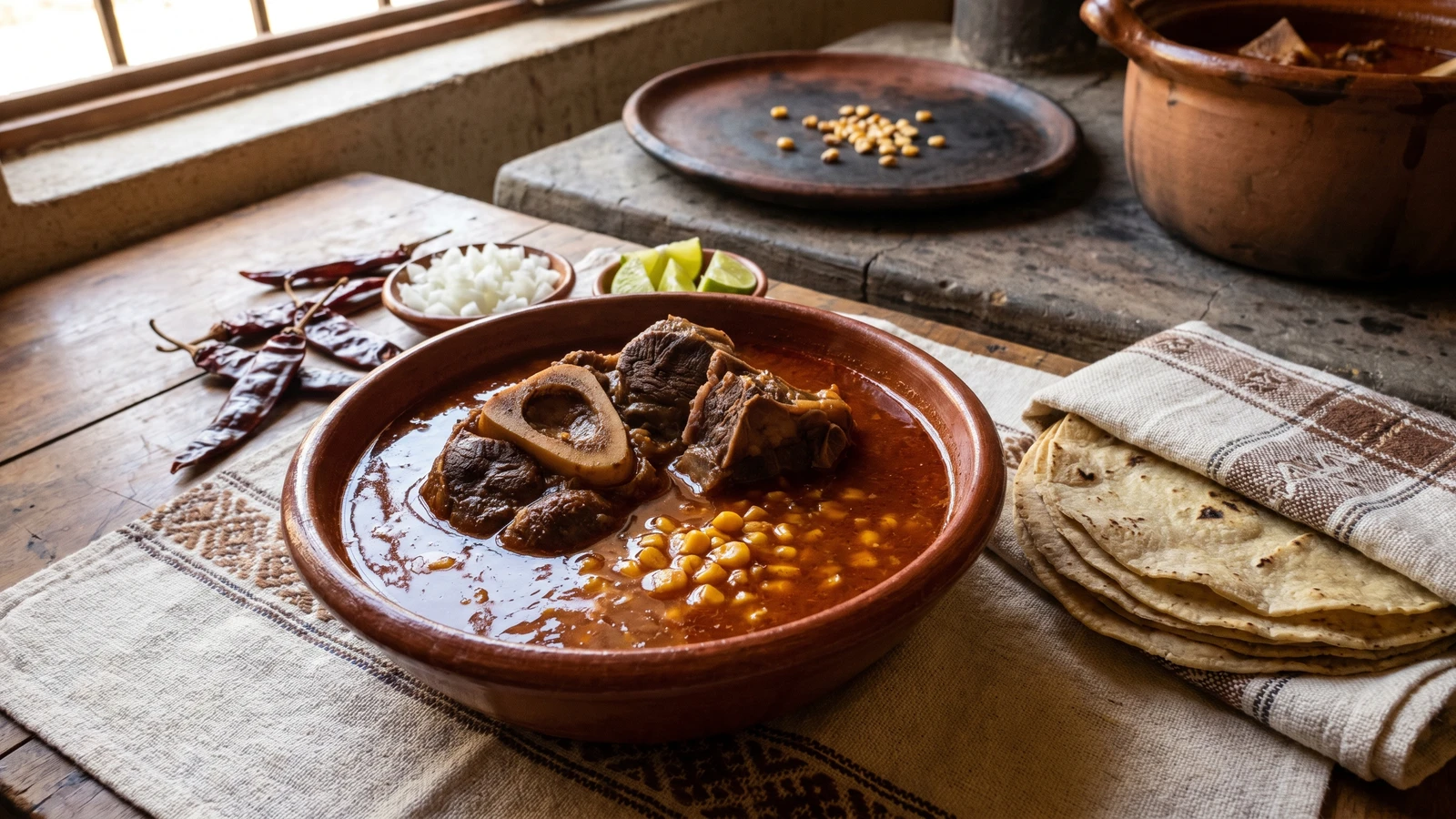
A Mixteca stew of bone-in beef and dry-toasted cracked corn simmered in chile guajillo broth until the corn surrenders its starch and the broth thickens into something that tastes like the hills of Oaxaca's high desert.
This dish comes from the Mixteca region of Oaxaca, the high desert hills west of the Valles Centrales where the cooking is leaner, drier, and more austere than the mole-rich cuisine most people associate with the state. The Mixteca is not tourist Oaxaca. It is ranchero Oaxaca: small towns, weekly tianguis markets, and home cooks who know how to build a serious meal from corn, dried chiles, and whatever cut of beef the carnicero has that day. Cada estado, su propia cocina, and within Oaxaca itself, each region keeps its own table.
Segueza is defined by one technique: you toast dried corn kernels on a hot comal until they crack open and turn golden-brown, then you simmer them with the beef until the starch releases and the broth thickens into something halfway between a caldo and a guiso. That toasted corn is the soul of the dish. It gives the broth a nutty, roasted depth that no flour, no masa, no shortcut can replicate. Skip the toasting and you have a thin beef soup with pale corn floating in it. Toast it properly and the whole pot transforms. The kernels split and darken. The kitchen smells like a milpa after harvest. That smell tells you the starch is ready to do its work.
I collected this recipe in Huajuapan de León from a señora who sold tamales de rajas at the Sunday tianguis. She made segueza for her family on Wednesdays, she told me, because the dried corn was the cheapest thing in her kitchen and a kilo of chambarete with the bone still in it could feed six people if you knew what you were doing. She toasted the corn in a clay comal so old the bottom was black, cracked every kernel by ear, and had the whole pot simmering before I finished writing down the chile quantities. My mother never made segueza. It wasn't a Jalisco dish. But when I tasted it that afternoon in Huajuapan, sitting at a plastic table in a courtyard with three dogs underfoot, I understood the principle she always taught me: good cooking is not about expensive ingredients, it is about knowing what to do with the ones you have. Saber cocinar es saber vivir.
Segueza (sometimes spelled 'cegueza') is a Mixtec-origin stew documented primarily in the Mixteca Alta and Mixteca Baja subregions of Oaxaca, with roots in the pre-Columbian practice of using dry-toasted, cracked corn as both sustenance and thickener in broths. The technique of toasting corn kernels on a comal before simmering them into stews predates the widespread adoption of nixtamalization in some Mixtec communities and served as a method of stretching scarce animal protein across large families. Unlike Oaxaca's celebrated mole, tlayuda, and mezcal traditions, segueza has remained largely invisible outside the Mixteca, a regional daily-kitchen dish that never crossed into restaurant menus or national recognition, and is rarely documented in Mexican cookbooks published outside the state.
Quantity
2 pounds
bone-in, cut into 2-inch pieces
Quantity
1 pound
Quantity
10 cups
Quantity
1 tablespoon, plus more to taste
Quantity
1 cup
Quantity
8
stemmed and seeded
Quantity
3 medium, about 1 pound
Quantity
1 medium
quartered
Quantity
6
unpeeled
Quantity
2 sprigs
Quantity
for serving
Quantity
for serving
Quantity
for serving
warmed
| Ingredient | Quantity |
|---|---|
| beef shank (chambarete de res)bone-in, cut into 2-inch pieces | 2 pounds |
| bone-in beef short ribs (costilla de res) | 1 pound |
| water | 10 cups |
| kosher salt | 1 tablespoon, plus more to taste |
| dried white corn kernels (maíz blanco seco) | 1 cup |
| dried chile guajillostemmed and seeded | 8 |
| ripe tomatoes (jitomates) | 3 medium, about 1 pound |
| white onionquartered | 1 medium |
| garlic clovesunpeeled | 6 |
| fresh epazote | 2 sprigs |
| lime wedges (optional) | for serving |
| diced raw white onion (optional) | for serving |
| hand-pressed corn tortillas (optional)warmed | for serving |
Heat a dry comal or heavy skillet over medium heat. Add the dried corn kernels in a single layer and toast, stirring frequently with a wooden spoon, for 12 to 15 minutes. The kernels will pop and crack open as the moisture inside escapes. You will hear them. Listen for the sharp snap, like distant popcorn. Keep stirring. They should turn from pale yellow to a deep golden brown with dark spots where the starch has caramelized. The kitchen will smell like toasted grain, like standing next to a milpa fire. That smell is the flavor you are building into the broth. When most kernels have cracked and darkened, pull them off the heat and transfer to a bowl. Do not walk away from the comal during this step. Burned corn is bitter corn and there is no fixing it.
Place the beef shank and short ribs in a heavy stockpot. Add the water and salt. Drop in two of the onion quarters and three of the unpeeled garlic cloves. Bring to a gentle simmer over medium heat. Skim the gray foam that rises during the first ten minutes. That foam is impurities from the bone and blood. Remove it patiently. A clean broth is a clear broth. Once the foam stops rising, reduce the heat until you see lazy bubbles every few seconds. Cover partially and let the beef cook for one and a half to two hours. The shank is done when the meat pulls away from the bone but has not yet fallen apart. The short ribs will be tender before the shank. That is fine. Remove the ribs earlier if they are done and let the shank keep going.
While the beef simmers, heat your comal over medium heat again. Toast the guajillo chiles one or two at a time, pressing them flat against the comal with a spatula for about 20 to 30 seconds per side. They will puff, blister, and release a sharp, warm aroma. The skin should change color slightly and become pliable, never black. Transfer to a heatproof bowl, cover with hot tap water, and let them soak for 20 minutes. Hot water, not boiling. Boiling water cooks the skin and turns the sauce bitter.
Place the whole tomatoes, the remaining two onion quarters, and the remaining three unpeeled garlic cloves directly on the dry comal over medium-high heat. Roast, turning occasionally, until the tomato skins are blistered and charred in spots and the flesh is soft, about 10 to 12 minutes. The onion should have black edges. The garlic should be soft when you squeeze it through the papery skin. This char is flavor, not a mistake. Every señora in the Mixteca markets roasts her tomatoes this way. The comal does the work that an oven cannot.
Drain the soaked guajillos and discard the soaking water. Peel the roasted garlic. Place the drained chiles, roasted tomatoes, roasted onion, and peeled garlic in a blender. Add one cup of the beef broth from the simmering pot. Blend on high until completely smooth. This should take a full minute, maybe longer. You want a sauce with no visible pieces of chile skin. Strain through a medium-mesh sieve into a bowl, pressing the solids with the back of a spoon. Discard the skins. What comes through should be a deep brick-red puree, smooth and thick enough to coat the spoon.
Remove the spent onion and garlic from the beef broth. Stir the strained chile sauce directly into the pot with the beef. Add the toasted cracked corn. Stir everything together. The broth will turn a warm reddish-brown. Bring the pot back to a gentle simmer, partially cover, and cook for 45 minutes to one hour. The corn needs time. It will soften gradually, absorbing the chile broth, and the starch from the cracked kernels will thicken the liquid around them. Stir the pot every fifteen minutes and check the bottom. The corn can stick. After 45 minutes, taste a kernel. It should be tender but still have a slight bite, not mushy, not hard. The broth should have body now, coating the back of a spoon lightly. That thickness is the segueza.
Drop the two sprigs of epazote into the pot during the last five minutes of cooking. Epazote loses its character if you cook it too long. Five minutes is enough. Taste the broth for salt. The corn absorbs seasoning as it cooks, so you will likely need to add more salt now. Be assertive. A bland segueza is a wasted afternoon. Adjust until the broth tastes like it matches the work you put in.
Ladle the segueza into deep clay bowls, making sure each serving gets a piece of bone-in beef, a generous share of the thickened corn broth, and plenty of the softened, split kernels. Set lime wedges and a small dish of diced raw white onion on the table. Warm the tortillas on the comal until they puff. The tortilla is not a side dish here. It is the spoon. You tear a piece, scoop the broth and corn, press a chunk of beef into it, squeeze lime, and eat. Recetas probadas y garantizadas.
1 serving (about 420g)
Culinary guides, cultural storytelling, and the editorial depth that makes cooking meaningful.
Discover Culinary ExplorerChef Lupita
Aguascalientes' Bajio pozole de lengua, built with cacahuazintle hominy, tender beef tongue, chile ancho and guajillo, with xoconostle brightness and table garnishes.

Chef Lupita
Veracruz's Gulf coast rice from Alvarado, built with seafood stock, tomato, chile chipotle, epazote, shrimp, fish, jaiba, and pulpo, served loose and brothy in a clay cazuela.

Chef Lupita
Costa Chica's wet salt-beef stew, built from chile costeño, guajillo, tomato, manteca, yuca, plantain, and masa dumplings, the ranching pot of Cuajinicuilapa and Pinotepa.

Chef Lupita
Michoacán's P'urhépecha atápakua is a masa-thickened sauce and stew at once, built with pork, chile guajillo, and hierbabuena added only at the end.