
Chef Lupita
Aguascalientes Beef Tongue Pozole (Pozole de Lengua)
Aguascalientes' Bajio pozole de lengua, built with cacahuazintle hominy, tender beef tongue, chile ancho and guajillo, with xoconostle brightness and table garnishes.
A cooking platform built around craft, culture, and the stories behind what we eat.
Created by
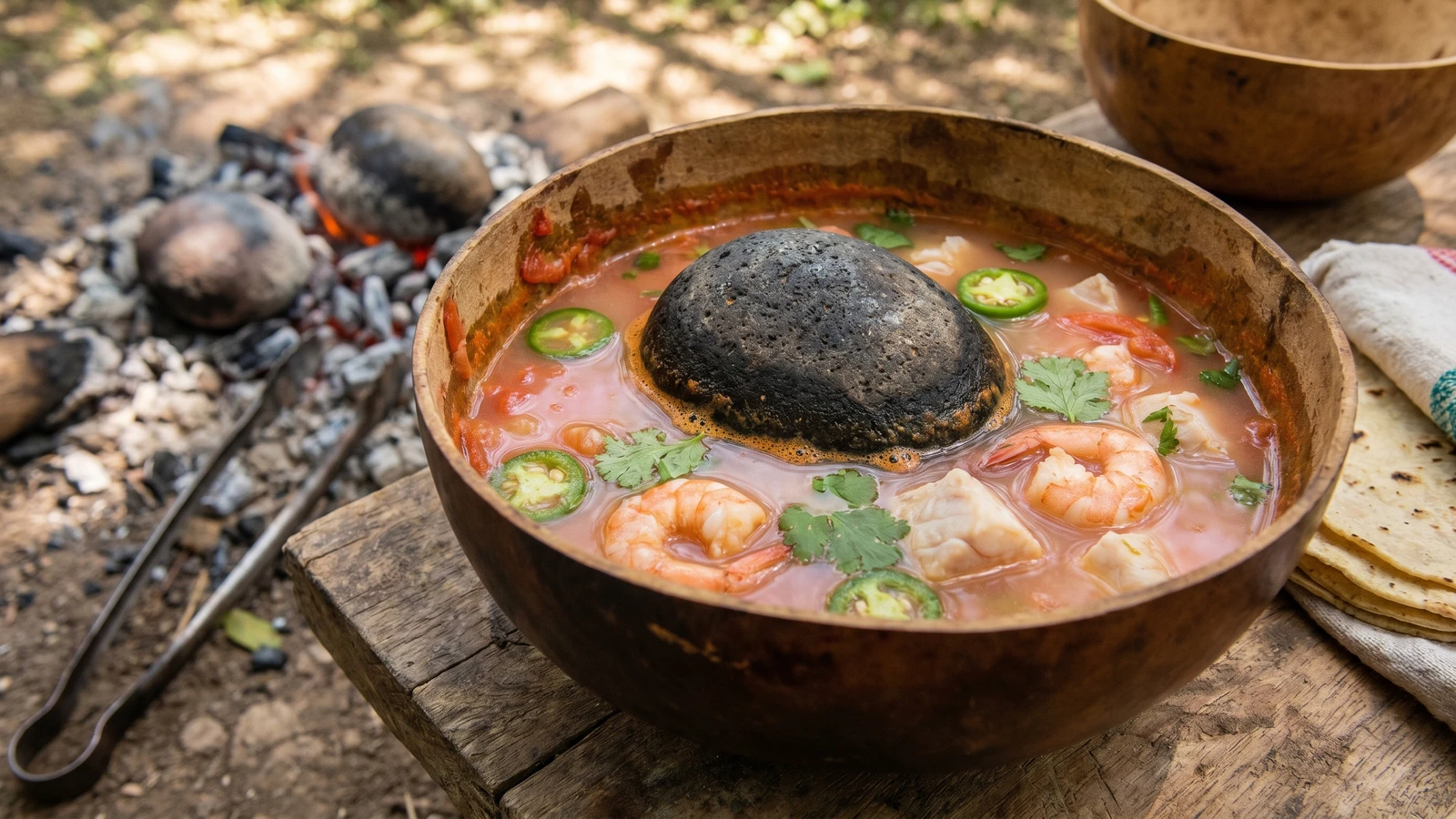
Northern Oaxaca's oldest cooking technique: raw fish, shrimp, tomato, chile de agua, and epazote brought to a boil in a gourd bowl by white-hot river stones pulled straight from the fire.
This dish is from the Chinantla, the humid lowland jungle in northern Oaxaca where the Chinantec people have lived and fished for millennia. Specifically from San Felipe Usila, a small town on the banks of the Rio Usila where the stones come from the same river that gives the shrimp and the fish. The geography is the recipe.
Caldo de piedra is not a stove dish. It is not even a kitchen dish. It is cooked outdoors, at the riverside, by building a wood fire, heating volcanic river stones until they glow white, and plunging them into a jicara, a dried gourd bowl, filled with raw shrimp, chunks of fresh river fish, chopped tomato, white onion, chile de agua, epazote, and water. The stones hit the liquid and it boils instantly. The broth cooks in front of you. You hear it before you taste it: a violent hiss, then a rolling boil that lasts thirty seconds, then calm. The fish is cooked. The shrimp are pink. The broth tastes like river water and mineral and smoke and chile. Nothing else on earth tastes like this.
What makes caldo de piedra unusual in Mexican cooking is that it is traditionally made by men. In the Chinantla, women rule the kitchen, the comal, the nixtamal, the mole. But this dish belongs to the men. It is prepared at the river as an act of courtship, of celebration, of hospitality. A man makes caldo de piedra for a woman he is trying to impress, or for a guest he wants to honor. The technique is the offering: the fire, the stones, the skill of knowing when a stone is ready and how to lower it into the gourd without cracking the vessel. My mother never made this. She had no recipe for it in her notebook. I learned it in Usila from a Chinantec fisherman named Don Ernesto who told me, while heating his stones in a fire on the riverbank: "La piedra sabe cuando esta lista." The stone knows when it is ready. He was right. Saber cocinar es saber vivir.
I will tell you honestly: this is one of the hardest recipes in this collection to make at home. Not because the ingredients are complex, they are simple, but because the technique requires river stones, a wood fire, and gourd bowls. I will teach you the traditional method first, because that is the real dish. Then I will give you guidance on adapting it. But know what you are adapting away from. The mineral flavor of the stone, the smoke of the fire, the speed of the boil, those are the dish. A pot on the stove makes a good fish soup. It does not make caldo de piedra.
Caldo de piedra is a living example of stone boiling, a cooking technique that predates the invention of fire-resistant pottery and was practiced across Mesoamerica for thousands of years. The Chinantec people of northern Oaxaca's tropical lowlands maintained the method not as a survival necessity but as a cultural practice tied to gender roles, courtship, and communal celebration. In 2010, the dish gained wider recognition when the Mexican government and the Chinantec community of San Felipe Usila promoted it as part of Mexico's UNESCO Intangible Cultural Heritage nomination, and it was featured at the Foro Mundial de la Gastronomia Mexicana. Despite its growing fame, caldo de piedra remains a hyperlocal tradition: the volcanic basalt stones used must be collected from specific riverbeds where the mineral composition allows them to withstand repeated thermal shock without fracturing, and the dish is still prepared almost exclusively in the Chinantla region by Chinantec men who learn the technique from their fathers and grandfathers.
Quantity
1 pound
rinsed
Quantity
1 pound
scaled, gutted, and cut into 2-inch pieces (keep the head)
Quantity
4 medium
roughly chopped
Quantity
1 medium
roughly chopped
Quantity
3 to 4
stemmed and sliced into rounds
Quantity
4 sprigs
Quantity
1/2 cup
roughly chopped
Quantity
6 cups
divided among the gourd bowls
Quantity
to taste
Quantity
6 to 8
each about the size of a large fist
Quantity
enough for a sustained fire, approximately 1 hour
Quantity
for serving
warmed
Quantity
for serving
| Ingredient | Quantity |
|---|---|
| fresh whole river shrimp or large head-on shrimprinsed | 1 pound |
| fresh whole mojarra, tilapia, or firm white-fleshed fishscaled, gutted, and cut into 2-inch pieces (keep the head) | 1 pound |
| ripe tomatoesroughly chopped | 4 medium |
| white onionroughly chopped | 1 medium |
| fresh chile de agua or chile serranostemmed and sliced into rounds | 3 to 4 |
| fresh epazote | 4 sprigs |
| fresh cilantro leaves and stemsroughly chopped | 1/2 cup |
| cold waterdivided among the gourd bowls | 6 cups |
| kosher salt | to taste |
| smooth volcanic river stoneseach about the size of a large fist | 6 to 8 |
| hardwood for fire (oak, mesquite, or similar) | enough for a sustained fire, approximately 1 hour |
| hand-pressed corn tortillas (optional)warmed | for serving |
| lime wedges (optional) | for serving |
Build a hardwood fire outdoors in a fire pit, on a cleared patch of ground, or in a large outdoor fire ring. Let it burn down to a solid bed of coals with active flames, about 30 minutes. Nestle the river stones directly into the hottest part of the fire, burying them in the coals. They need at least 45 minutes to one hour in the fire. You are looking for the stones to glow faintly white-gray at the edges. A stone that is not hot enough will warm the broth without boiling it, and then you have soup, not caldo de piedra. Don Ernesto told me: wait until you think the stone is ready, then wait ten more minutes.
While the stones heat, set out your gourd bowls or deep heat-resistant clay bowls, one per person. Into each jicara, place a portion of the raw fish pieces and a handful of the shrimp. Divide the chopped tomato, onion, and chile de agua rounds evenly among the bowls. Tuck a sprig of epazote and a pinch of cilantro into each one. Add about one cup of cold water to each bowl and season with a generous pinch of salt. The bowls should look abundant, not spare. Each one is a complete meal waiting for the stone.
When the stones have been in the fire for at least 45 minutes, use long-handled metal tongs or a pair of thick green-wood sticks to lift one stone from the coals. The stone should be uniformly hot and pale gray. Tap off any loose ash. If it glows faintly in the shadowed parts, it is ready. You need one to two stones per jicara depending on their size and how much liquid is in the bowl.
This is the moment. Hold the jicara steady on a flat surface. Using the tongs, lower one white-hot stone into the center of the bowl slowly but without hesitation. The liquid will erupt into a violent boil on contact. You will hear a fierce hiss, then the broth will roll and bubble furiously for 20 to 30 seconds. The fish turns opaque. The shrimp curl and pink. The tomato and onion release their juices into the broth. The epazote blooms. The stone gives up its mineral heat and a faint smokiness that you cannot get any other way. If the boil dies down quickly and the fish is not yet cooked through, add a second hot stone immediately. Do not wait. Asi se hace y punto.
Once the boil subsides and the fish and shrimp are cooked through, about one to two minutes total, the caldo is ready. The stone stays in the bowl. It belongs there. It is part of the presentation and it continues to keep the broth hot while you eat. Scatter a little more fresh cilantro on top. Serve with lime wedges and warm corn tortillas on the side. Eat immediately, at the fire, standing or sitting on the ground, the way it has been eaten in the Chinantla for centuries. This is not a dish you plate in a kitchen and carry to a dining table. The fire and the river and the smoke are the dining room. Cada estado, su propia cocina.
1 serving (about 500g)
Culinary guides, cultural storytelling, and the editorial depth that makes cooking meaningful.
Discover Culinary ExplorerChef Lupita
Aguascalientes' Bajio pozole de lengua, built with cacahuazintle hominy, tender beef tongue, chile ancho and guajillo, with xoconostle brightness and table garnishes.

Chef Lupita
Veracruz's Gulf coast rice from Alvarado, built with seafood stock, tomato, chile chipotle, epazote, shrimp, fish, jaiba, and pulpo, served loose and brothy in a clay cazuela.

Chef Lupita
Costa Chica's wet salt-beef stew, built from chile costeño, guajillo, tomato, manteca, yuca, plantain, and masa dumplings, the ranching pot of Cuajinicuilapa and Pinotepa.

Chef Lupita
Michoacán's P'urhépecha atápakua is a masa-thickened sauce and stew at once, built with pork, chile guajillo, and hierbabuena added only at the end.