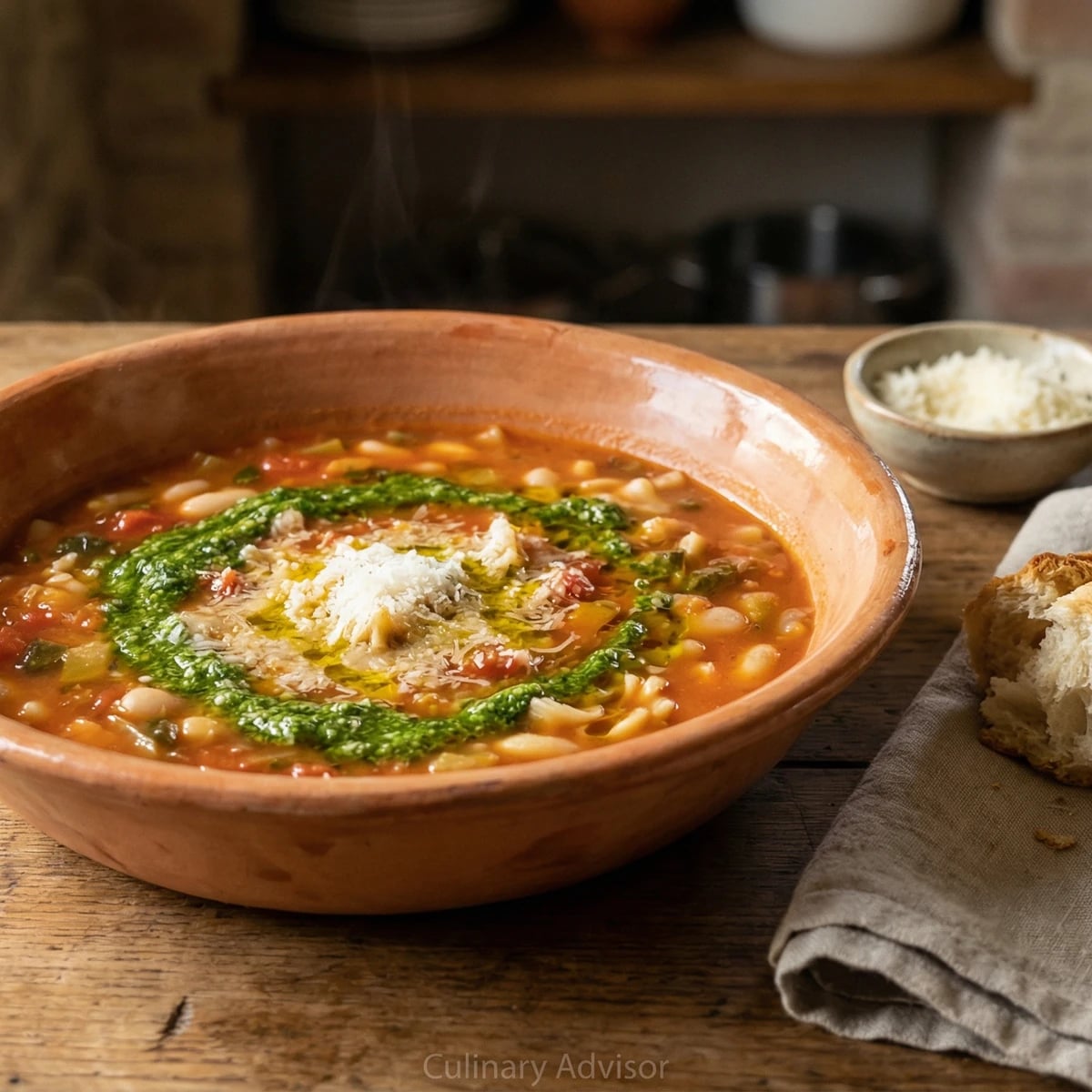
A generous pot of market vegetables simmered with beans and pasta in a broth enriched with Parmesan rind, finished with a bright swirl of basil pesto that transforms everything it touches.
Soups & Stews
Italian
Weeknight
Budget Friendly
Batch Cooking
30 min
Active Time
45 min cook•1 hr 15 min total
Yield8 servings
Minestrone is not a recipe. It is a way of thinking. You go to the market, you see what looks alive, you bring it home. The soup writes itself from there.
In summer, you might add zucchini and green beans still warm from the field, fresh shell beans if you can find them. In autumn, winter squash and sturdy greens. The point is not to follow a list but to respond to what the season offers. The bones stay the same: a slow-cooked soffritto, good stock, beans for substance, pasta for comfort, and pesto to wake everything up at the end.
This is the kind of cooking that feeds a family for days without boredom. The soup actually improves as it sits, the flavors deepening and the broth thickening. Make a big pot on Sunday and eat it through Wednesday. Freeze what remains for a night when you have nothing left to give.
The technique, the tradition, and the story behind every dish.
sturdy greens (kale, chard, or cavolo nero)stems removed, leaves torn
2 cups
fresh basil pesto
1/2 cup
Parmigiano-Reggianofreshly grated
for serving
Equipment Needed
•Large heavy-bottomed pot or Dutch oven (6-quart minimum)
•Wooden spoon
•Ladle
Instructions
1
Build the aromatic base
Warm the olive oil in a large heavy pot over medium heat. Add the onion, celery, and carrots with a generous pinch of salt. Cook slowly, stirring occasionally, until the vegetables soften and the onion turns translucent, about ten minutes. This is your soffritto, the soul of the soup. Do not rush it.
The salt draws moisture from the vegetables and helps them cook without browning. You want sweetness, not color.
2
Add garlic and tomatoes
Stir in the garlic and cook until fragrant, about one minute. Add the tomatoes, crushing them through your fingers as they fall into the pot. Let the tomatoes cook down for three to four minutes until they begin to concentrate and deepen in color. The kitchen should smell like something worth eating.
3
Pour in the stock
Add the stock, Parmesan rind, thyme sprigs, and bay leaf. Bring to a gentle simmer. The rind will slowly release its salty, savory depth into the broth as it cooks. This is why you save your rinds in the freezer. They are too valuable to discard.
If using store-bought stock, taste it first. Adjust the salt accordingly, as some brands are already quite salty.
4
Add seasonal vegetables
Add your harder seasonal vegetables first: zucchini, green beans, fennel, potatoes, winter squash. These need more time to become tender. Simmer for ten to fifteen minutes, tasting a piece to check. Vegetables should yield to a fork but still have life in them.
5
Add beans and pasta
Stir in the cannellini beans and pasta. Continue simmering until the pasta is tender but still has a pleasant bite, eight to twelve minutes depending on the shape. The starch from the pasta will thicken the broth slightly, giving it body.
6
Finish with greens
Remove the Parmesan rind, thyme stems, and bay leaf. Add the torn greens and stir until they wilt into the broth, just two to three minutes. Kale keeps its texture; chard melts more softly. Both are good. Taste the broth and adjust the salt and pepper. The soup should taste alive.
7
Serve with pesto
Ladle the hot soup into warmed bowls. Drop a generous spoonful of pesto into each bowl and drag a spoon through it so the green ribbons swirl through the broth. Finish with freshly grated Parmigiano-Reggiano. Pass more pesto and cheese at the table for those who want abundance.
Stir the pesto in gently rather than mixing it completely. The pockets of basil and garlic that hit you with each spoonful are half the pleasure.
Chef Tips
•Save your Parmesan rinds in the freezer. They are too precious to throw away. Drop one into any soup, braise, or pot of beans to add depth without effort.
•If basil is not in season, make a parsley-walnut pesto or stir in a spoonful of good olive oil and a handful of chopped fresh herbs instead. The soup does not require basil to be delicious.
•For a heartier meal, add a piece of crusty bread rubbed with garlic and drizzled with olive oil to the bottom of each bowl before ladling in the soup.
•This soup freezes well without the pasta. Add freshly cooked pasta when you reheat each portion, or the noodles will turn to mush.
•Dried beans are better than canned if you have the time. Soak them overnight, cook them in unsalted water until tender, and add them with their cooking liquid for even more body.
Advance Preparation
•The soup base (through step 3) can be made a day ahead and refrigerated. Bring to a simmer before adding vegetables, beans, and pasta.
•Complete soup without pasta keeps refrigerated for up to 5 days. The flavors improve with time.
•Freeze soup without pasta for up to 3 months. Add freshly cooked pasta when serving.
•Pesto can be made up to a week ahead. Cover the surface with a thin layer of olive oil to prevent browning.
Frequently Asked Questions
Nutrition Information
1 serving (about 400g)
Calories
270 calories
Total Fat
13 g
Saturated Fat
3 g
Trans Fat
0 g
Unsaturated Fat
9 g
Cholesterol
8 mg
Sodium
740 mg
Total Carbohydrates
27 g
Dietary Fiber
5 g
Sugars
4 g
Protein
9 g
Where cooking meets culture.
Culinary guides, cultural storytelling, and the editorial depth that makes cooking meaningful.