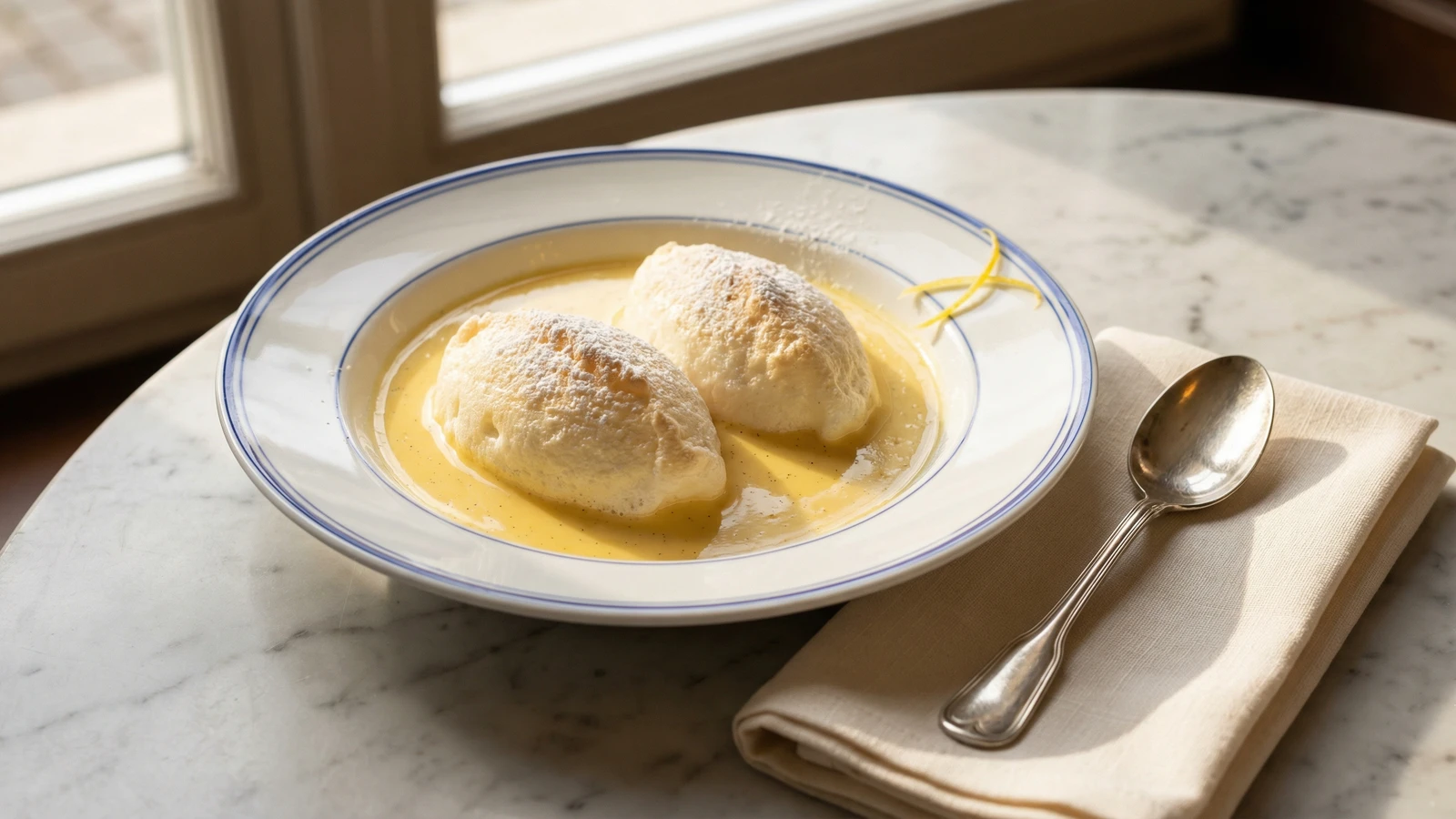
Soft poached meringue Nockerl floating on golden Kanarimilch, the canary-yellow vanilla custard that proves Austrian cooks have always known what to do with eggs, sugar, and patience.
Desserts
Austrian
Dinner Party
Date Night
25 min
Active Time
25 min cook•50 min total
Yield4 servings
In my grandmother Eva's kitchen in Kent, Gretel Beer made this dessert the way she made everything: with complete confidence and very few ingredients. Four eggs. Milk. Sugar. A vanilla pod. That's it. She'd separate the eggs at the counter, whites into one bowl, yolks into another, and say, "This is the most honest dessert in the Viennese kitchen. You can't hide anything."
She was right. Schneenockerl auf Kanarimilch is two things made from the same eggs, served together. The whites become Nockerl, soft meringue clouds poached in sweetened milk until they're set on the outside and still trembling in the center. The yolks become Kanarimilch, a golden vanilla custard so named because the Viennese thought it looked like canary feathers. You ladle the cold custard into a shallow bowl, set the warm Nockerl on top, and that's your dessert. It floats. It's beautiful. And it costs almost nothing to make.
What makes it special is what makes all good Mehlspeisen special: technique over ingredients. The egg whites need to be beaten properly, shaped with confidence, and poached gently. The custard needs to be stirred constantly over low heat until it coats the back of a spoon, and not one degree further or you'll have sweet scrambled eggs. There's nowhere to hide a mistake, which is exactly why getting it right feels so good. This is the kind of dessert that reminds you Austrian pastry cooks have been doing extraordinary things with ordinary ingredients for centuries.
Schneenockerl auf Kanarimilch appears in Viennese cookbooks as far back as the late 18th century, part of a rich tradition of egg-based Mehlspeisen that Austrian cooks developed to feed large households beautifully on modest ingredients. The name Kanarimilch, canary milk, refers to the vivid yellow color the egg yolks give the custard. The dish belongs to a family of "Koch" and "Nockerl" desserts that formed the backbone of bourgeois Viennese home cooking, served as a light course after a heavy Tafelspitz or as a standalone Mehlspeise at the Kaffeehaus.
The technique, the tradition, and the story behind every dish.
vanilla podsplit and scraped (or 2 teaspoons Vanillezucker)
1
granulated sugardivided
120g
salt
pinch
lemon zest (optional)
1 teaspoon
powdered sugar
for dusting
Equipment Needed
•Wide shallow saucepan (24-28cm)
•Two large soup spoons for shaping
•Slotted spoon
•Fine-mesh sieve
•Wooden spoon
•Hand mixer or stand mixer for egg whites
Instructions
1
Warm the poaching milk
Pour the milk into a wide, shallow saucepan. Add the scraped vanilla seeds and the empty pod. If you're using Vanillezucker instead, add it now along with 40g of the granulated sugar. Heat the milk over medium-low until small bubbles form at the edges. You want it just below a simmer, never boiling. Boiling milk will tear your Nockerl apart instead of setting them gently. Keep the heat low and the surface barely trembling.
A wide pan matters here. You need room for the Nockerl to float without touching each other. A deep saucepan will crowd them. Use the widest pan you have, at least 24cm across.
2
Beat the egg whites
While the milk heats, beat the egg whites with a pinch of salt in a spotlessly clean bowl until they hold soft peaks. Add 60g of the sugar gradually, a tablespoon at a time, beating continuously. Keep going until the meringue is glossy, smooth, and holds firm peaks that curl just slightly at the tip. If you add the sugar too fast, the whites won't reach their full volume. Patience here pays off in lighter Nockerl.
Gretel always said your eggs should be at room temperature for whipping. Cold whites take longer to reach full volume and the meringue is less stable. Take the eggs out of the fridge thirty minutes before you start.
3
Shape and poach the Nockerl
Using two large soup spoons dipped in hot water, shape the meringue into oval Nockerl. Scoop a generous spoonful of meringue with one spoon, then pass it to the other spoon, turning it to form a smooth egg shape. You should get six to eight Nockerl from this amount. Slide them gently onto the surface of the barely simmering milk, leaving space between each one. Cover the pan and poach for four to five minutes. Don't lift the lid. The trapped heat sets the tops while the milk sets the bottoms. When you uncover them, they should be firm on the outside but still soft and cloud-like inside.
Dipping the spoons in hot water between each Nockerl keeps the meringue from sticking. You'll get cleaner shapes and your kitchen will stay calm.
4
Lift and rest the Nockerl
Lift the poached Nockerl out of the milk with a slotted spoon and set them on a clean plate. They'll look pale and pillowy and impossibly delicate. Handle them gently. Keep the poaching milk in the pan. You need it for the custard, and it's now flavored with vanilla and a whisper of meringue sweetness, which is exactly what you want.
5
Make the Kanarimilch
In a separate bowl, whisk the four egg yolks with the remaining 20g of sugar until pale and thick. Slowly pour the warm poaching milk through a fine sieve into the yolk mixture, whisking constantly. You're tempering the yolks so they don't scramble on contact. Pour the whole mixture back into the saucepan and cook over the lowest heat you have, stirring constantly with a wooden spoon. Constantly means constantly. Don't answer the phone. Don't check your messages. Stir in slow figure-eights, scraping the bottom and sides of the pan. The custard is ready when it coats the back of the spoon and you can draw a clean line through it with your finger that doesn't run back together. This takes five to eight minutes.
If you see the custard start to look grainy at the edges, pull the pan off the heat immediately and whisk hard. Pour it through a sieve into a cold bowl. You can rescue a custard that's just beginning to split. You cannot rescue one that's fully curdled. Stay close and keep stirring.
6
Cool the custard
Pour the finished Kanarimilch through a fine sieve into a clean bowl or jug. Remove the vanilla pod if you haven't already. Let the custard cool to room temperature, stirring occasionally to prevent a skin from forming. If you want to speed this up, set the bowl over a larger bowl of ice water and stir until cool. The custard will thicken slightly as it cools. It should be pourable but rich, the color of a canary's breast, golden and glossy.
7
Assemble and serve
Divide the cool Kanarimilch among shallow bowls or deep plates. Set two Nockerl on each pool of custard. They'll float. Dust the tops lightly with powdered sugar. If you like, scatter the finest thread of lemon zest across the surface. Serve immediately. The Nockerl are best within thirty minutes of poaching, while they're still soft and yielding against the cool custard beneath them. Mahlzeit!
Chef Tips
•This is a dish of two temperatures. The Kanarimilch should be cool and the Nockerl should be served while they're still slightly warm from poaching. That contrast between the cold custard and the warm, pillowy meringue is what makes the first spoonful so good. Don't refrigerate the Nockerl.
•Use a real vanilla pod if you can get one. The Kanarimilch is so simple that the quality of the vanilla has nowhere to hide. If you can't find a pod, use good Vanillezucker. Do not use vanilla extract here. The flavor is different and the custard won't taste right.
•The whole recipe uses just four eggs, milk, and sugar. This is the kind of cooking where your ingredients have to be good because there are so few of them. Buy the freshest eggs you can find. The yolks should be deep orange, and they'll give your Kanarimilch that proper canary color.
•If you have leftover Kanarimilch, pour it into small glasses and chill it. It's beautiful on its own the next day, served cold with a biscuit on the side.
Advance Preparation
•The Kanarimilch can be made up to 24 hours ahead and refrigerated, covered with cling film pressed directly onto the surface to prevent a skin.
•The Nockerl must be poached fresh and served within thirty minutes. There is no shortcut around this. They deflate as they sit and there's no bringing them back.
Frequently Asked Questions
Nutrition Information
1 serving (about 200g)
Calories
275 calories
Total Fat
9 g
Saturated Fat
4 g
Trans Fat
0 g
Unsaturated Fat
5 g
Cholesterol
200 mg
Sodium
145 mg
Total Carbohydrates
39 g
Dietary Fiber
0 g
Sugars
39 g
Protein
10 g
Where cooking meets culture.
Culinary guides, cultural storytelling, and the editorial depth that makes cooking meaningful.