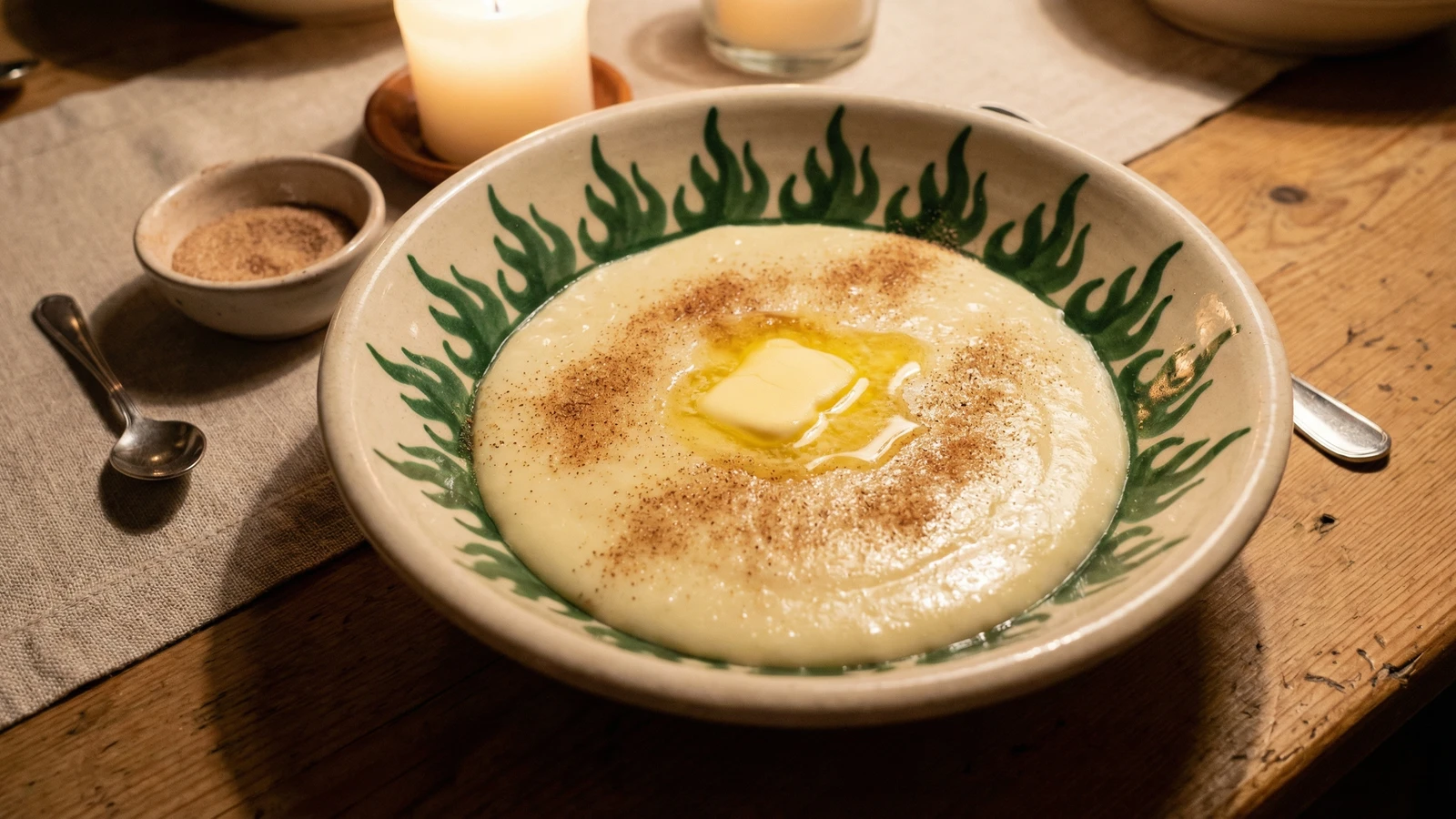
Salzburg's quiet Christmas Eve pudding, nothing more than milk, flour, butter, and patience, served warm with cinnamon sugar before the walk to midnight Mass.
Desserts
Austrian
Christmas
Holiday
Comfort Food
10 min
Active Time
25 min cook•35 min total
Yield4 servings
On Christmas Eve in Salzburg, the city goes still. The markets close, the Getreidegasse empties, and the snow, if you're lucky, falls without wind. Before midnight Mass, before the goose and the Karpfen and the whole bright noise of Christmas Day, there is this: a warm bowl of Milchkoch, eaten in a quiet kitchen.
I didn't grow up with this dish. It found me when I moved to Salzburg and started cooking through the Alpine traditions that don't make it into the tourist guidebooks. Milchkoch is peasant food, and I mean that as the highest compliment. Milk, flour, butter, a little sugar. You cook it slowly on the stovetop until it thickens into something between a porridge and a pudding, glossy and soft, then you dust it with cinnamon sugar and eat it warm. It's the kind of cooking where there is nowhere to hide. Every ingredient has to be good because there are only four of them.
Gretel always said that the simplest dishes are the hardest to get right, and she was talking about exactly this kind of food. You need whole milk, real butter, and the patience to stir without rushing. The flour goes in slowly, like rain, and you keep stirring until the mixture pulls cleanly from the sides of the pot and turns silky. That's it. No eggs, no cream, no complication. The dish earns its place at the table by being honest, and on Christmas Eve in this city, honesty feels like exactly the right way to begin.
Salzburger Milchkoch, also called Bachlkoch in local dialect, belongs to a family of ancient Alpine milk dishes that predate modern Austrian cuisine by centuries. Christmas Eve was traditionally a fasting day in Catholic Austria, and families ate simple, meatless meals before attending Christmette, the midnight Mass. Milchkoch was the Salzburg region's answer to this tradition: a humble, warming pudding that cost almost nothing to make but filled the belly before a long, cold walk to church. The dish appears in regional Salzburg cookbooks from the 18th century, though it was certainly made long before anyone thought to write it down.
The technique, the tradition, and the story behind every dish.
Pour the milk into a heavy-bottomed saucepan and add the butter, sugar, Vanillezucker, and salt. Set it over medium-low heat and let everything warm together slowly. You want the butter to melt completely and the sugar to dissolve before the milk gets anywhere near a simmer. Stir it gently a few times. When you see the first lazy bubbles rising at the edges, the milk is ready.
Use the best whole milk you can find. This dish is mostly milk, so the quality of it is the quality of your pudding. If you can get unhomogenized milk from a farm shop, even better.
2
Add the flour
Reduce the heat to low. Take the flour in one hand and a wooden spoon in the other. Sprinkle the flour into the hot milk in a slow, steady stream, stirring constantly with the spoon. Not a dump, not a handful. A steady rain. If you add the flour too fast, you'll get lumps, and there is no fixing lumps in a dish this simple. Keep stirring as you go. The mixture will start to thicken after the first minute.
Griffiges Mehl, the coarser Austrian flour, absorbs liquid more gradually than fine flour and gives the Milchkoch a slightly better texture. If you can't find it, standard plain flour works. Sift it first to reduce the chance of lumps.
3
Cook the pudding
Keep stirring over low heat for fifteen to twenty minutes. This is the part that asks for patience. The pudding will go through stages: first thin and grainy, then thick and reluctant, then finally smooth and glossy.You're looking for the moment when it pulls away from the sides of the pot cleanly and has the consistency of soft polenta. It should hold its shape briefly on the spoon before slowly sliding off. If it's stiff, you've gone too far. Add a splash of warm milk and stir it back.
Don't leave the spoon. This is not the kind of cooking where you walk away and check your phone. Five seconds of neglect on a hot spot and you'll have scorched milk on the bottom of your pot. Low heat, constant stirring, the full twenty minutes.
4
Rest briefly
Take the pot off the heat and let the Milchkoch sit for two or three minutes with the lid on. It will settle and the texture will even out. The surface will develop a thin, soft skin. That's fine. It's supposed to.
5
Serve warm with cinnamon sugar
Spoon the warm pudding into bowls. Mix a tablespoon of cinnamon with two tablespoons of sugar and set it on the table for everyone to help themselves. Each person dusts their own bowl. In Salzburg, some families add a small knob of butter on top that melts into a golden pool across the surface. I do this every year. It's the only garnish the dish wants or needs. Mahlzeit!
Chef Tips
•The butter on top at the end is not optional in my kitchen. A cold knob of good unsalted butter set on the hot pudding melts slowly and gives each spoonful a richness that the cinnamon sugar alone can't provide. Let it melt halfway, then start eating.
•If you're serving this to children, stir a spoonful of honey into the pudding while it's still warm. It rounds everything out. Gretel always said honey and milk belong together, and she wasn't wrong.
•Leftovers, if there are any, can be poured into a buttered dish, cooled, sliced, and pan-fried in butter the next morning. This is a tradition in itself. The slices turn golden and crisp on the outside while staying creamy inside. Dust with cinnamon sugar again.
•This is a Christmas Eve dish, but there's no reason to wait for December. On cold nights in Salzburg, when the snow is coming down and I don't want to cook anything complicated, Milchkoch is exactly what I make.
Advance Preparation
•Milchkoch is best made and served immediately. It thickens as it cools and loses its soft, spoonable texture.
•You can measure out and combine the dry ingredients ahead of time, but the cooking itself takes less than thirty minutes and should be done just before serving.
•If you plan to pan-fry leftovers the next day, pour the warm pudding into a buttered rectangular dish and refrigerate. It will set firm enough to slice.
Frequently Asked Questions
Nutrition Information
1 serving (about 310g)
Calories
485 calories
Total Fat
21 g
Saturated Fat
13 g
Trans Fat
0 g
Unsaturated Fat
6 g
Cholesterol
70 mg
Sodium
260 mg
Total Carbohydrates
61 g
Dietary Fiber
1 g
Sugars
23 g
Protein
13 g
Where cooking meets culture.
Culinary guides, cultural storytelling, and the editorial depth that makes cooking meaningful.