
Chef Freja
Danablu Mad med Rå Æggeblomme
Danish blue cheese layered on dark rye with a raw egg yolk nestled on top, red onion rings, and chives. The last piece at a Danish lunch, and the one that stays with you longest.
A cooking platform built around craft, culture, and the stories behind what we eat.
Created by Chef Freja
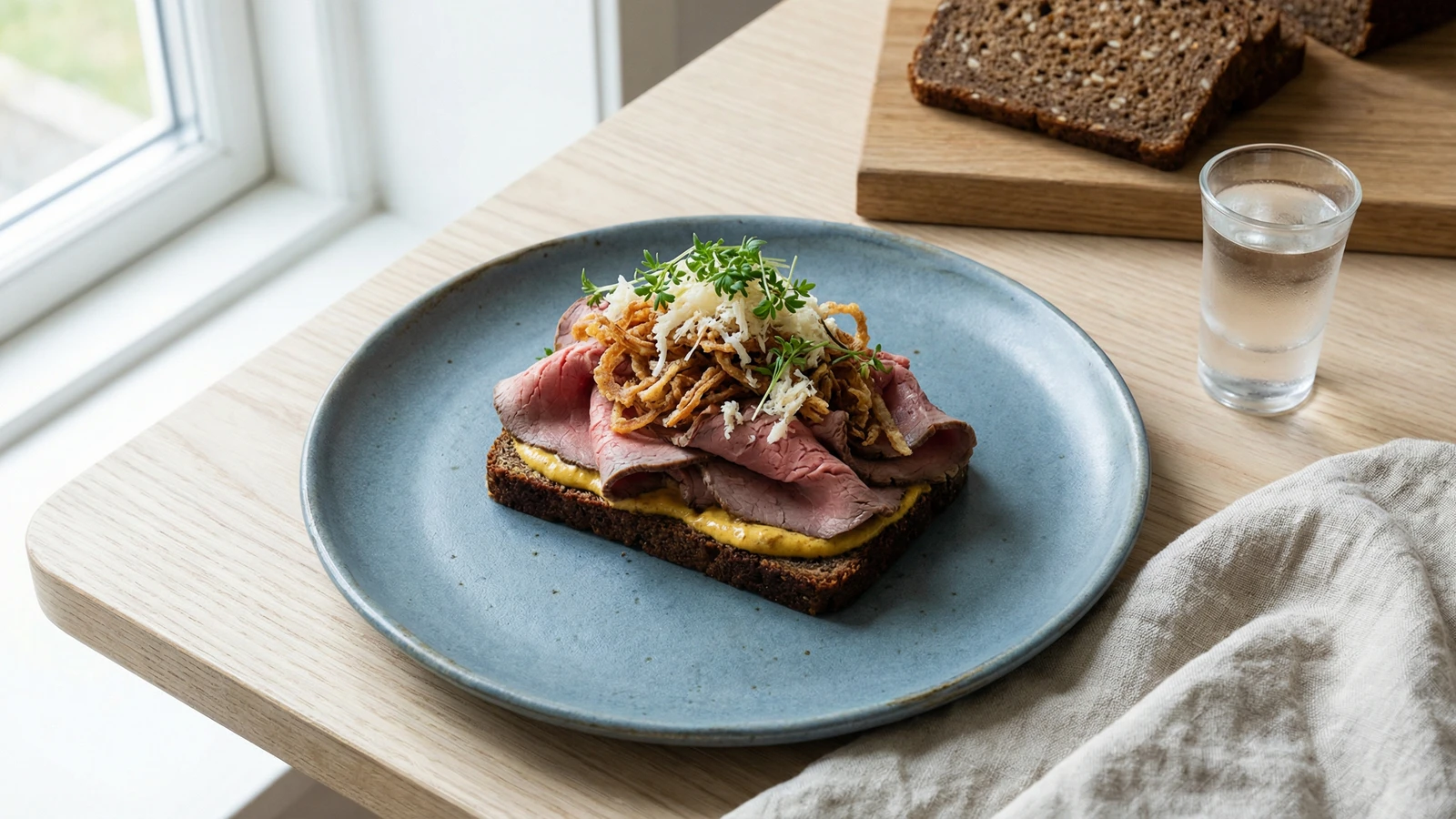
Thin-sliced rare roast beef folded onto dark rugbrod with curry-yellow remoulade, freshly grated horseradish, and a generous pile of ristede løg fried to a deep amber crisp. The meat course of a proper Danish lunch.
There's an order to a Danish lunch. You start with the herring, work through the warm fish, arrive at the meat, and finish with cheese. Roastbeef on rugbrod belongs to the middle of that progression, the moment when the aquavit has already been poured once and the table has settled into the slow rhythm of smorrebrod. You don't rush this piece. You build it, you look at it, and then you eat it.
This is a piece of architecture more than a sandwich. Dark rugbrod on the bottom. A thin seal of butter, then golden-yellow remoulade spread right to the edges. Slices of rare beef, folded loose so there's air between them. A snowfall of freshly grated horseradish. A generous scatter of ristede løg, onions fried to a deep amber crisp that crackles under the fork. A few sprigs of cress to finish. Each layer is visible, and each one does something the others can't.
The whole thing depends on two things: the beef must be rare and cold, and the onions must be crisp. I'll walk you through both. The beef is seared hard, roasted gently to 52C, chilled thoroughly, and sliced paper-thin against the grain. The onions are soaked in milk, tossed in seasoned flour, and fried in small batches until they reach the color of dark honey. Neither step is difficult. Both reward attention. You'll know when it's right, and when it is, this is the piece that tells your guests you know what you're doing. Tak for mad.
Roastbeef smorrebrod belongs to the golden age of the Danish lunch restaurant, the period between the 1880s and the First World War when Copenhagen became famous for its smorrebrodshus, the dedicated lunch houses where patrons ordered from menus that sometimes ran to more than two hundred pieces. Oskar Davidsen opened his now-legendary establishment in 1888, and his descendants still serve the same classic kødpålæg today. The curry in the remoulade is a nineteenth-century trace of the Danish East India Company's trade routes through Tranquebar, the small colonial outpost on the Coromandel coast, and it remains the detail that distinguishes a Danish remoulade from every other remoulade in Europe.
Quantity
500g
trimmed and tied
Quantity
2 tablespoons
Quantity
30g
Quantity
to taste
Quantity
freshly ground, to taste
Quantity
4 thick slices
Quantity
softened, to spread
Quantity
4 generous tablespoons
Quantity
1 small piece
peeled
Quantity
small handful
Quantity
2 large
sliced paper-thin
Quantity
150ml
Quantity
75g
Quantity
1 teaspoon
Quantity
as needed
| Ingredient | Quantity |
|---|---|
| beef sirloin or topsidetrimmed and tied | 500g |
| neutral oil | 2 tablespoons |
| unsalted butter | 30g |
| fine sea salt | to taste |
| black pepper | freshly ground, to taste |
| dark rugbrod | 4 thick slices |
| unsalted butter (for the bread) | softened, to spread |
| Danish remoulade | 4 generous tablespoons |
| fresh horseradish rootpeeled | 1 small piece |
| garden cress or watercress | small handful |
| yellow onionssliced paper-thin | 2 large |
| whole milk | 150ml |
| plain flour | 75g |
| fine sea salt (for the onions) | 1 teaspoon |
| neutral oil (for deep frying) | as needed |
Pat the beef completely dry and season generously with salt and pepper on every surface. Heat the neutral oil in a heavy oven-safe pan over high heat until it just begins to shimmer. Lay the beef in and sear it hard on every side, including the ends, until you have built a deep mahogany crust all over. This takes about six minutes in total. Don't rush it and don't move the meat until each side has colored properly. The crust is where the flavor starts, and a pale roast will give you a pale slice on the bread.
Drop the butter into the pan and slide the whole thing into an oven heated to 150C. Roast gently until a thermometer pushed into the thickest part reads 52C, about twenty minutes for a 500g piece. This is rare, and rare is what you want. Smorrebrod beef is sliced paper-thin and served cold, and anything more cooked than rare turns grey and dry in the fridge. Low and slow here, not high and fast, so the meat cooks evenly from edge to centre.
Lift the beef out of the pan and let it rest on a board for ten minutes so the juices settle back into the fibres. Then wrap it tightly in parchment or cling film and put it in the fridge for at least three hours, or overnight if you can. Slicing the beef thin is impossible while it is warm. Warm beef tears and shreds under the knife. Cold beef holds its shape and lets you shave it as fine as you like.
Separate the onion slices into rings and drop them into the milk. Let them soak for ten minutes. The milk softens their raw edge and helps the flour cling. Drain them, shake off the excess, and toss them through the flour seasoned with the teaspoon of salt until every ring is coated. Heat enough neutral oil in a deep heavy pan to submerge a handful of onions at a time, bringing it to 170C. Fry in small batches, stirring gently with a slotted spoon, until the rings turn the color of dark honey. Lift them onto kitchen paper. Take them out just before they look fully done. They crisp further as they cool, and onions pulled too late go bitter and dark.
Unwrap the cold beef and set it on a board. Using your sharpest knife, slice it as thinly as you possibly can, going against the grain. You want slices so fine you can almost see through them. If the knife catches or tears the meat, it isn't sharp enough. Sharpen it before you continue. Blunt knives are the reason most home cooks give up on thin-sliced beef.
Butter each slice of rugbrod thinly, right to the edges. The butter is a seal that keeps the bread from going soft under the remoulade. Spread a generous tablespoon of remoulade across the buttered surface. Fold the slices of beef loosely and lay them on top in overlapping piles, never flat. The air between the folds is what gives the piece its height and its softness in the mouth. Grate a snowfall of fresh horseradish over the beef. Crown each piece with a generous heap of ristede løg, enough that some fall onto the plate. Finish with a few sprigs of cress. Serve at once with a knife and a fork, and an aquavit if the moment calls for it.
1 serving (about 225g)
Culinary guides, cultural storytelling, and the editorial depth that makes cooking meaningful.
Discover Culinary ExplorerChef Freja
Danish blue cheese layered on dark rye with a raw egg yolk nestled on top, red onion rings, and chives. The last piece at a Danish lunch, and the one that stays with you longest.

Chef Freja
Thick-sliced Danbo on properly buttered rugbrod with sweet pepper rings and a crown of garden cress. The cheese smorrebrod that lives in every Danish lunchbox, from the first day of school to the last day at the office.

Chef Freja
Copenhagen's most storied smorrebrod: leverpostej, cold salt beef, trembling aspic, onion rings, and fresh cress on dark rugbrod. Invented at Oskar Davidsen's in the 1880s for a hungry veterinarian and still one of the great pieces of the Danish lunch table.

Chef Freja
Pungent Esrom from North Zealand on dark rye with paper-thin radish and fresh chives. The cheese course that closes a proper Danish smorrebrod spread, one of the quietest, most satisfying bites in the whole tradition.