Culinary Explorer

A cooking platform built around craft, culture, and the stories behind what we eat.
Discover Culinary Explorer
Riebel (Vorarlberg Cornmeal Crumbles)

Riebel (Vorarlberg Cornmeal Crumbles)

Created by

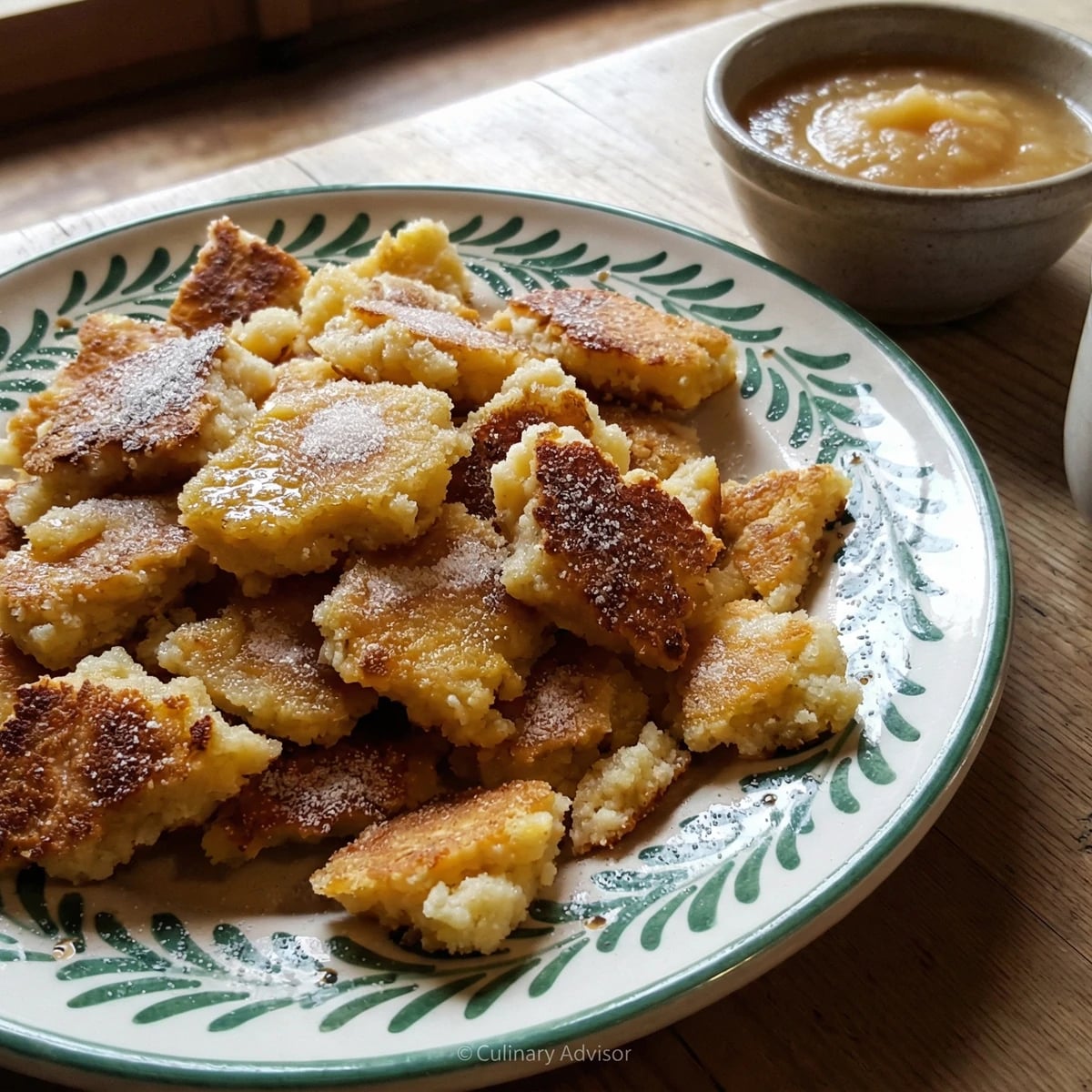
Vorarlberg's own cornmeal porridge, crumbled and fried golden in butter, served with apple sauce or elderberry compote. Austria's westernmost breakfast tradition, and one of its oldest.

Breakfast & Brunch
Austrian
Comfort Food
Budget Friendly
10 min
Active Time
30 min cook40 min total
Yield4 servings

Most people think of Vienna when they think of Austrian food. Understandable. But Austria's kitchens stretch from the Danube to the Rhine, and the westernmost corner, Vorarlberg, has a culinary identity all its own. Riebel is the dish that proves it.

I first tasted Riebel on one of those childhood trips with Gretel and my grandmother Eva. We'd driven west from Salzburg into the Vorarlberg, and at a farmhouse Gasthaus near Bregenz, a woman brought out a wide pan of golden crumbles with a bowl of warm apple sauce and a pot of strong coffee. Gretel looked at it and said, 'This is Alemannic cooking. Not Viennese. A different Austria entirely.' She was right. Riebel comes from the corn-growing tradition of the Rhine Valley, where Vorarlbergers have cultivated a specific variety called Riebelmais for over three hundred years. You cook coarse cornmeal and wheat semolina together in milk until it forms a thick porridge, let it cool and set, then crumble it with your hands and fry the pieces in good butter until the edges go golden and crisp. The soft centers stay tender. The contrast is the whole point.

It's peasant food in the best sense. Five ingredients, no technique more complicated than patience and a hot pan. The kind of breakfast that kept farming families going through Alpine winters. You eat it with a spoonful of Apfelmus (apple sauce) or Holunderbeerkompott (elderberry compote), and maybe a dusting of sugar if you have a sweet tooth. Some people eat it savory, with cheese or alongside sausage, but the sweet version is the one that feels like home in Vorarlberg. This is good Austrian home cooking from a part of Austria most visitors never reach.

Riebel traces its origins to the introduction of maize in the Rhine Valley during the 17th century. Vorarlberg farmers developed a specific corn variety, Riebelmais, adapted to the region's Alpine climate, and Riebel became the daily staple breakfast across the province. The dish is linguistically and culturally Alemannic, connecting Vorarlberg's food traditions more closely to neighboring Switzerland and Swabia than to Vienna. In 2000, Vorarlberger Riebelmais received protected designation as a Slow Food Presidium, recognizing the heritage grain and the traditional dish it produces.

The technique, the tradition, and the story behind every dish.

Discover Culinary Explorer

Ingredients

coarse cornmeal (polenta grind, ideally Riebelmais)

Quantity

150g

coarse wheat semolina (Grieß)

Quantity

100g

whole milk

Quantity

400ml

water

Quantity

200ml

salt

Quantity

1/2 teaspoon

unsalted butter

Quantity

50g

for frying

granulated sugar (optional)

Quantity

for serving

Apfelmus (apple sauce) or Holunderbeerkompott (elderberry compote)

Quantity

for serving

Equipment Needed

  • Heavy-bottomed saucepan (2-liter minimum)
  • Wooden spoon
  • Wide heavy pan or skillet (28cm) for frying

Instructions

  1. 1

    Cook the porridge base

    Combine the milk and water in a heavy-bottomed saucepan and bring to a gentle simmer over medium heat. Add the salt. Once the liquid trembles at the surface, slowly pour in the cornmeal and semolina together, stirring constantly with a wooden spoon. Pour in a thin, steady stream. If you dump it all in at once, you'll get lumps that no amount of stirring will rescue.

    The mix of milk and water matters. All milk makes the porridge too rich and it browns too fast in the pan later. All water makes it bland. The combination gives you a clean corn flavor with just enough body.
  2. 2

    Stir and thicken

    Reduce the heat to low. Stir the porridge frequently for about ten minutes. It will thicken considerably and start to pull away from the sides of the pan. You'll feel real resistance in the spoon. That's what you want. When the mixture is thick enough to hold its shape when you drag the spoon through it, leaving a trail that doesn't immediately fill back in, it's done. The kitchen will smell like toasted corn and warm milk.

  3. 3

    Cool and set the porridge

    Spread the hot porridge onto a plate or shallow dish, pressing it to a thickness of about two centimeters. Let it cool to room temperature, then refrigerate for at least twenty minutes until firm. You can do this the night before if you're making Riebel for breakfast. The porridge needs to set solid enough that you can break it apart with your fingers into rough, irregular crumbles.

    The overnight method is how Vorarlberg farmhouses traditionally did it. Cook the porridge after supper, let it set overnight, fry it first thing in the morning. Good planning, not laziness.
  4. 4

    Crumble the porridge

    Turn the set porridge out onto a board. Break it apart with your hands or two forks into rough, uneven pieces, some the size of a walnut, some smaller. Don't make them too fine or they'll turn to mush in the pan. Don't make them too uniform either. The variation in size is what gives you that mix of crispy edges and soft centers in the finished dish.

  5. 5

    Fry the crumbles

    Melt the butter in a wide, heavy pan over medium heat. When it foams and the foam begins to subside, add the crumbled porridge in a single layer. Don't crowd the pan. If your pan isn't wide enough, work in two batches. Let the pieces sit undisturbed for two to three minutes until the undersides turn golden and a dry, crisp crust forms. Then toss or turn them gently and let the other sides crisp. The butter should be doing the talking here. You'll hear a steady, quiet sizzle. If it's roaring, your heat is too high.

    Resist the urge to stir constantly. The golden crust only forms when the crumbles sit still against the hot pan. Move them too often and you'll end up with soft, pale porridge instead of Riebel.
  6. 6

    Serve warm

    Pile the golden crumbles onto warm plates. Sprinkle with a little sugar if you like. Serve immediately with a generous spoonful of warm Apfelmus or Holunderbeerkompott on the side. A strong cup of coffee belongs next to this. In Vorarlberg they drink it black. Mahlzeit!

Chef Tips

  • If you can't find Riebelmais (and outside Austria, you probably can't), use a coarse-ground polenta cornmeal. Not instant polenta, not fine cornflour. You need the texture that coarse grind provides. The grains should feel slightly gritty between your fingers.
  • The semolina is not optional. Riebel is not polenta. The wheat semolina gives the crumbles a structure that holds together in the pan and a flavor that pure corn doesn't deliver on its own. Coarse Grieß is what you want, not the fine stuff used for puddings.
  • Gretel always said that simple dishes punish bad ingredients. Five ingredients means each one has nowhere to hide. Use good butter, full-fat milk, and the best cornmeal you can find. The difference shows.
  • For the savory version, skip the sugar and serve Riebel alongside Bergkäse (mountain cheese) and a green salad. Vorarlbergers eat it both ways and have strong opinions about which is better.

Advance Preparation

  • The porridge can be cooked the night before and refrigerated. In fact, this is the traditional method. Cold, firm porridge crumbles more easily and fries more crisply than porridge that's only been cooled for twenty minutes.
  • Apfelmus can be made three to four days ahead and stored in the fridge. Reheat gently before serving. Holunderbeerkompott keeps even longer.

Frequently Asked Questions

Nutrition Information

1 serving (about 180g)

Calories
390 calories
Total Fat
15 g
Saturated Fat
9 g
Trans Fat
0 g
Unsaturated Fat
6 g
Cholesterol
37 mg
Sodium
340 mg
Total Carbohydrates
56 g
Dietary Fiber
4 g
Sugars
9 g
Protein
9 g

Note: Chef personas and recipes are created with AI assistance. Cook with care: follow safe food-handling practices, check doneness with a thermometer when needed, and adapt for allergies and your kitchen.

Where cooking meets culture.

Culinary guides, cultural storytelling, and the editorial depth that makes cooking meaningful.

Discover Culinary Explorer

More from Austrian Warme Mehlspeisen

Browse the full collection