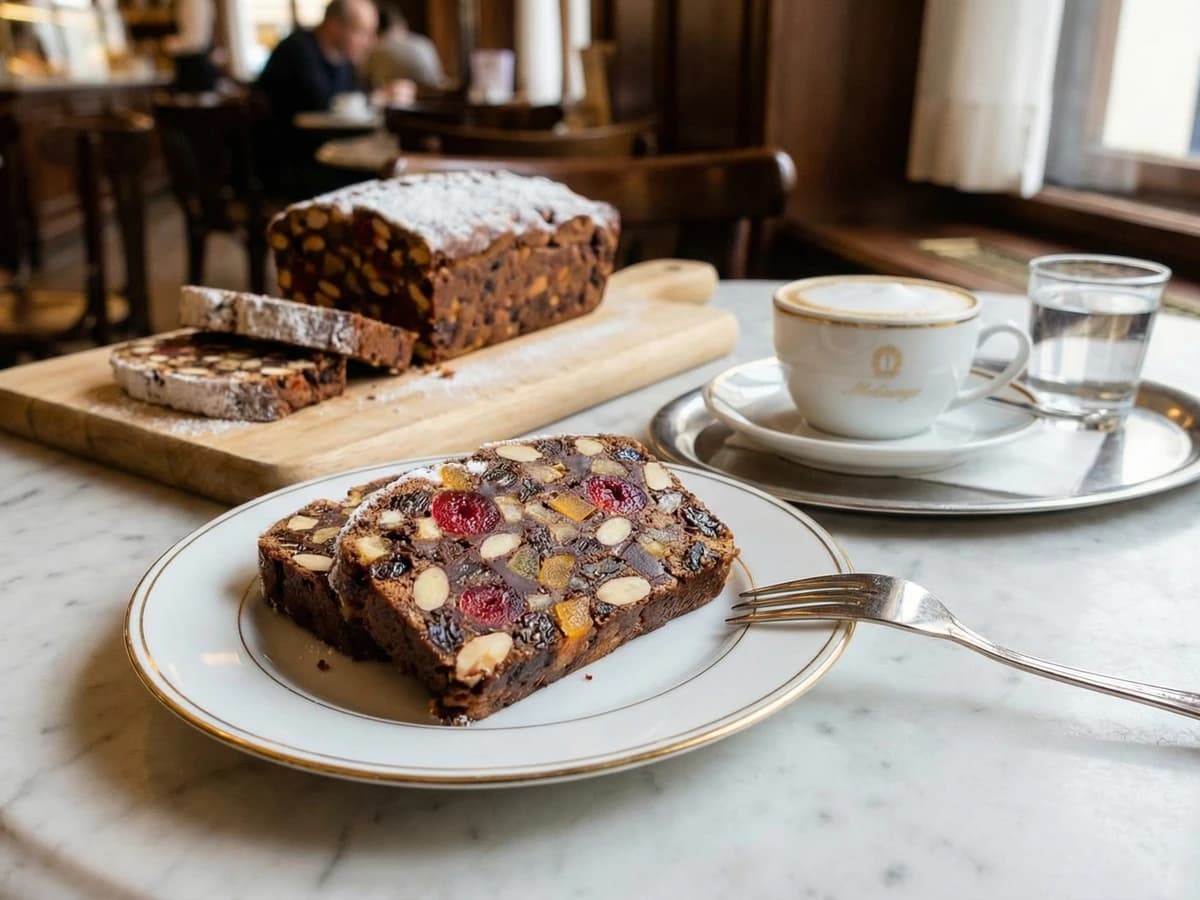
A dense chocolate-almond cake shaped like a saddle of venison in a ridged mold, glazed in dark chocolate and studded with blanched almond slivers along the spine. The Konditorei classic that fools the eye and wins the table.
Desserts
Austrian
Dinner Party
Special Occasion
40 min
Active Time
50 min cook•2 hr 30 min total
Yield8-10 servings
Rehrücken fooled me the first time I saw it. I was seven, maybe eight, in a Konditorei in Salzburg during one of those annual trips with Gretel and my grandmother Eva. Behind the glass case sat what I was certain was a small roast, dark and ridged, with neat rows of white larding along the top. Gretel laughed when I asked why there was meat next to the Torten. She bought me a slice. It was chocolate. Dense, dark, almond-scented chocolate with a glaze so glossy I could see the shop lights reflected in it. The blanched almonds I'd mistaken for larding strips cracked between my teeth. I didn't say a word until I'd finished every crumb.
That's the joke at the heart of Rehrücken, and the Viennese love a good joke. The whole cake is designed to look like a Rehsattel, a saddle of venison, the kind of grand roast you'd serve at a Habsburg hunting lodge. The ridged mold gives it the shape. The dark chocolate glaze gives it the color of roasted game. The almonds pressed into the ridges mimic the larding needles a cook would thread through lean venison to keep it moist. It's pastry dressed as Sunday roast, and it has been making people smile in Austrian Konditoreien for nearly two centuries.
The cake itself is serious. Ground almonds replace most of the flour, which gives the crumb that dense, moist quality that lasts for days without drying out. You melt good dark chocolate into butter, fold in whipped egg whites for just enough lift, and let the almonds do the rest. The glaze is nothing more than chocolate and butter, poured over the cooled cake in one confident motion. If you've never worked with a Rehrücken mold before, don't worry. The mold does the hard work. You just fill it, bake it, and turn it out. The shape does the rest.
Rehrücken appears in Viennese cookbooks from the early 19th century, born from the Austrian Konditorei tradition of trompe-l'oeil baking, where pastry chefs competed to create confections that mimicked savory dishes. The name translates to 'saddle of venison,' and the distinctive half-cylinder mold with its lengthwise ridges was purpose-built to complete the illusion. Venison saddle was a prestige dish of the Austrian aristocracy, and the chocolate cake version allowed the Bürgerlich middle class to serve their own version of the grand hunting table, in sugar and almonds instead of game.
The technique, the tradition, and the story behind every dish.
•Rehrücken mold (half-cylinder ridged baking mold, approximately 30cm) or a standard loaf tin
•Heatproof bowl for melting chocolate
•Hand mixer or stand mixer
•Wire cooling rack
•Pastry brush for buttering the mold
Instructions
1
Prepare the mold
Preheat your oven to 170°C (340°F). Butter the Rehrücken mold generously, getting into every ridge with a pastry brush. Dust it with fine breadcrumbs, tap out the excess, and set it aside. The ridges are what give this cake its identity. If they stick, you lose the whole illusion. Don't skimp on the butter.
If you don't own a Rehrücken mold, a standard loaf tin will give you the right density and slice, just not the ridged shape. The cake is still magnificent. But the mold is worth buying if you plan to make this more than once. It's a beautiful piece of kit.
2
Melt the chocolate
Melt the 150g of chopped chocolate in a heatproof bowl set over a pan of barely simmering water. The bowl should not touch the water. Stir gently until smooth and glossy, then take it off the heat and let it cool until it's warm but not hot. If you add hot chocolate to your butter and eggs, you'll cook them. Patience here costs you five minutes and saves the entire cake.
3
Cream butter and sugar
Beat the softened butter with the caster sugar and Vanillezucker until pale and fluffy. This takes a good three to four minutes with a hand mixer, longer by hand. You want the mixture almost white and visibly increased in volume. Add the egg yolks one at a time, beating well after each. The mixture should be smooth and thick, like a golden cream. Stir in the lemon zest and the melted chocolate until everything is evenly combined. The batter will turn a deep, dark brown.
4
Fold in almonds and breadcrumbs
Mix the ground almonds and breadcrumbs together, then fold them into the chocolate batter with a large spoon or spatula. Work gently but thoroughly. The ground almonds are doing the job that flour does in most cakes, giving the crumb structure and moisture. The breadcrumbs add just enough texture to keep it from being too dense. This is a cake that relies on its ingredients, not on leavening tricks.
5
Whip and fold the egg whites
In a clean bowl, beat the six egg whites with a pinch of salt until they hold firm, glossy peaks. Fold a third of the whites into the chocolate batter first to loosen it. This sacrificial third makes room for the rest. Now fold in the remaining whites in two additions, using slow, sweeping strokes from the bottom up. You're folding in the air that will lift this cake. Every rough stir knocks that air out. Be gentle. The batter should be dark, mousse-like, and still streaked with a few wisps of white. That's fine. A few streaks are better than a deflated batter.
Gretel always said the secret to folding is confidence and a light hand. Move the spatula in one direction, turning the bowl with your other hand. Don't stir. Don't swirl. Fold.
6
Bake the cake
Pour the batter into your prepared mold, smoothing the top gently. Bake at 170°C for 45 to 50 minutes. The cake is done when a skewer inserted into the center comes out with just a few moist crumbs clinging to it. Not wet batter, not bone dry. A few crumbs. This cake continues to set as it cools, and overbaking it will cost you the moist, fudgy center that makes Rehrücken what it is. Let it cool in the mold for fifteen minutes, then turn it out carefully onto a wire rack. The ridges should release cleanly if you buttered well. Cool completely before glazing.
7
Make the chocolate glaze
Melt the 150g of glaze chocolate with the 50g of butter in a heatproof bowl over barely simmering water, stirring until smooth. Add the rum if using. Let the glaze cool for five minutes. It should be pourable but not thin. If it runs off the cake like water, it's too hot. If it clumps, it's too cool. You want it to coat the back of a spoon in a glossy, even layer. That's your moment.
Use the best dark chocolate you can afford. This glaze has two ingredients. There is nowhere for poor chocolate to hide.
8
Glaze the Rehrücken
Place the wire rack over a sheet of baking paper to catch the drips. Pour the glaze over the top of the cake in one steady, confident motion, starting at one end and moving to the other. Let it flow down the sides and into the ridges. Do not touch it. Do not spread it. Do not go back and try to fix thin spots. The glaze knows what to do. Gravity and good chocolate will give you a smooth, glossy finish that looks like polished wood. Let it set for a few minutes until it's no longer dripping but still tacky.
9
Stud with almonds
While the glaze is still slightly tacky, press blanched almond slivers into the ridges along the top of the cake in neat, evenly spaced rows. These are the larding strips. This is where the illusion comes together. Stand back and look at it. You've made a chocolate cake that looks like a roast saddle of venison. The Viennese have been delighting in this trick since the 1800s, and it still works every time. Let the glaze set completely, at least thirty minutes at room temperature, before slicing.
10
Slice and serve
Cut the Rehrücken into slices about two centimeters thick with a sharp knife dipped in hot water. Wipe the blade between cuts for clean edges through the glaze. Serve on individual plates with a generous spoonful of unsweetened Schlagobers (whipped cream) on the side. Not on top. On the side. The cream softens each bite of that dense, almond-rich chocolate crumb. A cup of strong Viennese coffee alongside is not optional. Mahlzeit!
Chef Tips
•Buy whole blanched almonds and sliver them yourself if you can. Pre-cut slivers from a bag are often stale and break when you press them into the glaze. Fresh-cut almonds are firm and white and they crack between your teeth the way they should.
•The ground almonds carry this cake. Don't substitute almond flour that's been sitting in your cupboard for six months. Almonds go rancid quietly, and rancid almonds will ruin every bite. Taste one before you start. It should be sweet and clean. If it's bitter or flat, buy new ones.
•Rehrücken improves on the second day. The crumb tightens, the chocolate flavor deepens, and the almonds release their oil into the cake. Wrap it well and store at room temperature. It keeps beautifully for four or five days, which is why it's a perfect dinner party cake: you can bake it the day before and forget about it.
•If your glaze sets with a few thin spots, leave them. A slightly imperfect glaze looks handmade. A perfect glaze looks factory-made. The Konditorei tradition values skill, not sterility.
Advance Preparation
•The cake can be baked one to two days ahead and stored wrapped at room temperature. Glaze on the day you plan to serve.
•The glaze can be made an hour ahead and kept at room temperature. Rewarm gently over simmering water if it firms up before you're ready to pour.
•Once glazed and studded, Rehrücken holds at room temperature for up to four hours before serving. It does not need the fridge.
Frequently Asked Questions
Nutrition Information
1 serving (about 120g)
Calories
630 calories
Total Fat
48 g
Saturated Fat
22 g
Trans Fat
1 g
Unsaturated Fat
25 g
Cholesterol
175 mg
Sodium
110 mg
Total Carbohydrates
40 g
Dietary Fiber
7 g
Sugars
25 g
Protein
12 g
Where cooking meets culture.
Culinary guides, cultural storytelling, and the editorial depth that makes cooking meaningful.