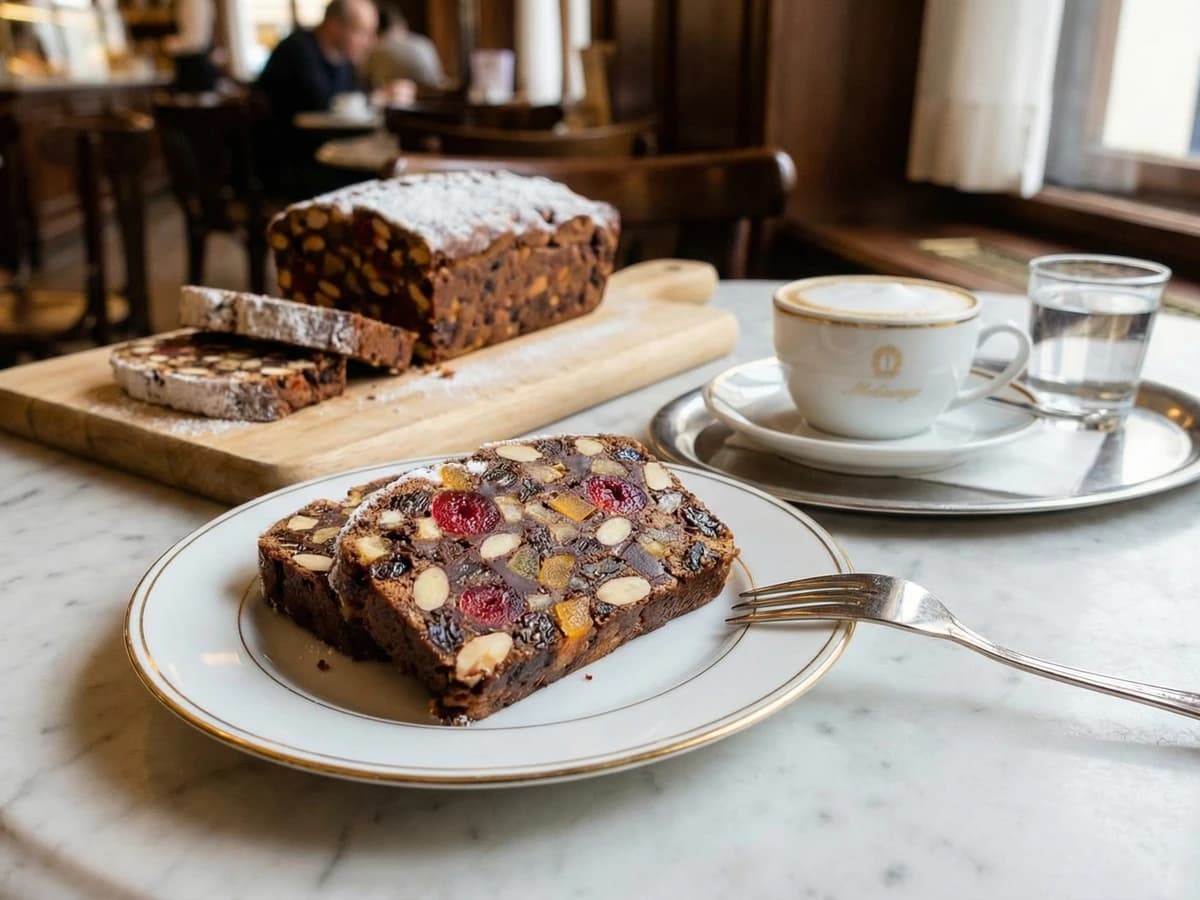
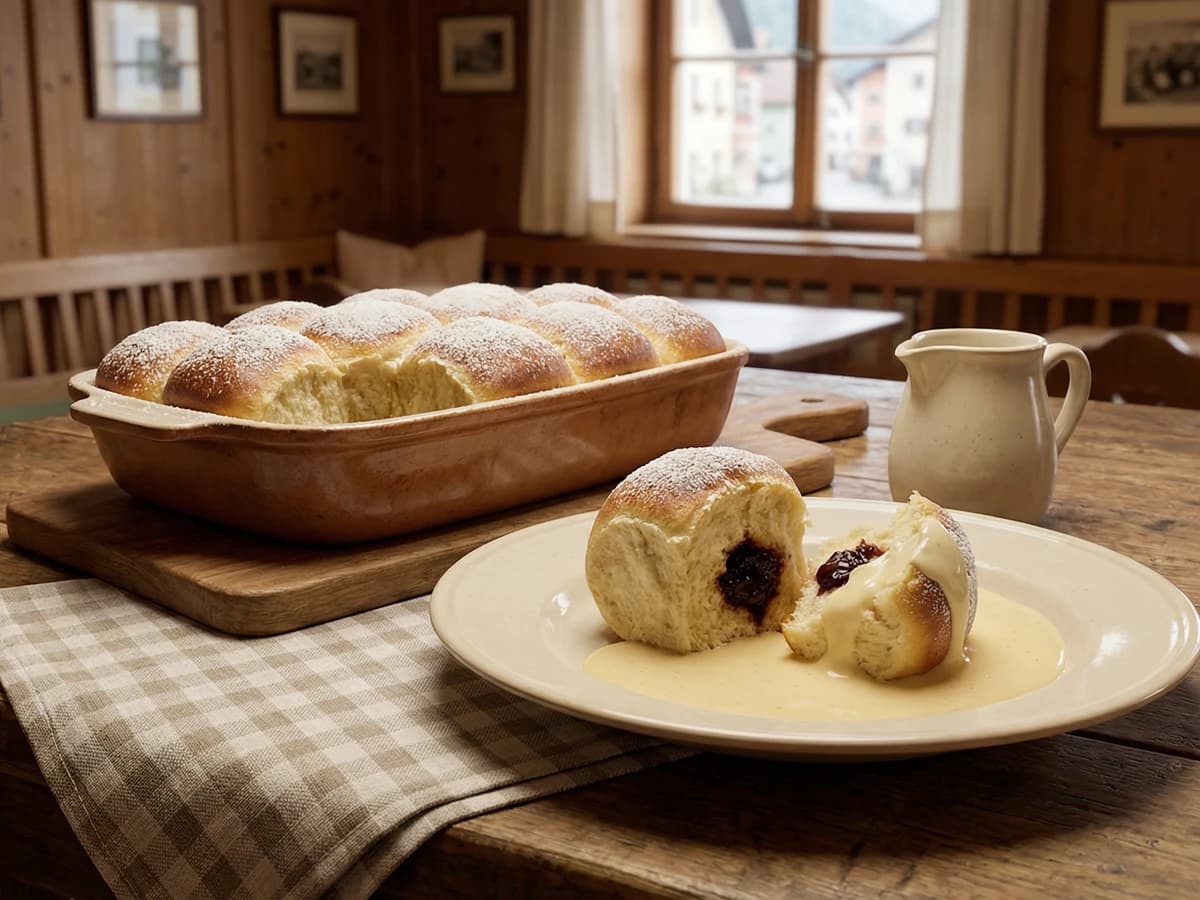
Austria's marble-swirled yeast cake with rum-soaked raisins, baked in the fluted ring mold that sits in every kitchen from Vienna to Vorarlberg, and dusted with powdered sugar just before you put the coffee on.
Desserts
Austrian
Weeknight
Comfort Food
30 min
Active Time
50 min cook•2 hr 30 min total
Yield12 servings
In my grandmother Eva's kitchen in Kent, there was a heavy ceramic Gugelhupfform that lived on the top shelf. It came down every Sunday. Gretel always said that a household without a Gugelhupf mold was not a serious household, and while she was smiling when she said it, she also meant it completely. The mold is the thing. That tall, fluted ring with the chimney in the center isn't just decorative. The hole lets heat reach the middle of a thick, rich cake so it bakes evenly. Every Austrian kitchen has one, and most of them are older than the person using them.
Gugelhupf is not a weekend project or a special occasion showpiece. It's the cake Austrians bake because it's Tuesday and the cake tin is empty. The dough is a yeast batter, closer to brioche than sponge, enriched with good butter and eggs and perfumed with lemon zest and rum-soaked raisins. The marble swirl, a spoonful of cocoa worked into part of the batter, gives each slice a different pattern. No two cuts look the same. You eat it for Jause, the Austrian afternoon coffee break, sliced thick and maybe lightly toasted if it's a day old, with butter melting into the crumb.
The technique is straightforward but it asks you to respect the yeast. Give it time. Let it rise properly, twice. Don't skimp on the butter or rush the kneading. This is good Austrian home cooking at its most fundamental: simple ingredients, proper technique, and the patience to let the dough tell you when it's ready.
The origins of Gugelhupf are claimed by Austria, Bohemia, and Alsace, and the argument has been going on for centuries with no sign of resolution. The name likely comes from the Middle High German 'gugel' (hood) and 'hupf' (to rise), describing the cake's distinctive peaked shape. What's certain is that Gugelhupf was already a fixture in Viennese households by the 18th century, appearing in cookbooks alongside Strudel and Kipferl as foundational Austrian baking. Marie Antoinette reportedly missed it so much after moving to Versailles that she had Gugelhupf molds sent from Vienna, which may or may not be the origin of the phrase about cake that got her into trouble.
The technique, the tradition, and the story behind every dish.
•Gugelhupfform (fluted ring mold, 24cm, ceramic or heavy metal)
•Stand mixer with dough hook (or strong arms and patience)
•Wire cooling rack
•Fine-mesh sieve for powdered sugar dusting
•Wooden skewer for testing
Instructions
1
Soak the raisins
Put the raisins in a small bowl and pour the rum over them. Cover and leave them for at least an hour, longer if you can manage it. Overnight is better. The raisins need to drink up that rum properly. If you skip this step or rush it, the raisins just sit in your cake like dry little pebbles and the whole Gugelhupf suffers for it.
Gretel always said: if you wouldn't drink the rum, don't bake with it. Use something decent. The raisins will tell on you.
2
Make the yeast sponge
Warm the milk until it's just lukewarm, the temperature of a comfortable bath. Dissolve the yeast in it with a teaspoon of sugar from your measured amount. Stir gently and leave it for ten minutes. When it turns foamy and smells like fresh bread, your yeast is alive and ready. If nothing happens, your milk was too hot and killed it. Start again with fresh yeast and cooler milk.
3
Build the dough
Put the flour in a large bowl and make a well in the center. Pour in the yeast mixture, then add the remaining sugar, Vanillezucker, salt, lemon zest, and eggs. Mix with a wooden spoon until the dough starts to come together, then add the softened butter in pieces. Now work the dough. You can use a stand mixer with the dough hook for eight minutes, or do it by hand for twelve. The dough is sticky and rich and it will resist you at first. Keep going. You're done when it pulls away from the sides of the bowl in glossy, elastic strands and makes a soft slapping sound against the bowl. This is a yeast dough enriched with butter and eggs, so it behaves more like a brioche than a bread. Don't add extra flour to make it easier to handle. The richness is the point.
Room temperature eggs matter here. Cold eggs will seize the butter and give you a lumpy dough. Take them out of the fridge an hour before you start.
4
First rise
Cover the bowl with a clean tea towel and put it somewhere warm but not hot. The top of the fridge, a turned-off oven with the light on, a sunny windowsill. Let the dough rise until it has doubled in size, about one hour. The exact time depends on your kitchen. A cold room takes longer. Don't rush it. Yeast works on its own schedule and it rewards patience the same way good broth does.
5
Prepare the mold
Butter every flute and curve of your Gugelhupfform generously with soft butter, then dust with fine breadcrumbs, turning and tapping until every surface is coated. Tip out the excess. This is not optional and it's not about being fussy. The breadcrumb coating gives the crust a delicate crunch and ensures the cake releases cleanly from the mold. If you skip this, you'll spend twenty minutes trying to pry your beautiful cake out in pieces.
Fine dry breadcrumbs, not panko or coarse crumbs. Some Austrian bakers use ground almonds instead, which adds a subtle nuttiness to the crust. Both work.
6
Create the marble swirl
Punch the risen dough down gently and fold in the drained rum-soaked raisins. Remove about a third of the dough to a separate bowl. Mix the cocoa powder with a tablespoon of milk to make a smooth paste, then work it into the smaller portion until the color is even and dark. You now have two-thirds vanilla dough and one-third chocolate dough.
7
Fill the mold
Drop alternating spoonfuls of vanilla and chocolate dough into the prepared mold, layering them unevenly. Don't try to be precise. The beauty of a marbled Gugelhupf is that every slice looks different. When all the dough is in, take a butter knife and drag it through the batter in a loose figure-eight pattern, two or three passes, no more. You want veins and swirls, not a uniform brown. Smooth the top gently with wet fingers.
8
Second rise
Cover the mold with the tea towel and let the dough rise again until it reaches about two-thirds up the side of the mold, thirty to forty minutes. Don't let it go higher or the cake will mushroom over the top and lose its shape. While the dough rises, preheat your oven to 170°C (340°F). Position the rack in the lower third.
9
Bake the Gugelhupf
Bake for 45 to 50 minutes. The cake is done when a wooden skewer pushed into the deepest part comes out clean and the top is a deep golden brown. If the top is browning too fast after thirty minutes, lay a sheet of foil loosely over it and continue baking. The center of this cake is thick, so trust the skewer, not the color alone.
Every oven lies. Start checking at 40 minutes. A Gugelhupf that's overbaked goes dry and crumbly. Five minutes too long does real damage to a yeast cake this rich.
10
Cool and unmold
Let the cake rest in the mold for fifteen minutes on a wire rack. This is the hardest part, because the kitchen smells incredible and you want to tip it out immediately. Resist. The cake needs those fifteen minutes to pull away from the sides and firm up enough to hold its shape. After fifteen minutes, place a plate or board over the mold, flip it in one confident motion, and lift the mold straight up. The cake should release cleanly, showing every fluted ridge in golden detail.
11
Dust and serve
Let the Gugelhupf cool completely before dusting. This is important. If you dust a warm cake, the powdered sugar melts into the surface and disappears. Once it's truly cool, hold a fine sieve over the top and tap powdered sugar over it generously, letting it settle into the ridges and valleys of the fluted shape. Cut with a serrated knife. Serve with coffee and, if you like, a spoonful of Schlagobers on the side. Mahlzeit!
Chef Tips
•Soak the raisins in rum. Not a splash, a proper soak, at least an hour. Overnight is better. If the raisins aren't plump and fragrant when you fold them in, they haven't soaked long enough.
•Use real Vanillezucker, not vanilla extract. You can make your own by burying two split vanilla pods in a jar of caster sugar for a week. The flavor is rounder and warmer than extract, and it's what Austrian bakers reach for every time.
•A Gugelhupf is better the day after you bake it. The crumb settles and the flavors deepen overnight. Wrap it in a clean tea towel, not cling film, so the crust stays intact. It keeps beautifully for three to four days this way.
•If your Gugelhupf sticks to the mold, you didn't butter it thoroughly enough. Get into every ridge with a pastry brush. The breadcrumb coating is your insurance policy.
Advance Preparation
•Raisins can be soaked in rum up to three days ahead. Store covered in the fridge. The longer they soak, the better.
•The finished Gugelhupf improves overnight. Bake it the day before you plan to serve it, wrap in a tea towel, and store at room temperature.
•Gugelhupf freezes well for up to one month, wrapped tightly. Thaw at room temperature and dust with fresh powdered sugar before serving.
Frequently Asked Questions
Nutrition Information
1 serving (about 100g)
Calories
410 calories
Total Fat
17 g
Saturated Fat
10 g
Trans Fat
0 g
Unsaturated Fat
5 g
Cholesterol
100 mg
Sodium
50 mg
Total Carbohydrates
56 g
Dietary Fiber
2 g
Sugars
21 g
Protein
8 g
Where cooking meets culture.
Culinary guides, cultural storytelling, and the editorial depth that makes cooking meaningful.