
Chef Elsa
Bröselnudeln
Broad egg noodles tossed in golden butter-toasted breadcrumbs until every strand is coated and crackling. Four ingredients, fifteen minutes, and a dish that has kept Austrian families fed and happy for centuries.
A cooking platform built around craft, culture, and the stories behind what we eat.
Created by
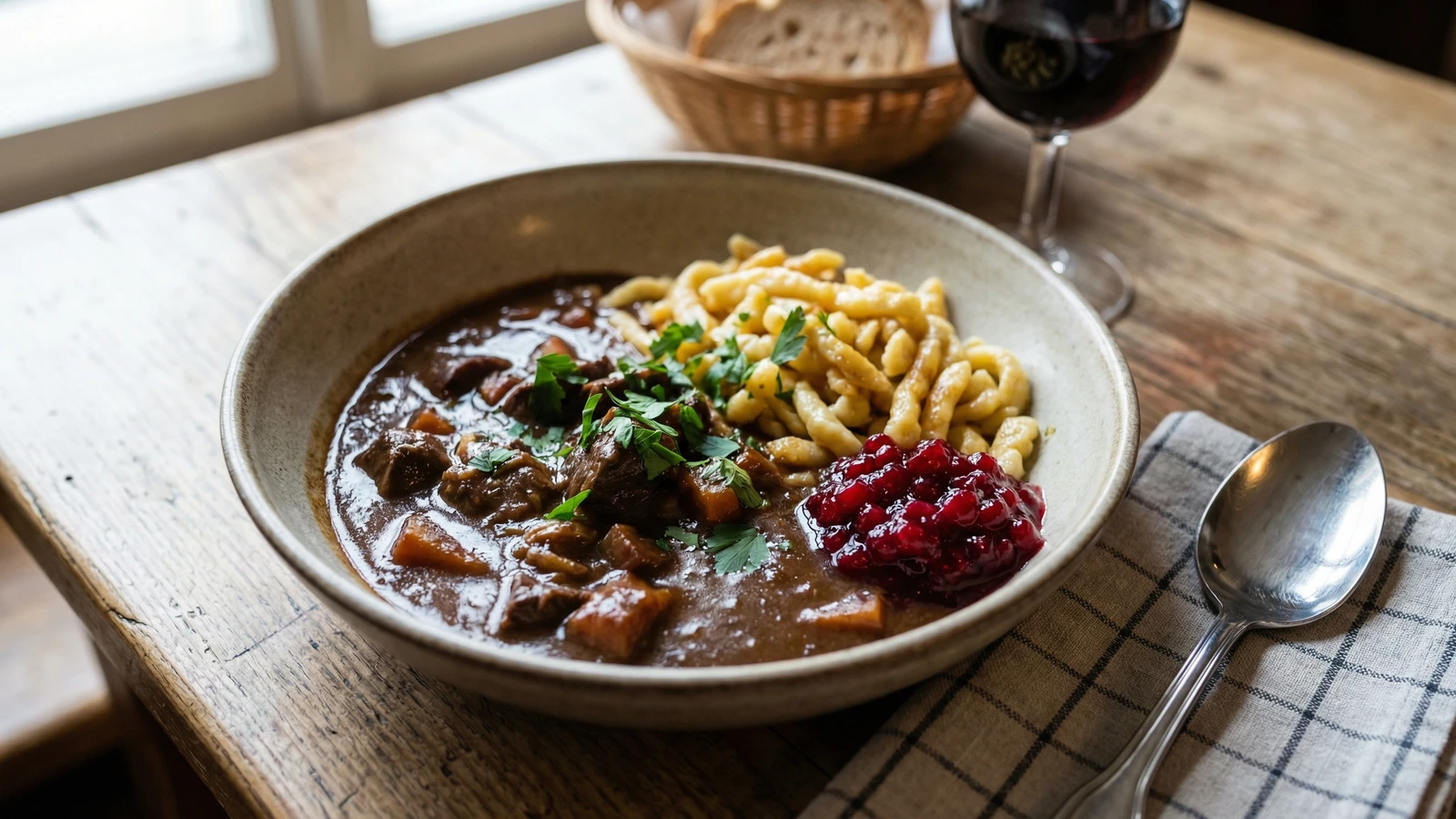
Autumn's alpine tradition: venison shoulder braised low and slow in Zweigelt with juniper berries and root vegetables, finished with a spoonful of tart Preiselbeeren and served over Butterspätzle or Semmelknödel.
Every autumn in Salzburg, the menus change overnight. One week you're eating Marillenknödel and grilled trout. The next, the whole city smells like game and red wine and juniper. Rehragout appears on every Gasthaus chalkboard from October to January, and when it's done right, there is no better cold-weather supper in Austria.
I first fell in love with this dish on one of our childhood trips to the Salzkammergut. Gretel and my grandmother Eva had taken me to a Gasthof near Hallstatt, the kind of place where the tablecloths are checkered and the portions are enormous. The Rehragout arrived in a heavy ceramic dish, dark and glossy, with a bright streak of Preiselbeeren on the side and a pile of Butterspätzle that could have fed two people. I was maybe ten. I cleaned the plate.
What makes this ragout work is restraint. You brown the venison properly, you build the braising liquid with good Austrian red wine and honest root vegetables, and then you leave it alone for two hours. The juniper and allspice do the work quietly. You don't need twelve spices or a complicated marinade. Venison has a clean, mineral flavor that deserves respect, not burial. The Preiselbeeren come at the end, sharp and cold against the warm, dark sauce. That contrast is the whole point.
At my restaurant in Salzburg, this is one of the dishes I look forward to putting back on the menu every year. It's the kind of cooking that makes you grateful for the cold.
Austrian Wildküche, the tradition of cooking game, runs deep in the Alpine provinces where deer, chamois, and wild boar have been hunted for centuries. The Habsburgs maintained vast hunting estates across Salzburg, Styria, and Carinthia, and their court kitchens refined peasant game stews into the structured ragouts and braised dishes that Austrian Gasthaus menus still serve today. Preiselbeeren, the small wild lingonberries that grow across Austria's mountain forests, became the traditional accompaniment to game not as decoration but because their sharp acidity cuts the richness of venison in a way no other fruit can match.
Quantity
1.2 kg
cut into 4cm cubes
Quantity
3 tablespoons
Quantity
2 medium
finely diced
Quantity
2 medium
peeled and cut into 1cm dice
Quantity
1/2 (about 200g)
peeled and cut into 1cm dice
Quantity
1
peeled and cut into 1cm dice
Quantity
2 tablespoons
Quantity
2 tablespoons
Quantity
500ml
Quantity
500ml
Quantity
8
lightly crushed
Quantity
4
Quantity
2
Quantity
4 sprigs
Quantity
3
Quantity
1 strip (about 5cm)
Quantity
1 tablespoon
Quantity
to taste
Quantity
150g
for serving
Quantity
for finishing
chopped
| Ingredient | Quantity |
|---|---|
| boneless venison shoulder or legcut into 4cm cubes | 1.2 kg |
| clarified butter or lard | 3 tablespoons |
| onionsfinely diced | 2 medium |
| carrotspeeled and cut into 1cm dice | 2 medium |
| celeriacpeeled and cut into 1cm dice | 1/2 (about 200g) |
| parsnippeeled and cut into 1cm dice | 1 |
| tomato paste | 2 tablespoons |
| plain flour | 2 tablespoons |
| Austrian red wine (Zweigelt or Blaufränkisch) | 500ml |
| beef or game stock | 500ml |
| juniper berrieslightly crushed | 8 |
| whole allspice berries | 4 |
| bay leaves | 2 |
| fresh thyme | 4 sprigs |
| whole cloves | 3 |
| orange zest | 1 strip (about 5cm) |
| red wine vinegar | 1 tablespoon |
| salt and freshly ground black pepper | to taste |
| Preiselbeeren (lingonberry preserves)for serving | 150g |
| fresh flat-leaf parsleychopped | for finishing |
Pat the venison cubes thoroughly dry with kitchen paper. This is not a step you can skip. Wet meat won't brown, it will steam, and steamed meat tastes boiled, not braised. Season generously with salt and pepper on all sides. Let the cubes sit at room temperature for twenty minutes while you prepare the vegetables. Cold meat straight from the fridge drops the temperature of your pan and gives you a gray, sorry sear.
Heat two tablespoons of clarified butter in a heavy Dutch oven or braising pot over high heat. You want the fat shimmering and almost smoking. Brown the venison in batches, leaving space between each piece. If you crowd the pan, the meat steams instead of searing and you lose that deep, caramelized crust that gives the whole ragout its backbone. Three to four minutes per batch, turning once. The surface should be dark brown, almost mahogany. Set the browned pieces aside on a plate. Don't pour away the juices that collect there. They go back in later.
Lower the heat to medium and add the remaining tablespoon of butter to the same pot. Add the diced onions and cook, stirring occasionally, until they turn soft and golden, about eight minutes. The browned bits on the bottom of the pot will start to dissolve into the onions. That's flavor. Don't scrub them away. Add the carrots, celeriac, and parsnip. Cook for another five minutes until the edges just begin to soften. Stir in the tomato paste and let it cook for a full minute, stirring constantly. Raw tomato paste tastes tinny and sharp. Cooked tomato paste tastes rich and round. One minute makes the difference.
Sprinkle the flour over the vegetables and stir it in. Cook for another minute. The flour will thicken the sauce later, but it needs to toast slightly now so the finished ragout doesn't taste pasty. Pour in the red wine and use a wooden spoon to scrape every browned bit off the bottom of the pot. This is your fond, and it holds half the flavor of the dish. Let the wine bubble for two minutes, reducing slightly. The alcohol needs to cook off or it will leave a harsh, boozy edge in the sauce.
Return the browned venison to the pot along with any juices from the plate. Pour in the stock. Add the crushed juniper berries, allspice, bay leaves, thyme sprigs, cloves, and the strip of orange zest. Stir gently to combine. The liquid should come about three-quarters of the way up the meat. If it doesn't, add a splash more stock. Bring to a gentle simmer, then cover with a tight-fitting lid and reduce the heat to the lowest setting. Cook for two to two and a half hours. The surface should barely tremble. If you see a rolling boil, your heat is too high and the venison will seize up and go stringy. Check it once after an hour and stir gently.
After two hours, test a piece with two forks. It should pull apart easily with almost no resistance. If it still holds its shape firmly, give it another thirty minutes. Venison shoulder needs time. The connective tissue has to fully dissolve into the sauce, and that doesn't happen at the two-hour mark for every piece. When it's right, the meat will be tender enough to cut with a spoon.
Remove the bay leaves, thyme sprigs, orange zest, and any whole cloves you can find. Stir in the red wine vinegar. Taste the sauce. It should be deep and rich with a gentle warmth from the spices and a slight sweetness from the root vegetables. If it's too thin, remove the lid and simmer uncovered for ten minutes to concentrate it. If it needs brightness, add another splash of vinegar. Season with salt and pepper. The sauce should coat the back of a spoon in a glossy, dark film.
Ladle the ragout into warm, deep plates or a large serving dish. Scatter chopped parsley over the top. Place a generous spoonful of Preiselbeeren on the side of each plate, not stirred in. The lingonberries are there to cut the richness, and the cook and the eater should be in charge of how much tartness they want with each bite. Serve with Butterspätzle, Semmelknödel, or Serviettenknödel. Mahlzeit!
1 serving (about 350g)
Culinary guides, cultural storytelling, and the editorial depth that makes cooking meaningful.
Discover Culinary ExplorerChef Elsa
Broad egg noodles tossed in golden butter-toasted breadcrumbs until every strand is coated and crackling. Four ingredients, fifteen minutes, and a dish that has kept Austrian families fed and happy for centuries.

Chef Elsa
Vienna's weeknight answer to everything: soft flour Nockerl fried golden in butter, scrambled through with eggs and buried under fresh chives. A sharp green salad on the side because the Viennese know that richness needs a counterpoint.

Chef Elsa
Soft Austrian potato dumplings in browned butter with warm, caraway-scented sauerkraut. A meatless Gasthaus meal that's been filling up Alpine kitchens for centuries.

Chef Elsa
Braised beef steaks in a velvety sauce of julienned root vegetables, capers, mustard, and sour cream, the kind of dish that made the Esterházy name famous in kitchens long after it faded from politics.