Culinary Explorer

A cooking platform built around craft, culture, and the stories behind what we eat.
Discover Culinary Explorer
Pollo Mongol Mexicalense

Pollo Mongol Mexicalense

Created by

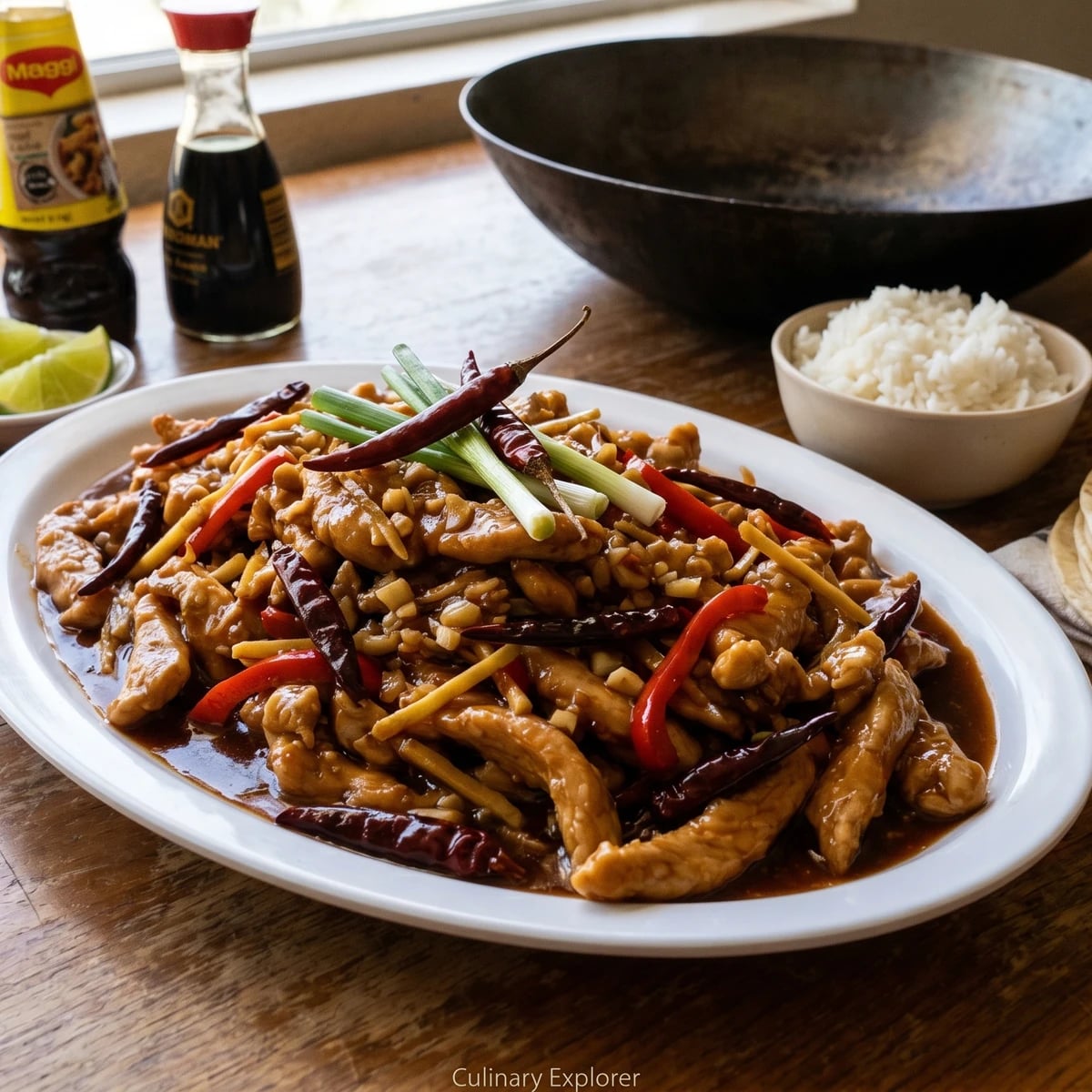
Mexicali's signature Cantonese-Mexican stir-fry: velveted chicken, ginger, scallions, and dried chile de arbol in a glossy soy-and-Maggi sauce, eaten over rice or rolled into a Sonoran-style flour tortilla.

Main Dishes
Mexican
Weeknight
Quick Meal
Comfort Food
25 min
Active Time
15 min cook40 min total
Yield4 servings

This is from Mexicali. Not from China, not from generic 'Mexico,' but from the capital of Baja California, where the largest Chinatown per capita in Mexico has been cooking this dish since the early 20th century. If you do not know that Mexicali has a Chinese quarter called La Chinesca, with hundreds of restaurants and a Cantonese cooking lineage older than most American Chinatowns, then you do not know northern Mexican cuisine.

Pollo Mongol is what happens when Cantonese cooks who arrived to build the railroads and work the cotton fields of the Mexicali Valley settled in, raised families, opened restaurants, and started cooking for the Mexican palate around them. The technique is Cantonese: the velveting, the high-heat wok work, the soy and oyster sauce. The seasoning is Baja: chile de arbol instead of dried Sichuan chile, Maggi sauce on the table next to the soy, a splash of Mexican Coca-Cola in the sauce because Mexicali cooks figured out decades ago that the cane sugar caramelizes the way nothing else does. Flour tortillas show up alongside the rice because this is the north and flour tortillas are what the north eats. Asi se hace y punto.

My notebook has three versions of Pollo Mongol, all collected from senoras and one senor in La Chinesca over a long weekend in 2017. Don Felipe at a corner restaurant near the Plaza del Mariachi told me his abuelo arrived from Guangzhou in 1919 and the recipe has not changed since the 1940s. He uses lard, not oil. He laughed when I asked about substitutions. La manteca es el sabor, even in a Cantonese-Mexican kitchen. Saber cocinar es saber vivir.

Mexicali's Chinese community took root between 1900 and 1920, when thousands of Cantonese laborers, mostly from Guangdong province, arrived to work on the Colorado River Land Company cotton fields and the railroads connecting Baja California to the rest of Mexico. By 1925, La Chinesca was the largest Chinese settlement in Mexico, and at its peak Mexicali's Chinese population outnumbered its Mexican one. Pollo Mongol, despite its name, has no documented Mongolian origin; it is a 20th-century Mexicali invention that borrowed the 'Mongolian beef' naming convention from American-Cantonese restaurants while developing its own profile, distinguished by the use of chile de arbol, Maggi sauce, and the regional habit of serving Chinese food alongside flour tortillas.

The technique, the tradition, and the story behind every dish.

Discover Culinary Explorer

Ingredients

boneless skinless chicken thighs

Quantity

1 1/2 pounds

sliced against the grain into 1/4-inch strips

soy sauce (for marinade)

Quantity

2 tablespoons

Shaoxing wine or dry sherry

Quantity

1 tablespoon

cornstarch (for marinade)

Quantity

2 teaspoons

toasted sesame oil

Quantity

1 teaspoon

soy sauce (for sauce)

Quantity

1/4 cup

oyster sauce

Quantity

2 tablespoons

Maggi sauce

Quantity

1 tablespoon

Mexican Coca-Cola

Quantity

1 tablespoon

rice vinegar

Quantity

1 tablespoon

sugar

Quantity

1 teaspoon

cornstarch slurry

Quantity

2 teaspoons cornstarch dissolved in 3 tablespoons cold water

lard or neutral oil

Quantity

3 tablespoons

fresh ginger

Quantity

1 (2-inch) piece

peeled and cut into matchsticks

garlic cloves

Quantity

6

smashed and roughly chopped

dried chile de arbol

Quantity

8 to 10

stemmed

white onion

Quantity

1 small

sliced into 1/4-inch wedges

scallions

Quantity

2 bunches

white and light green parts cut into 2-inch lengths, dark green tops thinly sliced for serving

red bell pepper

Quantity

1

sliced into 1/4-inch strips

steamed white rice (optional)

Quantity

for serving

hand-pressed flour tortillas (optional)

Quantity

for serving

warmed

lime wedges (optional)

Quantity

for serving

salsa de chile de arbol (optional)

Quantity

for serving

Equipment Needed

  • Carbon steel wok or 12-inch heavy skillet
  • Long-handled wok spatula or wooden spoon
  • Sharp knife for slicing chicken thin against the grain
  • Small bowls for mise en place

Instructions

  1. 1

    Marinate the chicken

    In a bowl, combine the chicken with the 2 tablespoons soy sauce, Shaoxing wine, 2 teaspoons cornstarch, and toasted sesame oil. Toss with your hands until every strip is coated. Let it sit for 15 minutes at room temperature. The cornstarch is what gives the chicken that velvety surface the Mexicali cooks call 'velveted,' and the soy starts the seasoning from the inside. Skip this and you will have plain stir-fried chicken, not Pollo Mongol.

  2. 2

    Build the sauce

    In a separate bowl, whisk together the 1/4 cup soy sauce, oyster sauce, Maggi, Coca-Cola, rice vinegar, and sugar. Set the cornstarch slurry beside it. The Maggi and the splash of cola are not optional. Maggi is on every kitchen table in Mexicali, and the cola is what makes the sauce cling and gloss the way it does at La Misión and El Dragón. Asi se hace y punto.

    Mexican Coca-Cola, made with cane sugar, behaves differently from corn syrup cola. The cane sugar caramelizes in the wok. If you cannot find it, use 1 teaspoon of piloncillo dissolved in a tablespoon of warm water.
  3. 3

    Prep your mise en place

    Stir-frying is fast. Once the wok is hot, you have no time to chop. Set the ginger, garlic, chile de arbol, onion, scallion whites, and bell pepper in separate piles next to the stove. Have the marinated chicken, the sauce, and the slurry within arm's reach. La cocina no es decoracion, es trabajo, and this dish punishes a cook who is not ready.

  4. 4

    Sear the chicken

    Heat a wok or wide heavy skillet over the highest flame your stove will give you until it begins to smoke. Add 2 tablespoons of the lard. Swirl. Add the chicken in a single layer and let it sit untouched for 45 seconds so it picks up color. Then toss and stir-fry for 2 to 3 minutes more, until the chicken is just cooked through. Slide it out onto a plate. The wok should still be hot.

    If your stove is weak, cook the chicken in two batches. Crowding the wok steams the chicken instead of searing it, and you lose the wok hei, the breath of the wok, that distinguishes a real Mexicali stir-fry from a sad pan of chicken in soy sauce.
  5. 5

    Bloom the aromatics

    Return the wok to the flame. Add the remaining tablespoon of lard. Drop in the ginger, garlic, and whole chile de arbol. Stir constantly for 20 to 30 seconds. The chile will darken and the kitchen will smell sharp and toasted. Do not let the garlic burn. Burned garlic ruins the sauce and there is no recovering from it.

  6. 6

    Add the vegetables

    Add the white onion wedges, the scallion white and light green pieces, and the red bell pepper. Stir-fry over high heat for 90 seconds. The onion should still have crunch. The scallions should be wilted but not collapsed. The vegetables here are not a side. They are part of the dish, and they need texture.

  7. 7

    Sauce and finish

    Return the chicken and any juices to the wok. Pour the sauce around the edge of the pan, where it will hit the hot metal first and start to caramelize. Toss everything together for 30 seconds. Stir the cornstarch slurry one more time, then pour it in. Toss for another 30 to 45 seconds, until the sauce thickens into a glossy coat that clings to every piece. Pull the wok off the heat the moment the sauce gels. One more minute and you have glue.

  8. 8

    Serve at the table

    Tip everything onto a wide platter. Scatter the thinly sliced dark green scallion tops over the top. Set out steamed rice, warm flour tortillas, lime wedges, and a small bowl of salsa de chile de arbol. In Mexicali, half the table eats it over rice and the other half rolls it into flour tortillas like a taco. Both are correct. Cada estado, su propia cocina.

Chef Tips

  • Chicken thighs, not breasts. The thigh has the fat and the structure to survive a hot wok without turning to chalk. If your butcher only has breasts, slice them thinner and cut the cook time. But find thighs if you can.
  • The wok needs to be screaming hot before the chicken hits it. If you do not see a faint smoke off the lard, your stove is not hot enough yet. A weak sear is a steamed stir-fry, and a steamed stir-fry is not Pollo Mongol.
  • Maggi sauce is on every Mexicali table for a reason. It is not a substitute for soy. It is its own thing: salty, savory, slightly fermented, with a backbone you cannot replicate. Get a bottle. It will last you a year and you will use it on everything.
  • The chile de arbol stays whole. They are there for fragrance and gentle heat, not to be eaten. Diners who know push them to the edge of the plate. Diners who do not know learn quickly.

Advance Preparation

  • The chicken can be sliced and marinated up to 4 hours ahead and held in the refrigerator. Pull it out 15 minutes before cooking so it is not ice cold when it hits the wok.
  • The sauce mixture (everything except the slurry) can be whisked together one day ahead and refrigerated. Mix the cornstarch slurry only at the moment of cooking so it does not separate.
  • All vegetables can be cut several hours ahead. Stir-frying does not forgive a cook who is still chopping when the wok is hot.

Frequently Asked Questions

Nutrition Information

1 serving (about 480g)

Calories
795 calories
Total Fat
23 g
Saturated Fat
7 g
Trans Fat
0 g
Unsaturated Fat
14 g
Cholesterol
150 mg
Sodium
2600 mg
Total Carbohydrates
100 g
Dietary Fiber
5 g
Sugars
7 g
Protein
45 g

Note: Chef personas and recipes are created with AI assistance. Cook with care: follow safe food-handling practices, check doneness with a thermometer when needed, and adapt for allergies and your kitchen.

Where cooking meets culture.

Culinary guides, cultural storytelling, and the editorial depth that makes cooking meaningful.

Discover Culinary Explorer

More from Noroeste Main Dishes

Browse the full collection